

Page Table of Contents

Cloning an SSD to a larger one can give you more disk space to install programs and run Windows faster if your old SSD has limited storage space. The biggest advantage of cloning an SSD to another is that you do not have to reinstall Windows or programs from scratch, as the Reddit post reads.
How to fully clone SSD to a bigger SSD?
Before I send in my laptop for a repair, I want to factory reset it to see if it fixes my issues. I don't want to lose anything, so I wish to fully clone the OS and all my files. I don't know what tools are actually useful for doing this and are free. Any suggestions?
So, how do you copy over everything from one SSD to a larger SSD? We will walk you through how to clone SSD to larger SSD with tools, tips, and a step-by-step guide.
What to Prepare for Cloning SSD to Larger SSD
To clone a smaller SSD to a larger SSD, you will need cloning software and an external enclosure to connect the new SSD to your computer during the process. So, before cloning, some preparations are required to ensure a smooth and successful SSD cloning process!
1️⃣Prepare a USB adapter or an external enclosure
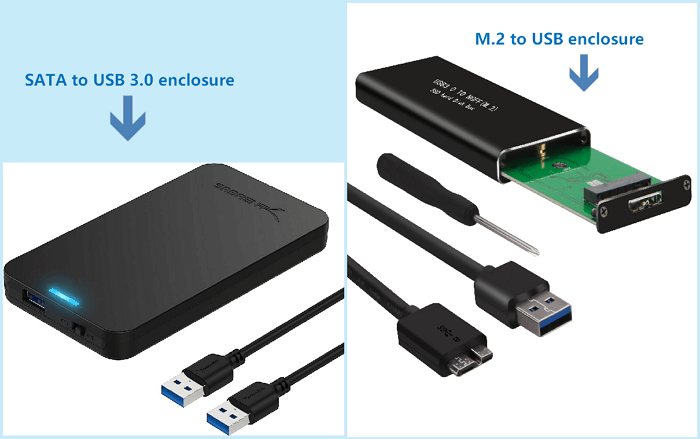
On a desktop computer, you can connect the new drive directly to its M.2 or SATA port and mount it. On a laptop with only one slot, you can use some external SSD enclosures. For a 2.5-inch SATA SSD drive, a SATA to USB 3.0 enclosure is enough, while for an M.2 NVMe or SATA drive, an M.2 to USB enclosure can work.
2️⃣Choose a reliable SSD
When choosing a new SSD, ensure its capacity is large enough to hold all your existing data, while also leaving enough room for future applications and system updates. Also, be sure to confirm that the new drive's interface type (such as SATA or NVMe) is compatible with your PC's motherboard.
3️⃣Backup Data
It is always a good idea to back up your data before performing any major drive upgrades or disk cloning processes. Most importantly, if your target SSD contains important data, you must back it up before cloning, as cloning will wipe all data on the target disk.
4️⃣Download Cloning Software
To clone an SSD to a larger SSD, you'll need to use cloning software because Windows lacks built-in cloning features. EaseUS Disk Copy is a great choice for an easy SSD cloning solution. It can help you clone a hard drive to another one from a different manufacturer and with different sizes, such as cloning a smaller SSD to a larger one and cloning a larger SSD to a smaller one.
It has Disk Mode, System Mode, and Partition Mode to meet your different needs, and it offers "SSD Alignment" or "Auto-fit disk" to ensure the operating system partition takes advantage of the new drive's larger capacity, so there will be no unallocated space on your new SSD after you clone C drive to new SSD.
If you want to have a smooth and successful SSD migration or SSD data transfer process, EaseUS disk cloning software is the second-to-none choice. Just download this simple yet powerful disk cloning software for SSD upgrade!
 Free Download
Windows 11/10/8/7
How to Clone SSD to Larger SSD on Windows 11/10/8/7
EaseUS Disk Copy can help you clone smaller SSDs to larger SSDs effortlessly while ensuring data integrity, seamless OS migration, and no unused space on the target SSD. Follow the steps below to clone boot drive to larger SSD or clone NVMe SSD to larger SSD:
Step 1. Connect the New SSD
- Install the new, larger SSD into the M.2 to USB enclosure or connect it via a USB-to-SATA adapter, and then plug the enclosure or adapter into a USB port on your computer.
- If your computer has 2 slots, install the new and larger SSD internally.
Step 2. Run EaseUS SSD Cloning Software
- Install and open the cloning software - EaseUS Disk Copy.
- Select the Disk Mode.
- Choose the smaller, older SSD as the source disk.
- Select the new, larger SSD as the destination disk.
- Enable "Preview partition layout" for advanced disk cloning settings.
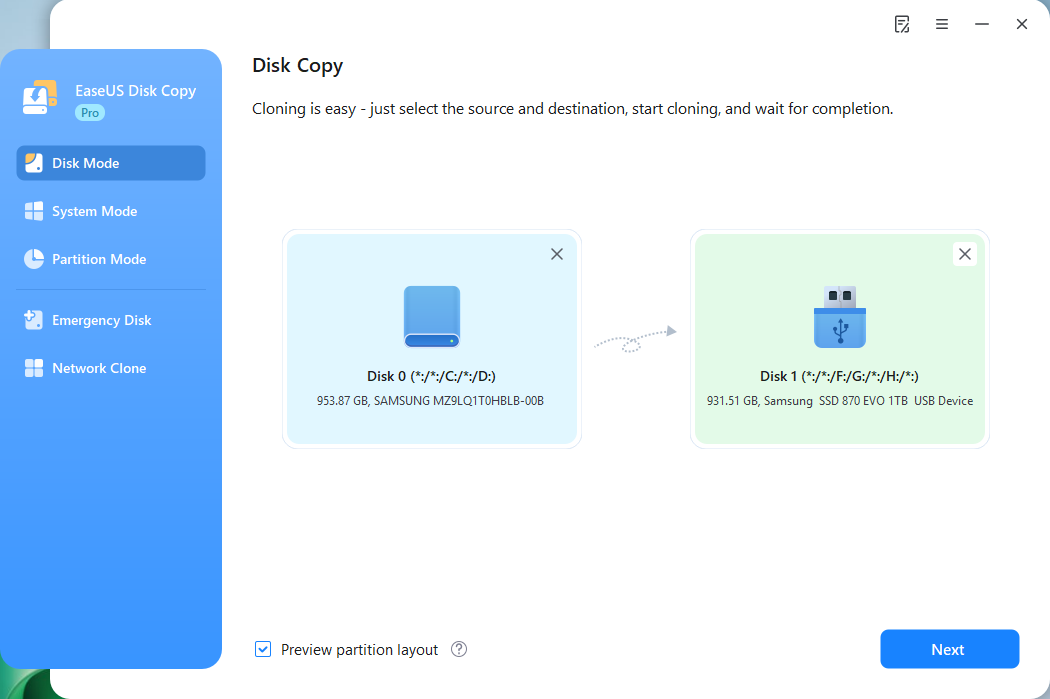
Make full use of the larger SSD capacity. If your new NVMe or SATA SSD is larger, choose "Auto-fit the disk" to automatically use the bigger disk space. And, 4K SSD alignment will be automatically selected.

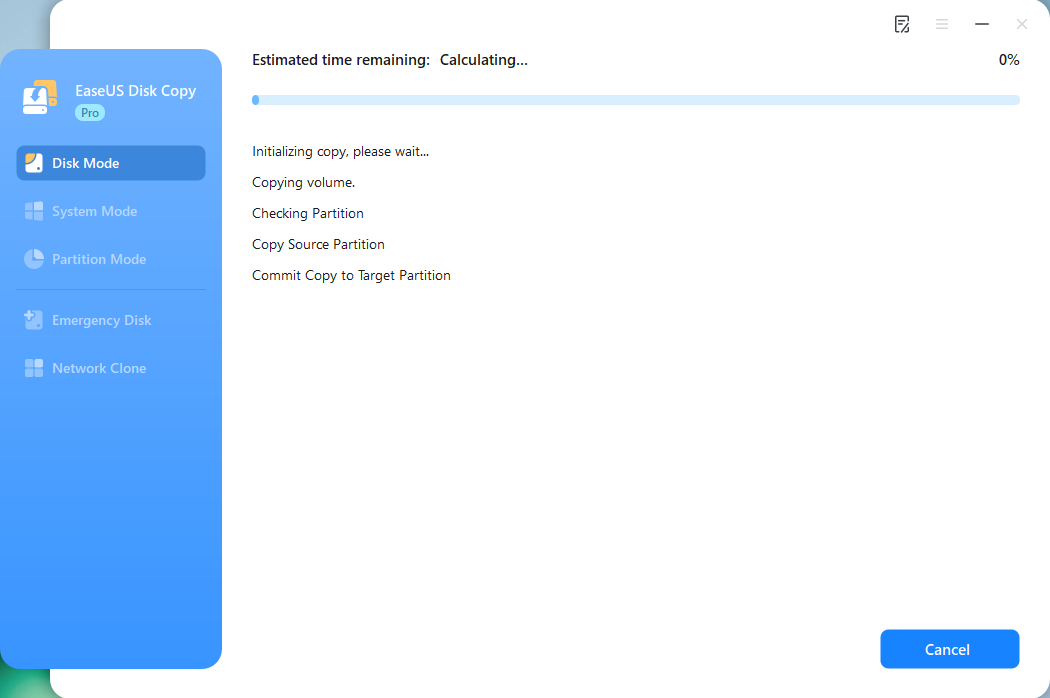
Step 3. Start Cloning SSD
Initiate the clone process and wait for it to complete. The time it takes will depend on the amount of data and the speed of your drives.
Step 4. Install the New SSD
- Once the cloning is finished, shut down your computer.
- Turn off your computer and remove the old SSD, then install the new, larger SSD in its place.
Step 5. Boot from the New SSD
- Start your computer. It should boot up from the new SSD, with all your files, programs, and Windows settings intact.
- You may need to enter your computer's BIOS or UEFI settings to ensure the new SSD is the primary boot drive.
- After booting, you should see that all your data is present and that the new SSD's full capacity is available for use.
#Troubleshooting SSD Cloning Issues
Cloning a smaller SSD to a larger one often leaves behind unallocated space, making the new drive appear identical in size to the old one. Other challenges include boot issues, potential cloning software errors, and potential data corruption if source drives are faulty.
This video shows how to to clone an SSD to a larger SSD using EaseUS Disk Copy:
Share this article on social media to help others copy over everything from one SSD to a larger SSD!

To Wrap Things Up
How to clone SSD to larger SSD? The best way to upgrade your SSD without data loss is to perform a disk clone. In this post, a powerful and full-featured SSD cloner, EaseUS Disk Copy, is introduced to help transfer data from a smaller SSD to a larger one without losing data or reinstalling Windows. After cloning, replace the old SSD (or change boot order) to boot your computer from the cloned SSD. Download and try this powerful SSD cloning software to upgrade your SSD to a spacious one!
Free Download
Windows 11/10/8/7
FAQs on How to Clone an SSD to a Larger SSD
1. Can I clone to a smaller SSD?
Yes, you can clone to a smaller SSD if the total amount of data on your current drive is less than the capacity of the new, smaller SSD. You will need to use a reliable disk cloning tool, and some tools, like EaseUS Disk Copy, offer features like "auto fit" to automatically resize partitions to fit the smaller drive.
2. Can I clone SSD to larger SSD without reinstalling Windows?
Yes. Disk cloning software can copy your entire system, including the operating system, installed programs, and files, from the old SSD to the new larger SSD. After cloning, you can replace the old drive or change the boot order in BIOS to boot from the new SSD. This allows you to upgrade to a larger SSD without reinstalling Windows or losing data.
3. How long does it take to clone a 1TB SSD?
Cloning a 1TB SSD can take from 15 minutes to several hours, depending on the speed of the source and target drives, the connection type (e.g., SATA vs. NVMe), and the amount of data being cloned.
4. Can I clone SSD with different brands?
Yes. You can clone an SSD to another SSD even if they are from different brands, such as Samsung, WD, or Crucial. EaseUS Disk Copy does not depend on the manufacturer. The main requirement is that the destination SSD has enough storage space to hold the data from the source drive.
5. Why is there unallocated space after cloning?
Unallocated space appears after cloning because most cloning software copies the source drive's existing partition structure, not automatically expanding the partition to fit the larger target drive. This leaves the extra space on the larger drive as unallocated. You can fix this by using the "Extend Volume" feature in Windows' Disk Management or a third-party disk management tool.
-
Updated by
Tracy became a member of the EaseUS content team in 2013. Being a technical writer for over 10 years, she is enthusiastic about sharing tips to assist readers in resolving complex issues in disk management, file transfer, PC & Mac performance optimization, etc., like an expert.…Read full bio