

Page Table of Contents

USB flash drives are convenient for storing and transferring files. However, when you need to upgrade to a larger USB drive, create a complete backup, or migrate data while preserving the original structure, simple copying may not be enough.
In these cases, you can clone the USB drive with a reliable USB cloner. This guide introduces a simple USB cloning tool and shows you how to clone a USB drive step by step.
What Is a USB Clone Tool
A USB clone tool is software designed to create an exact copy of one USB drive onto another. Unlike regular file copying, USB cloning can transfer not only files and folders but also partitions, boot information, file systems, and other data structures.
This makes it useful when upgrading to a larger USB drive, creating a backup, or preparing a duplicate bootable drive. A reliable USB clone tool can simplify the process by automatically handling the source and destination drives, reducing the risk of missing important data or settings.
For users who need a complete and consistent copy, USB cloning is often more efficient than copying files manually.
Download the Best USB Cloner - EaseUS Disk Copy
When choosing a USB cloning tool, whether paid, free, or hardware-based, it's important to look at compatibility, performance, features, speed, and data safety. Physical USB duplicators often suffer from compatibility issues, so USB cloning software is generally the more practical choice. A proper USB cloning tool can create an exact, bit-for-bit copy of a drive, including boot sectors, hidden files, partitions, and even system, ensuring the cloned USB works exactly like the original, which is essential for systems, licenses, and special configurations.
EaseUS Disk Copy is a reliable and easy-to-use USB driver cloner that allows users to clone a USB drive with just a few clicks. Beyond USB duplication, it also supports migrating Windows to a new drive, upgrading storage devices, and replacing an HDD with an SSD without reinstalling the OS or risking data loss, making it suitable for both personal and business use.
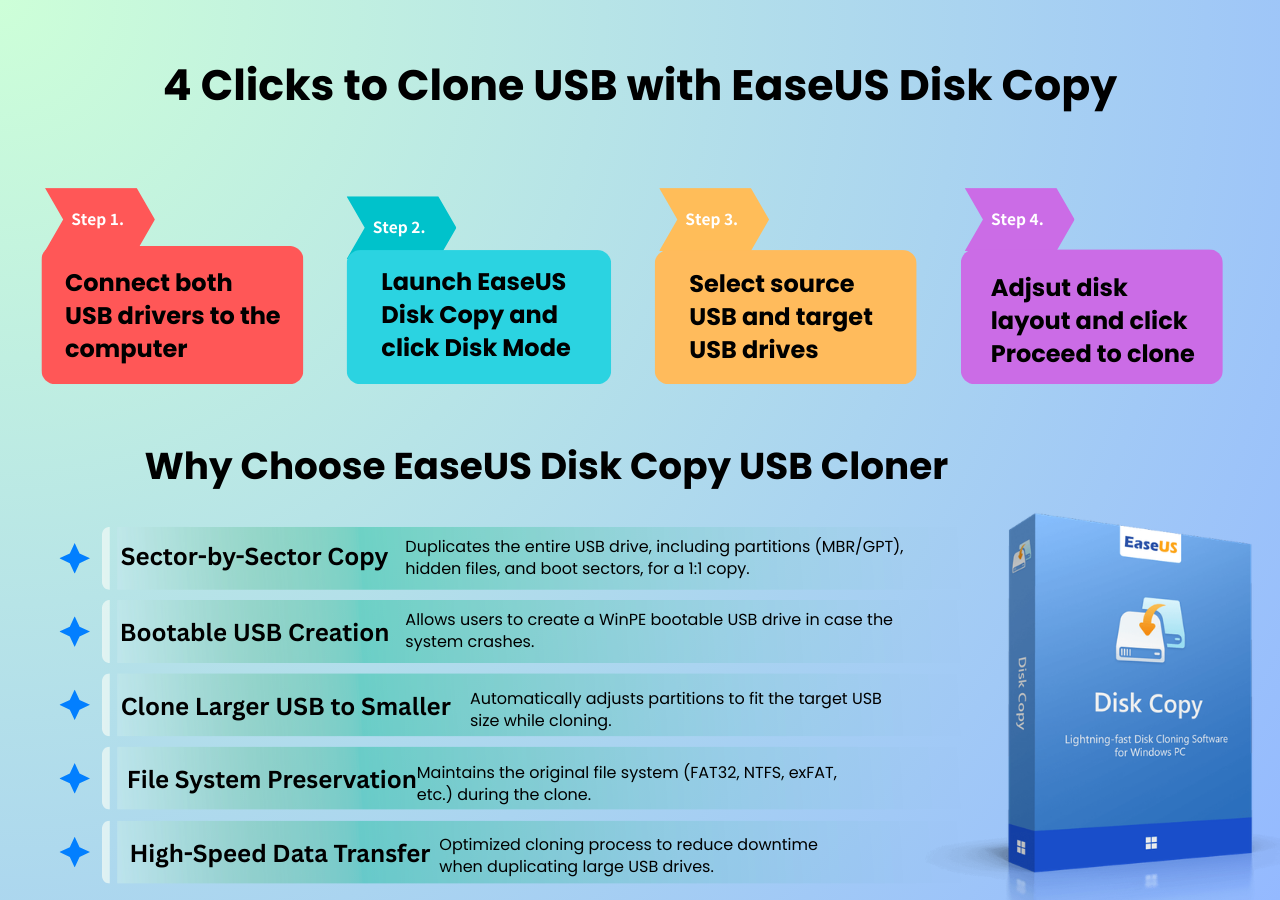
It is compatible with all USB drive types and interfaces from various brands, including USB 4.0/3.0 and SanDisk. Overall, this portable, straightforward USB cloning software provides all the necessary features. Besides, it is totally safe, and you can download it with confidence.
 Free Download
Windows 11/10/8/7
Step Guide: How to Clone USB Drive on Windows
Now that you have installed the EaseUS USB cloning software, follow the detailed steps below with screenshots to clone USB drive with EaseUS Disk Copy. Keep reading.
- 📌Tips:
- The following guide applies to all types of USB cloning, USB to USB, USB to hard drive, drive drive to USB, and clone Windows to USB.
- Before cloning, connect both the source and target USB drives to the computer properly.
- Ensure that the target USB disk has enough capacity to accommodate all data from the source USB.
- Back up the target USB because cloning will erase all data saved on it.
- Don't mix up the source USB and target USB while cloning.
Before cloning:
- Connect both USB sticks or USB drives to your Windows computer properly.
- Make sure the target USB has a larger capacity than the source USB.
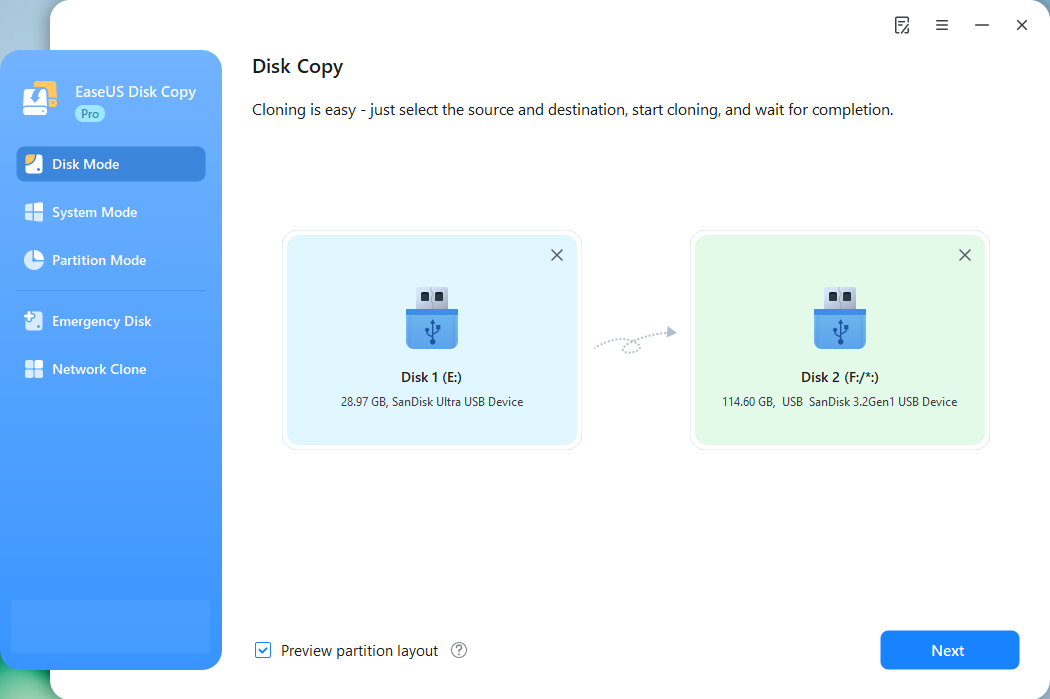
Step 1. Launch EaseUS Disk Copy and choose Disk Mode.
Install EaseUS Disk Copy USB cloning tool, launch it, and choose Disk Mode.

Step 2. Select the source and target USBs.
- Source - the old/smaller USB you want to make a copy.
- Destination - the new/larger USB that you want to clone data to.
Step 3. Adjust target USB layout.
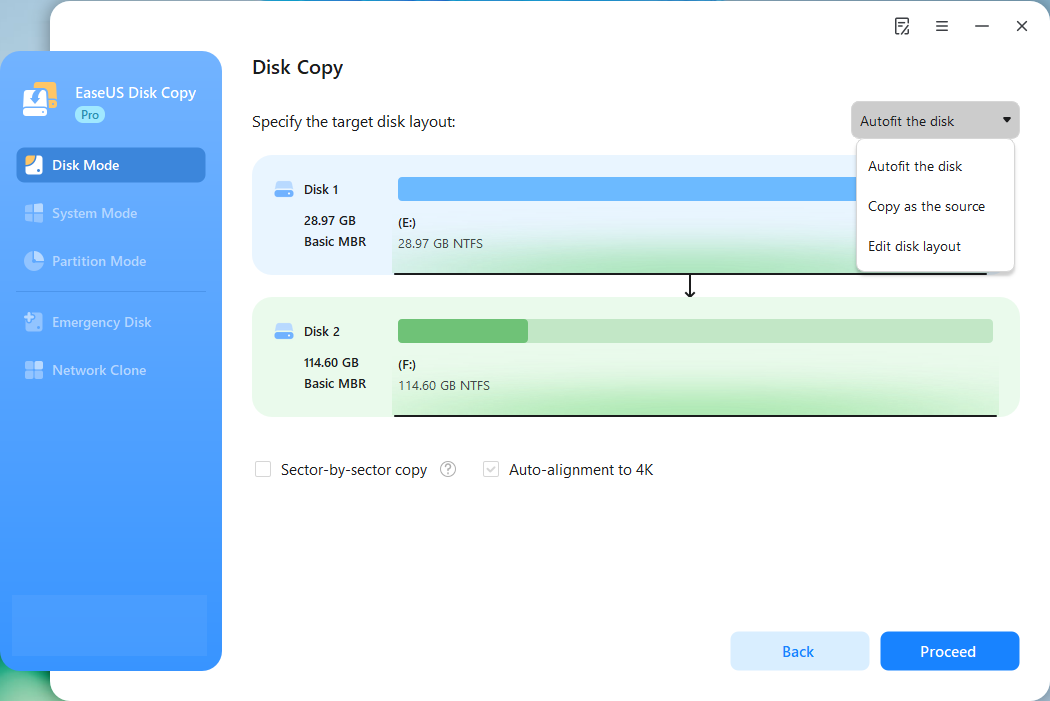
Specify the target USB layout as your preference. You can choose among:
- Autofit the disk: makes some changes by default on the destination disk layout so that it can work at its best.
- Copy as the source: create a 1-to-1 copy of your source disk, the layout is the same as the source disk.
- Edit disk layout: allows you to manually resize/move the partition layout on this destination disk.
Step 4. Start cloning.
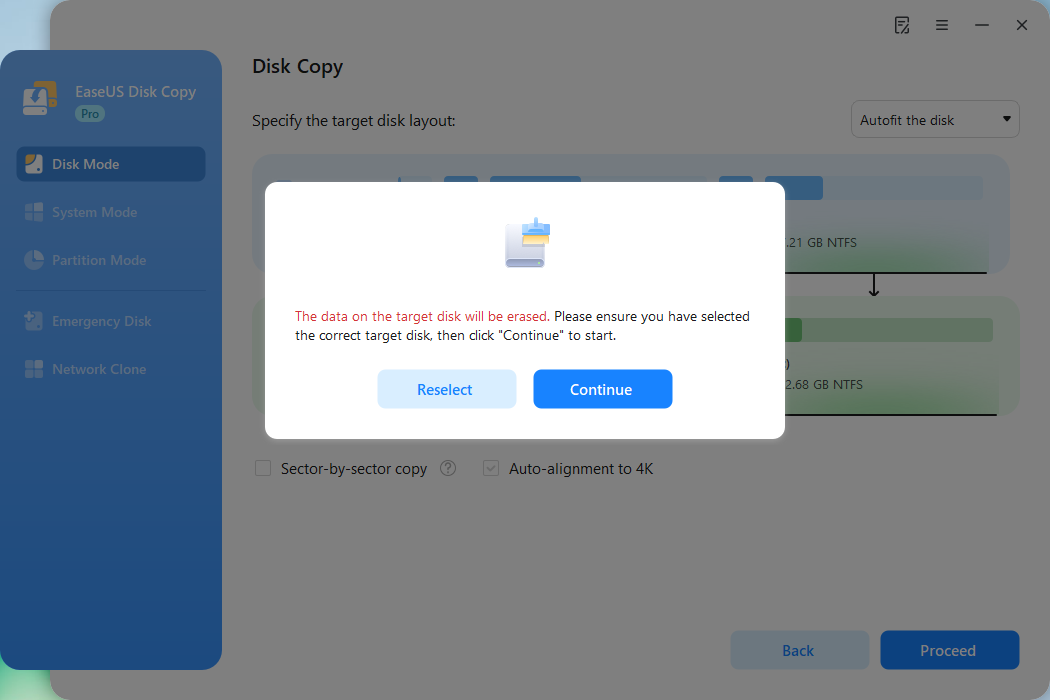
Click Proceed, a message will appear, warning you that data will be lost. Confirm the message by clicking Continue. Now, it will start executing the USB cloning task.
Important Note: If you have any concerns regarding how to use this tool or how to resolve issues that arise during the cloning process, be sure to get in touch with us immediately and we'll respond with technical support as soon as possible!
Video Guide to Clone USB Drive with USB Cloner
Prefer to watch the video tutorial? We also provide a YouTube video guide to help you clone a bootable USB to another.
- 00:09 - What Is a Bootable USB Drive
- 00:26 - Why Clone to Clone Bootable USB
- 00:58 - EaseUS Disk Copy - reliable USB cloning software
- 01:24 - How to clone bootable USB to another USB with EaseUS Disk Copy
- 02:00 - Ending
Share the blog on social media to help others clone USB effectively.

Issuse You May Encounter While Cloning USB Drive
Even with the right software and steps, USB cloning doesn't always go as planned. From capacity mismatches to boot failures, here are the three most common issues users encounter, and exactly how to fix them.
1. Cloning to a Smaller USB Drive Fails
I tried to clone a 64GB USB to a 32GB USB (or similar), even when the actual used space is only 20GB. Most cloning software refuses to proceed because it checks total capacity rather than used space by default.
Solution:
- Check used space first: Ensure the destination USB has capacity equal to or larger than the used space on the source, not the total size.
- Shrink partitions: Use disk management tools to resize partitions on the source drive to fit the destination.
- Use intelligent cloning: Select software with "clone only used sectors" or "smart cloning" options rather than sector-by-sector USB clone.
- Verify partition alignment: Ensure both drives use the same partition style (MBR or GPT) before starting.
2. The Cloned USB Won't Boot
The cloning appears successful, but when I try to boot from the cloned USB, the system doesn't recognize it or shows "No bootable device found."
This typically happens because simple file copying misses critical boot components like the Master Boot Record (MBR), GUID Partition Table (GPT), or hidden system files.
Solution:
- Don't use drag-and-drop: File copying skips boot sectors and hidden UEFI/BIOS files. Always use dedicated cloning software.
- Enable sector-by-sector cloning: For bootable drives, use sector-by-sector or "exact clone" mode to capture boot sectors.
- Check BIOS/UEFI settings:
- Disable Secure Boot if the original was created in Legacy mode
- Enable CSM (Compatibility Support Module) or Legacy Boot if needed
- Ensure boot mode (UEFI vs. Legacy) matches the source drive's configuration
- Repair bootloader if needed: Use Windows Recovery Environment commands:
- bootrec /fixmbr
bootrec /fixboot
bootrec /rebuildbcd
- bootrec /fixmbr
3. Cloned Drive Shows Wrong Capacity or Missing Files
I find the cloned USB only shows the original capacity (32GB showing on a 128GB drive) after I cloned my original USB to a larger one, and some files appear corrupted/missing.
This occurs when the cloning software creates an exact sector copy without adjusting partition sizes to utilize the full destination capacity.
Solution:
- Reallocate unallocated space: Use Disk Management (Windows) to extend the main partition into unallocated space post-cloning.
- Verify file integrity: Run chkdsk /f on the cloned drive to check for file system errors.
- Re-clone if necessary: If the clone is corrupted, reformat the destination drive and clone again, ensuring no interruptions during the process.
Share the blog on social media to help others clone USB effectively.
Bottom line
That's all there is to know about the USB clone tool and how to clone USB drive. With the right tool, you'll be able to easily and quickly clone USB drive. And, EaseUS Disk Copy is undoubtedly the simplest and best USB duplicator with high efficiency. So, why not try it today? If you have any questions or suggestions, please feel free to leave us a comment below. Also, don't forget to share this article with your friends if you found it helpful!
Free Download
Windows 11/10/8/7
FAQs Related to Cloning USB Drive
1. Can I just drag the folder to another USB drive?
You can copy files, but that's not the same as cloning. Dragging folders to the USB drive won't copy boot information, partition tables, and hidden files may not be transferred completely. To fully preserve bootability and partition structure, you need to use an imaging or cloning tool (such as Win32 Disk Imager, Clonezilla, or EaseUS Disk Copy).
2. How do I clone bootable USB to multiple identical targets?
You can use software together with a multi-port USB duplicator, or a standalone hardware duplicator (faster and suitable for mass production). For small batches, tools like Clonezilla or custom scripts work; for large batches, hardware is recommended.
3. What if the target USB is smaller than the source USB?
If the actual data size on the source is smaller than the target's capacity, you can shrink the partition before cloning or create an image and restore it to the smaller drive. Ensure that the partition structure and alignment are correct.
-
Updated by
Jean is recognized as one of the most professional writers in EaseUS. She has kept improving her writing skills over the past 10 years and helped millions of her readers solve their tech problems on PC, Mac, and iOS devices. …Read full bio