

Page Table of Contents

- Table of Contents
-
— What to Prepare for Cloning HDD to SSD Windows 10
— What's the Best Cloning Software for Windows 10?
— How to Clone Windows 10 to SSD Without Reinstalling
Step 2. Launch EaseUS OS Cloning Software
Step 5. Replace Drives & Boot from New SSD
Want to upgrade your Windows 10 PC from an HDD to an SSD without reinstalling everything? You can clone Windows 10 to SSD and keep your operating system, apps, files, and settings.
Clone Windows to SSD
I just bought a new SSD for my PC, got it installed, and it's working. Now I have two SSDs-my old one (512GB) and the new one (1TB). I want to move all my data to the new drive since it's faster and has more space. Does anyone have a good tutorial or know how to do it? -from Reddit
However, migrating your existing Windows 10 to a new SSD requires the right tools. This article walks you through how to clone Windows 10 to an SSD without reinstalling the OS or losing data.
What to Prepare for Cloning HDD to SSD Windows 10
Cloning Windows OS (Windows 10 or 11) to SSD means you make an exact 1-to-1 copy of the source drive content and disk layout. It doesn't sound like a simple copy-and-paste, but it creates an identical hard drive image, including all Windows installation files, the file system, configuration, program components, and every bit of data.
Before you start, check a few things to avoid problems during cloning.
1. Prepare the New SSD
Make sure the SSD is compatible with your computer and has enough space for the data you want to clone. If you're using a smaller SSD, make sure the data and partitions on the old drive can fit on it.
2. Connect the SSD
If your computer has a second drive slot, install the SSD directly. If there is only one slot, use a compatible SATA-to-USB adapter or external SSD enclosure.
3. Back Up Important Files
Cloning normally leaves the source drive unchanged, but it's still a good idea to back up important files first. If the new SSD already contains data, back it up as well. The cloning process may overwrite the destination drive.
4. Check the Boot Mode
Most newer Windows 10 PCs use UEFI with GPT, while older systems may use Legacy BIOS with MBR.
5. Download disk cloning software
There's no built-in Windows tool to clone Windows to SSD. Backup and Restore (Windows 7) only handles backups or disk imaging, not direct system cloning. If you want to clone a hard drive, you'll need to use professional cloning software.
Is the post helpful? Share it on Twitter/Reddit to help other users switch to a new SSD seamlessly.

What's the Best Cloning Software for Windows 10?
If Windows 10 is installed on a regular hard disk, users can install an SSD without reinstalling Windows by cloning the system drive using disk imaging software. If you need a reliable way to migrate Windows 10 from HDD to SSD, clone Windows 10 to SSD, or clone SSD to SSD, EaseUS disk cloning software can be a great option, though it's not the only one.
Here, we strongly recommend that you use EaseUS Disk Copy to complete the whole cloning task based on the facts below:
🔥EaseUS Disk Copy: Best Disk Cloning Software
- Simple UI: Intuitive UI design for upgrading to an SSD.
- Disk Mode: Clone HDD to SSD or clone SSD to SSD.
- System Mode: Clone Windows to SSD without reinstalling.
- SSD Alignment: Optimize SSD performance after cloning.
- Sector-by-sector clone: Clone hard drives with bad sectors.
 Free Download
Windows 11/10/8/7
Download this reliable EaseUS OS migration software to clone Windows to SSD seamlessly.
How to Migrate Windows 10 to SSD Without Reinstalling
EaseUS Disk Copy is secure and effective cloning software that is fully compatible with all Windows systems, and its disk clone feature lets users clone and migrate the entire disk, including the system, to a new SSD without losing any data.
Follow the tutorial on how to clone Windows 10 to SSD using EaseUS Disk Copy:
⚠️Note that the new SSD must be compatible with your computer's hardware (including form factor, interface, etc.), and ensure that the SSD capacity is at least equal to or larger than the size of your operating system.
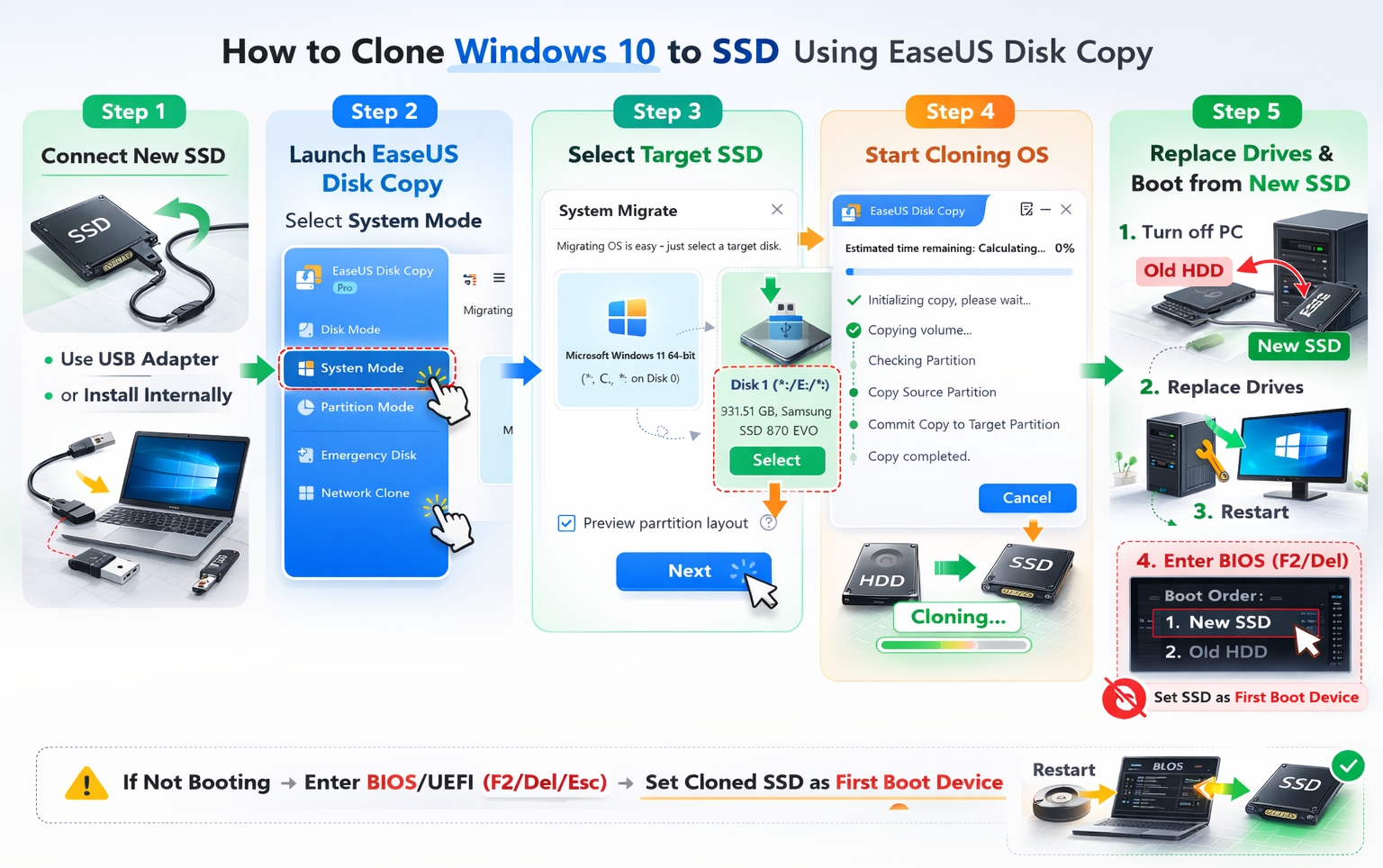
Step 1. Connect New SSD
- Insert the new SSD into the USB adapter and connect it to your computer via the USB port.
- Alternatively, install it internally if your PC has 2 or more disk slots.
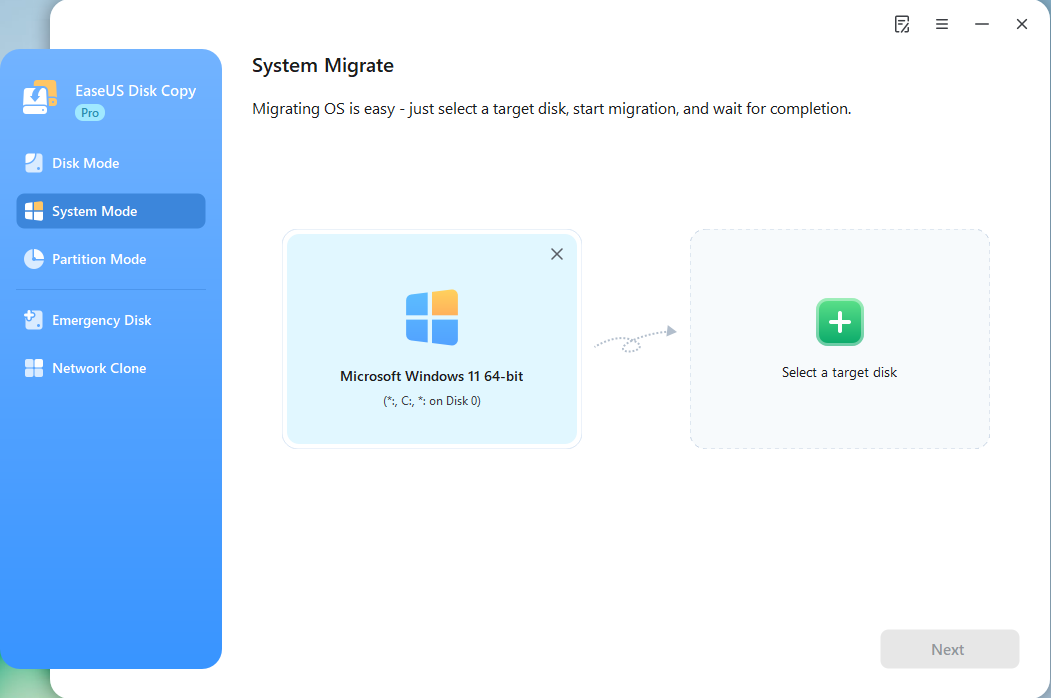
Step 2. Launch EaseUS OS Cloning Software
- Download & install EaseUS Disk Copy, launch it, and select System Mode.
- It will select the current system you use by default, including system-related partitions and boot sectors.
Step 3. Select Target SSD
- Choose the destination SSD that you want to move the OS to.
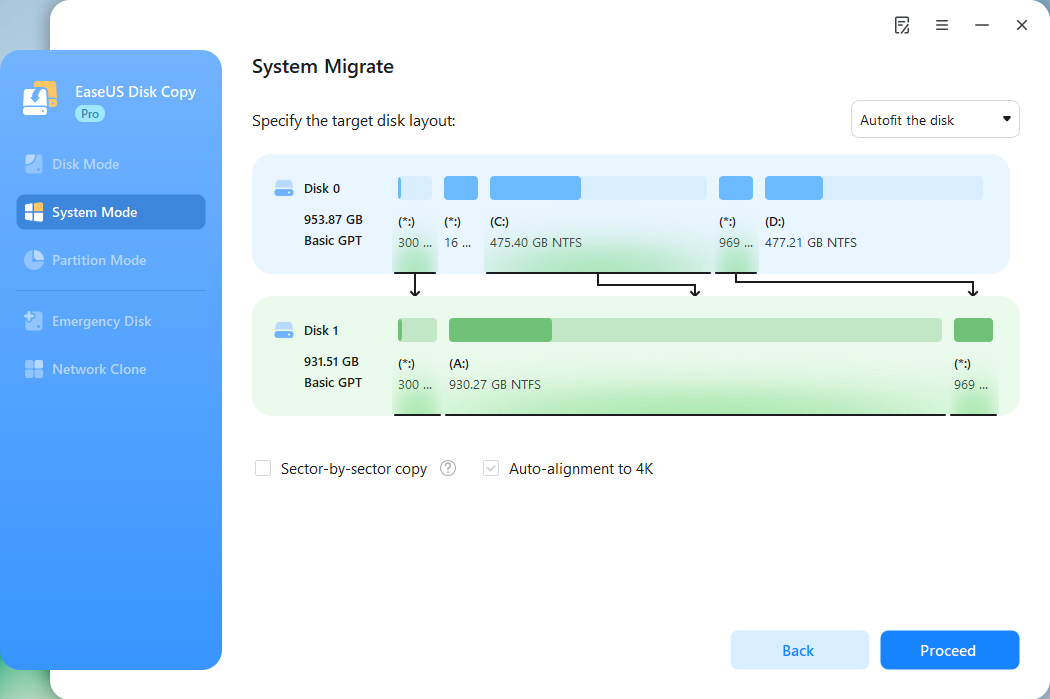
- Enable "Preview partition layout" for advanced cloning features, including sector-by-sector copy, and auto-4K Alignment.
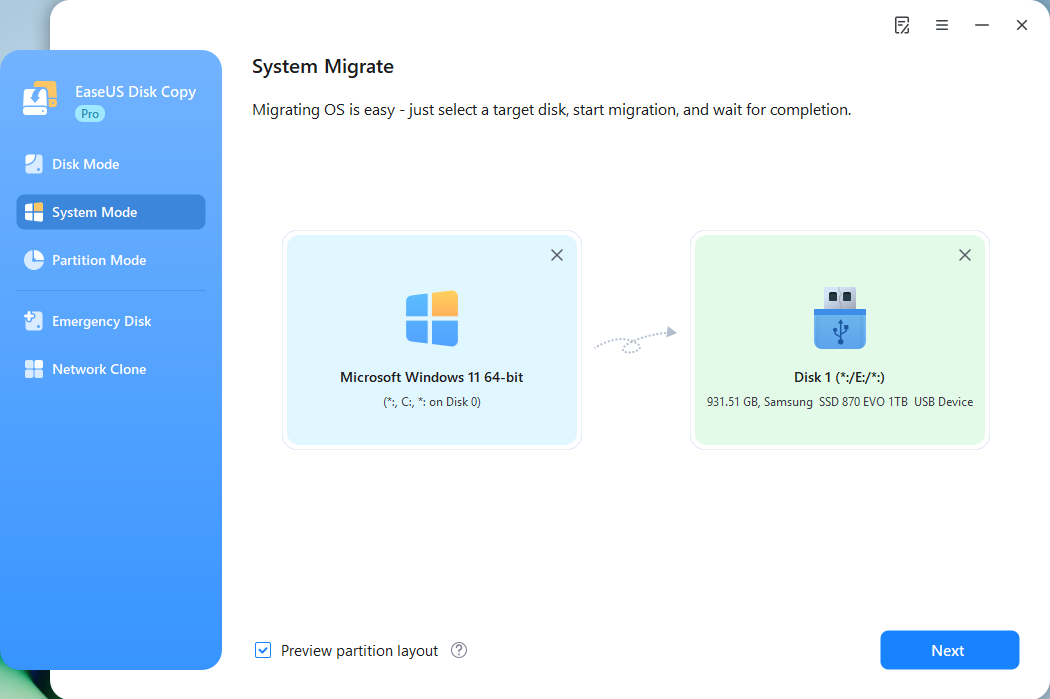
Note: Adjust disk layout if necessary.
- If your new SSD is larger, you can select "Auto-fit the disk" to make full use of the bigger space.
- The "Copy as the source" feature creates a 1-to-1 copy of your source disk; the target layout matches the source disk. You can use the sector-by-sector copy feature in this option.
Step 4. Start Cloning OS
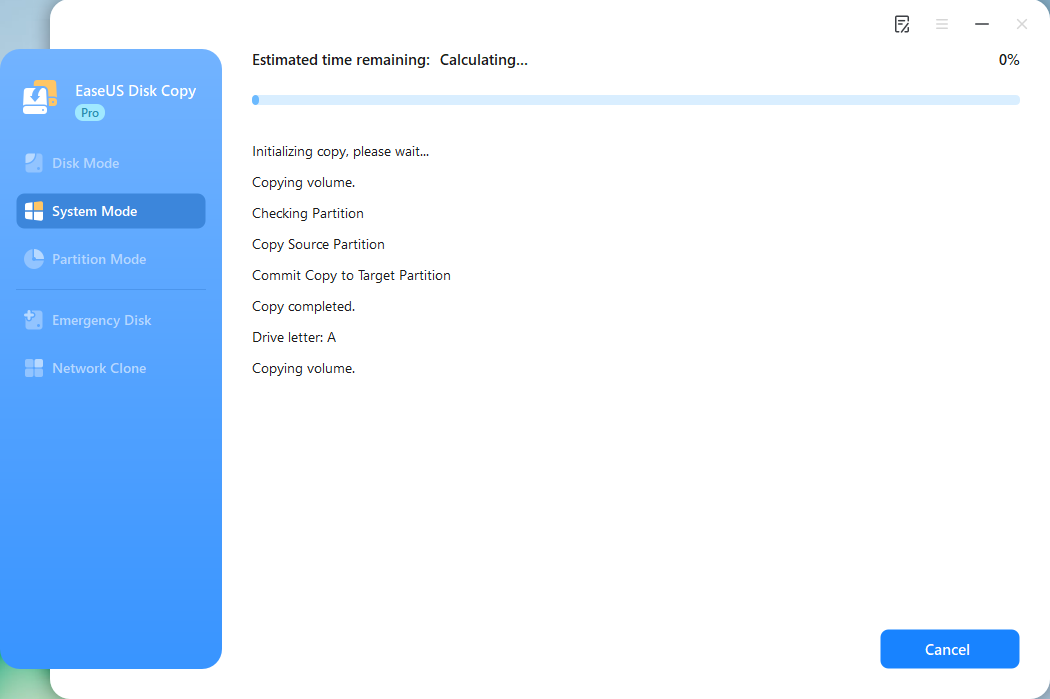
- Click Proceed to transfer Windows 10 to SSD and wait for the OS migration process to complete.
Step 5. Replace Drives & Boot from New SSD
- Once complete, turn off your computer. Locate and disconnect the old drive and connect the new SSD.
- Restart your computer, and it will boot from the new SSD.
- If the system isn't booting, change the boot order in BIOS/UEFI by pressing F1, F2, Esc, or Del during startup to set the cloned SSD as the first boot device.
Following these steps, you can easily migrate Windows 10 from an HDD to a new SSD.
This video provides a step-by-step guide on how to clone your Windows 10 to an SSD using EaseUS Disk Copy:
What to Do If Windows 10 Won't Boot After Cloning
If Windows won't boot from the cloned SSD, check these common causes before cloning the drive again.
Check the Boot Order
Open BIOS/UEFI and make sure the new SSD or Windows Boot Manager is selected as the first boot option. If the old drive is still connected, the PC may be booting from it instead.
Check UEFI and Legacy BIOS Settings
The boot mode should match the way Windows was installed. For example, a Windows installation on a GPT disk normally boots in UEFI mode, while an MBR installation may use Legacy BIOS mode. If the settings don't match, check BIOS/UEFI before making other changes.
Make Sure the System Partitions Were Cloned
Windows doesn't boot from the C: partition alone. On a UEFI/GPT system, the EFI System Partition (ESP) contains the files needed to start Windows. If the required system partition wasn't cloned, the new SSD may contain Windows files but still fail to boot.
Try Disconnecting the Old Drive
Temporarily disconnect the old drive and boot from the new SSD. This is a simple way to check whether the PC is still starting Windows from the original drive.
Is the post helpful? Share it on Twitter/Reddit to help other users switch to a new SSD seamlessly.
Conclusion
Cloning Windows 10 to an SSD remains one of the simplest and most effective ways to upgrade your computer without going through a time-consuming reinstall. By transferring your entire system, including the OS, applications, and personal files, you can enjoy a faster, smoother experience almost immediately.
Whether you're upgrading to an SSD for the first time or replacing an old drive, using a dedicated cloning tool like EaseUS Disk Copy ensures a smoother, safer process with minimal risk. In short, if you want a fast, reliable, and beginner-friendly way to clone Windows 10 to an SSD, Disk Copy is one of the most practical choices available.
Free Download
Windows 11/10/8/7
FAQ on Cloning Windows 10 to SSD
1. Why is my SSD detected but not booting?
A cloned SSD often fails to boot because of an incorrect BIOS boot order, MBR/GPT partition-style mismatches with UEFI/Legacy mode, missing EFI boot partitions, or a corrupted cloning process. To fix it, set the new SSD as the primary boot device in the BIOS, ensure the boot mode matches the partition style (UEFI for GPT, Legacy for MBR), and confirm all boot partitions were copied.
2. Can I clone Windows 10 to a smaller SSD?
Yes, you can clone Windows 10 to a smaller SSD as long as the used space on your current drive is less than the total capacity of the SSD. For example, if your HDD is 1TB but only 200GB is used, you can clone it to a 500GB SSD without issues.
3. How long does it take to clone Windows 10 to SSD?
Cloning Windows 10 to an SSD typically takes between 20 minutes and several hours; a common 500GB SSD-to-SSD transfer takes roughly 30-60 minutes. The time depends heavily on data volume, connection speed (USB 3.0 vs. NVMe), and drive type, with HDD to SSD cloning being slower than SSD to SSD.
4. Why is my SSD not showing up when cloning?
An SSD often fails to show up during cloning because of an improper physical connection, missing initialization in Windows, incorrect BIOS/UEFI settings (such as RAID vs. AHCI mode), or an incomplete clone process. Common solutions include reseating the cable/drive, initializing the disk in Disk Management, or updating storage drivers.
5. How to clone Windows 10 HDD to SSD for free without software?
You can clone Windows 10 HDD to SSD without third-party software by using Windows' built-in Backup and Restore tool.
- First, create a system image backup of your HDD and save it to an external drive.
- Then, connect your SSD and boot your PC using Windows installation media or a recovery drive.
- From the recovery options, choose System Image Recovery and restore the backup to the SSD.
This will effectively transfer Windows 10, along with programs and settings, to your new SSD. While not as straightforward as dedicated cloning tools, it’s a free method provided by Windows.
6. Can I use the old drive after cloning Windows 10 to SSD?
Yes. If Windows boots normally from the new SSD, you can keep the old drive as additional storage or wipe it for another use. Before deleting anything from the old drive, make sure your files and Windows installation are working correctly on the new SSD.
-
Updated by
Tracy became a member of the EaseUS content team in 2013. Being a technical writer for over 10 years, she is enthusiastic about sharing tips to assist readers in resolving complex issues in disk management, file transfer, PC & Mac performance optimization, etc., like an expert.…Read full bio