

Page Table of Contents

Don't worry if you tried all means to upgrade and clone the old HDD to SSD, but it turned out the cloned SSD won't boot on your computer. Here we've collected several effective ways that will make SSD bootable again in Windows 11/10/8/7.
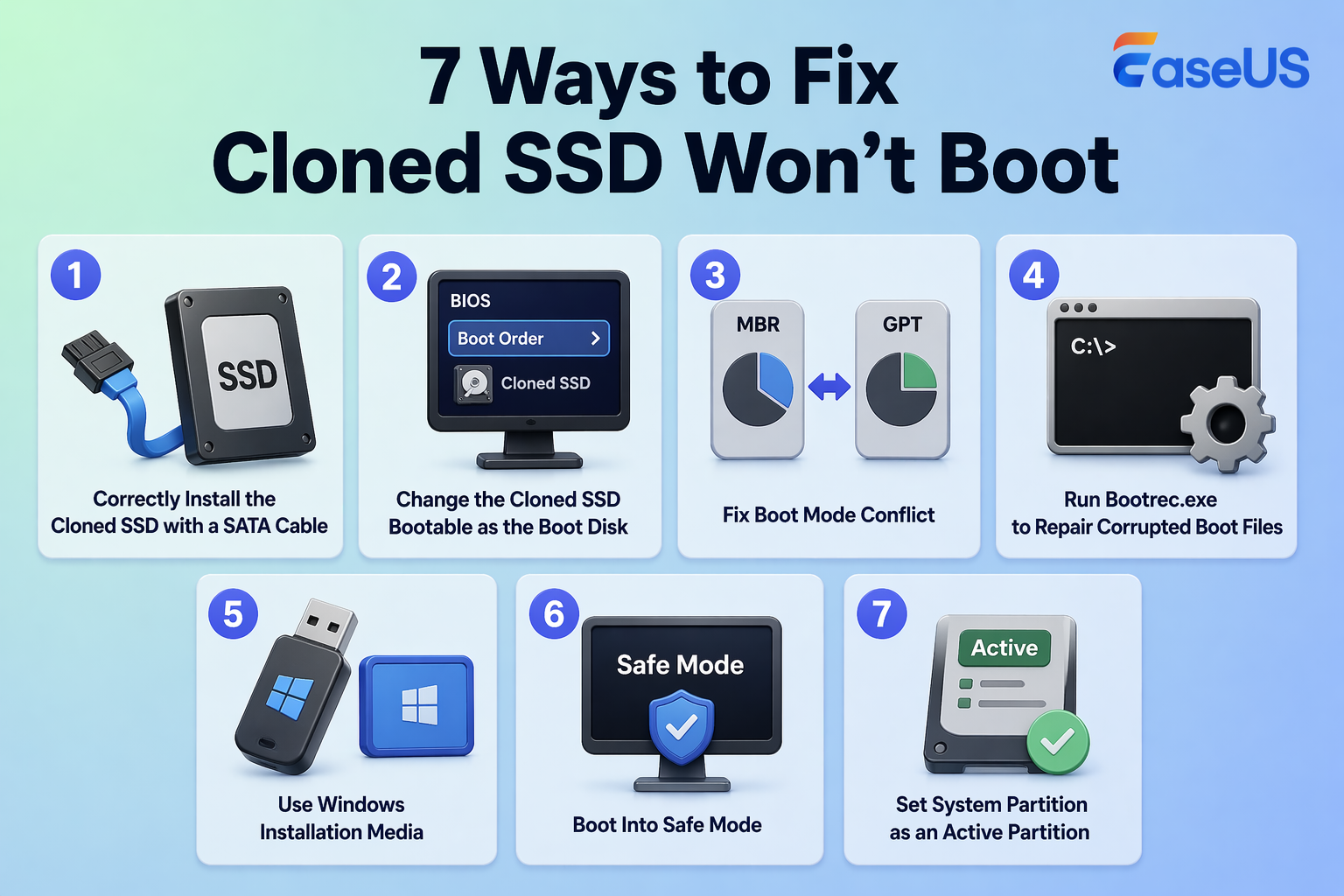
If your cloned SSD won't boot, the most common reasons are:
- The SSD is not set as the primary boot device
- The system partition is not active
- Bootloader (BCD) is missing or corrupted
- MBR/GPT mismatch with BIOS mode
To fix Windows won't boot after cloning, you can set the correct boot drive in BIOS, repair the bootloader using Bootrec, or adjust partition settings. Keep reading for detailed steps.
Causes - Why SSD Not Booting After Clone
Understanding the various causes will help you identify your specific issue faster. Here we list common reasons; refer to them before troubleshooting, then take the corresponding measures to fix cloned disk boot issue.
- Hardware recognition failure: Motherboard does not detect the new SSD, or the connection has issues.
- BIOS/UEFI not updated: System still tries to boot from the old drive.
- Boot mode mismatch: Incompatibility between disk partition style (MBR/GPT) and BIOS mode (Legacy/UEFI).
- Incomplete clone operation: Missing boot files due to bad sectors, interruption, or skipped system partitions.
- Lack of 4K alignment: Cloned SSD partitions are not properly aligned, causing performance or boot issues.
- Corrupted boot files: MBR or GPT data damaged during cloning.
Solutions - How to Fix Cloned SSD Won't Boot, Make SSD Bootable
The following methods are bound to resolve SSD not working after cloning for particular reasons. Follow the step-by-step guides to make the cloned SSD boot normally.
Method 1. Correctly Install the Cloned SSD with a SATA Cable
🎯Applicable Scenario: The new SSD isn't properly detected by the motherboard, the cloned SSD not showing in boot menu, or there are connection interface issues.
According to Reddit discussions, some Windows 10 users successfully booted their computer using this way
- Step 1. Use a SATA cable instead of a USB connection cable.
- Step 2. Install the SSD to the computer correctly via the SATA cable.
- Step 3. Close the computer case and restart the computer.
If the SSD boots up, congratulations. Your problem gets resolved. If not, continue with Method 2.
Method 2. Change the Cloned SSD Bootable as the Boot Disk
🎯Applicable Scenario: The system still prioritizes the old hard drive as the primary boot device.
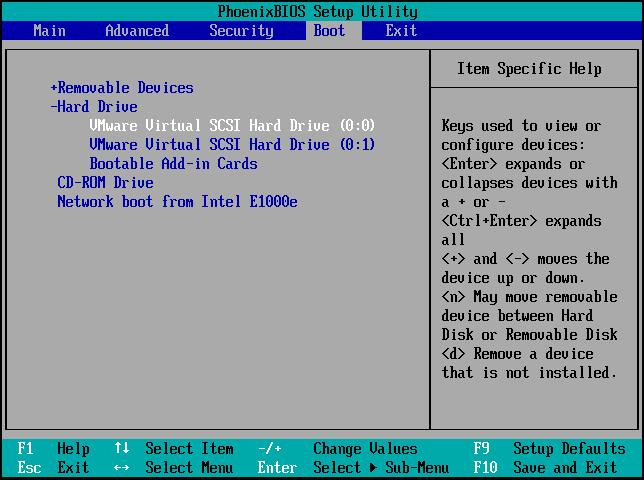
If the cloned SSD isn't set as the first boot option in the BIOS, your computer won't boot from it. Therefore, you need to access the BIOS and change the boot order to set the SSD as the boot disk. Here are the steps:
- Step 1. Restart the PC. When the startup screen appears, constantly press F2/F12/DEL to enter BIOS.
- Step 2. Next, use the arrow keys to select the Boot tab, then select the cloned SSD as the first boot option.
- Step 3. Press F10 to save and exit BIOS. And restart your computer.
Wait patiently, and if your computer boots up, congratulations. The problem gets resolved.
Note that, if your original boot disk is MBR, you'll need to set the partition active to make the SSD bootable after clone. And you can fix this issue in the next Method.
Share the blog on social media to help others fix the cloned SSD won't boot issue.

Method 3. Fix Boot Mode Conflict
🎯Applicable Scenario: MBR/GPT partition style doesn't match BIOS Legacy/UEFI mode
Diagnostic Steps:
- Press "Windows + R", type diskmgmt.msc
- Right-click disk > Properties > Volumes
- Check Partition Style: MBR (for Legacy) or GPT (for UEFI)
- Enter BIOS to verify the current boot mode
Conversion Methods:
- GPT to MBR: Use MBR2GPT.exe in Windows PE environment
- MBR to GPT: Backup data and use Disk Management conversion tool
Method 4. Run Bootrec.exe to Repair Corrupted Boot Files
🎯Applicable Scenario: Corrupted MBR or BCD configuration
Command Line Repair:
- Boot from Windows installation USB
- Press Shift + F10 to open Command Prompt
- Execute these commands sequentially:
bootrec /fixmbr
bootrec /fixboot
bootrec /scanos
bootrec /rebuildbcd
Method 5. Use Windows Installation Media
🎯Applicable Scenario: Coning tools' default settings might exclude critical system reserved partitions.
Create Boot Repair Disk
- Download Windows Media Creation Tool
- Prepare 8GB+ USB drive
- Create bootable installation media
- Use for startup repair and command-line operations
Reboot PC > Press F2/F8/Del to enter BIOS > Set PC to boot from EaseUS bootable Disk > Reboot PC. Then set cloned SSD as the boot drive, and set PC bbot from the cloned SSD.
After this, your computer should be able to boot up from the cloned SSD and you can make use of all cloned files on the new disk again.
- Notice:
- If you've followed through the above three methods, the SSD is still not booting, your SSD may have a problematic clone of your old hard drive.
- The best way out is to re-do the clone. And we'll show you the process in the next Method.
Method 6. Boot Into Safe Mode
If you have tried all the ways above, and none of them works, another way you can try is to boot into Safe Mode, which is very effective according to many users with the same issues. Now, let's see how to do it with steps:
Step 1. If you have both the source disk and cloned SSD connected to your computer, disconnect the source disk.
Step 2. Boot into the Safe Mode. (Specific Step: Restart your computer multiple times until the Automatic Repair shows up, then select Advanced Option to enter winPE. Then click Troubleshoot > Advanced Options > Startup Settings > Restart > Enable Safe Mode.)
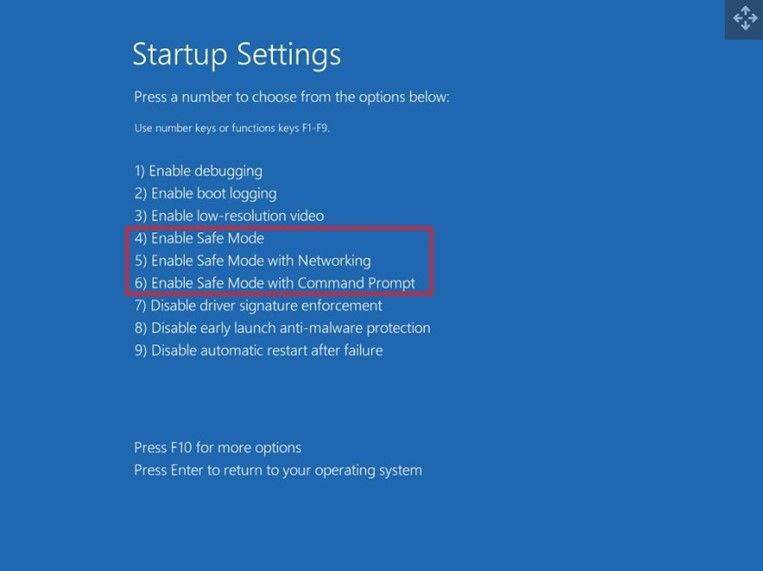
Step 3. Once it boots in Safe Mode, just restart again to boot in Normal Mode. Now the problem should be fixed now.
Share the blog on social media to help others fix the cloned SSD won't boot issue.
Method 7. Set System Partition as an Active Partition
For most Windows 10 installations, the active partition must be the primary partition containing the operating system's boot files. If your cloned SSD fails to boot, it's possible that the system partition hasn't been marked as active. You can resolve this using Command Prompt.
- Boot from the original hard drive, as the cloned SSD won't start up.
- Connect the SSD to your computer using a hard drive enclosure.
- Open a Command Prompt window with administrator privileges: type cmd in the search box, right-click "Command Prompt", and choose "Run as administrator".
- At the command prompt, enter the following lines sequentially, pressing Enter after each one:
diskpart
list disk
select disk X (Replace X with the SSD's disk number)
list partition
select partition X (Replace X with your system partition number)
active
Once finished, close Command Prompt, reinstall the SSD inside your computer, and attempt to boot from it again.
Advanced Fixes
An incomplete clone or clone failure will cause the cloned SSD to not boot. Besides, if you haven't cloned the boot partition, the cloned hard drive will not be able to boot either. Reliable disk cloning software - EaseUS Disk Copy can re-execute the disk cloning process, guaranteeing you the cloned hard disk bootable after the HDD to SSD clone.
Key Features of EaseUS Disk Copy
- Support smart and automatic disk layout.
- Support clone USB, external hard drive, HDD, and SSD.
- Compatible with almost all types and brands of HDDs and SSDs.
- Create a Portable USB to take your Windows anywhere.
- Automatically resize partitions while cloning.
- Cloning hard drive with bad sectors.
- Supports sector-by-sector cloning.
 Free Download
Windows 11/10/8/7
Follow the steps below to reclone SSD from scratch to ensure a successful boot.
Before cloning:
- If your computer has only one slot, connect the target disk to your machine via a USB-to-SATA/NVMe adapter.
- If your computer has an extra slot, install the target disk into the empty slot properly, and make sure it is compatible.
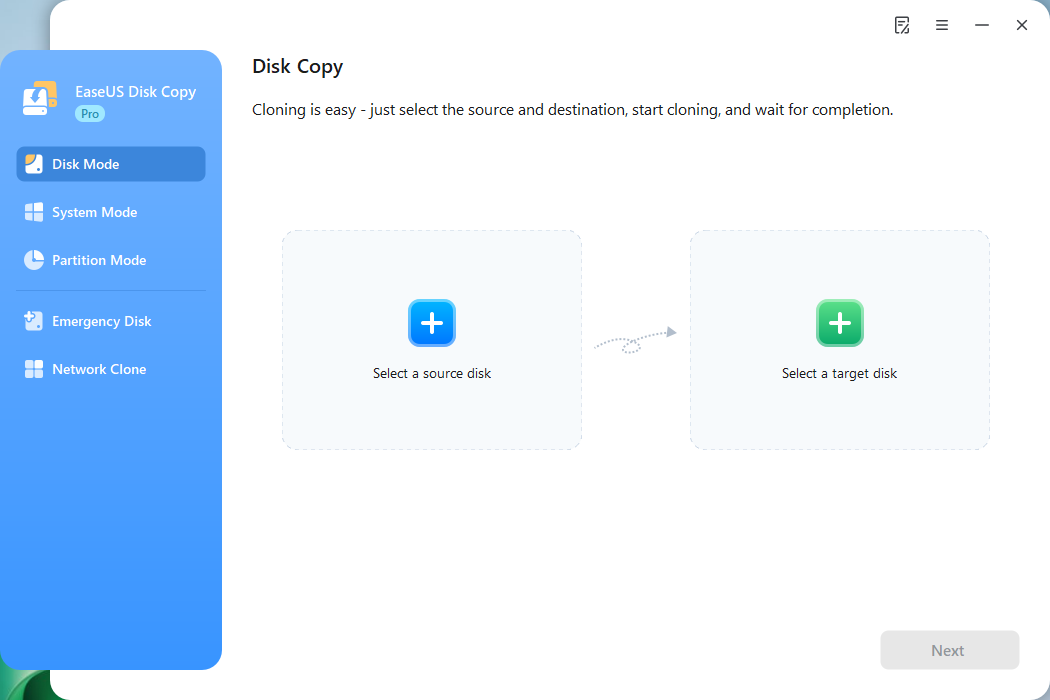
Step 1. Launch EaseUS Disk Copy and choose Disk Mode.
Install EaseUS Disk Copy cloning software on your Windows computer, then launch it and select Disk Mode from the left panel.
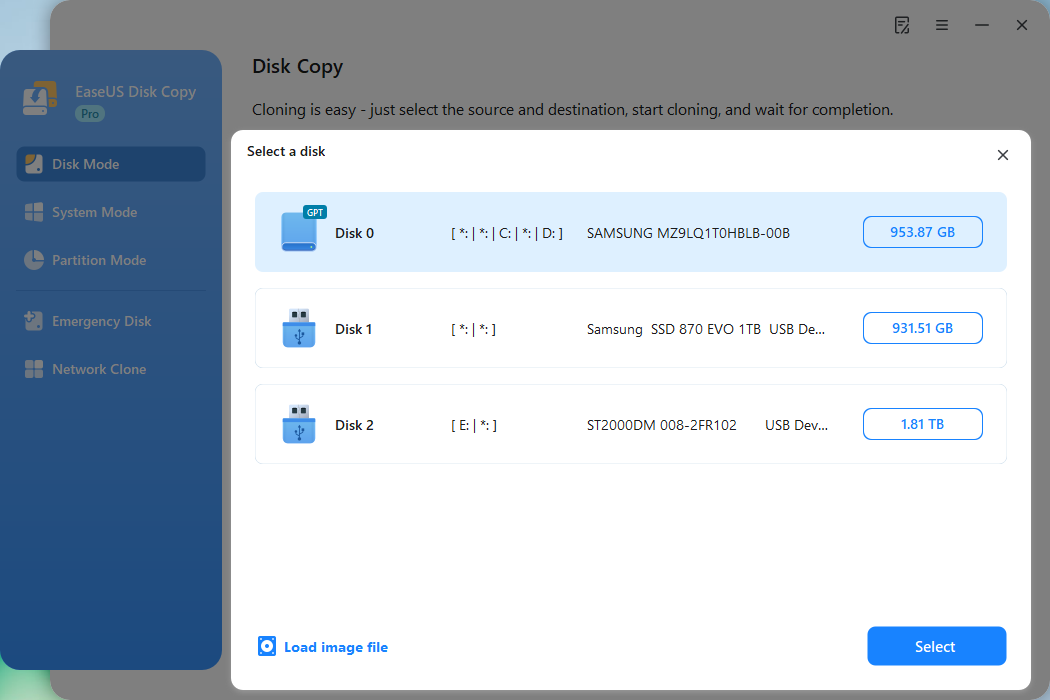
Step 2. Select the source drive.
Select the drive you want to copy, then click Select.
Step 3. Choose the target disk.
Choose the disk that you want to clone data to, and click Select. Note that the used space of the source disk should be less than the target disk capacity.
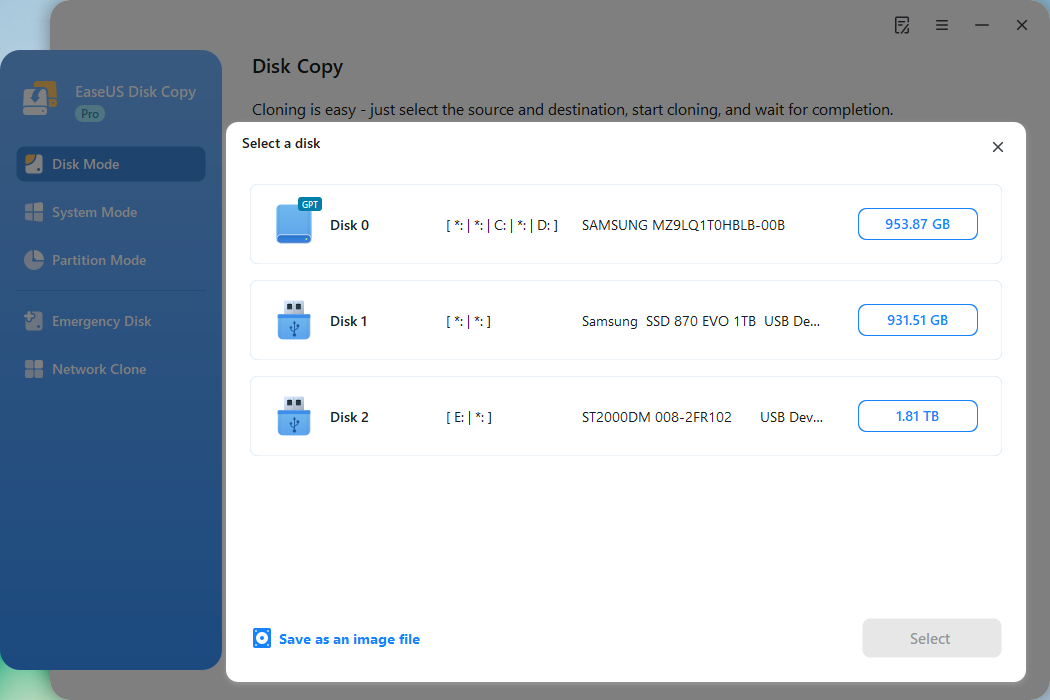
*At this step, you can also click the option "Save as an image file" to store your disk as a compressed image file, which can be restored without any data loss.
Step 4. Adjust disk layout.
Specify the target disk layout as your preference. You can choose among:
- Autofit the disk: makes some changes by default on the destination disk layout so that it can work at its best.
- Copy as the source: create a 1-to-1 copy of your source disk; the layout is the same as the source disk.
- Edit disk layout: allows you to manually resize/move the partition layout on this destination disk.
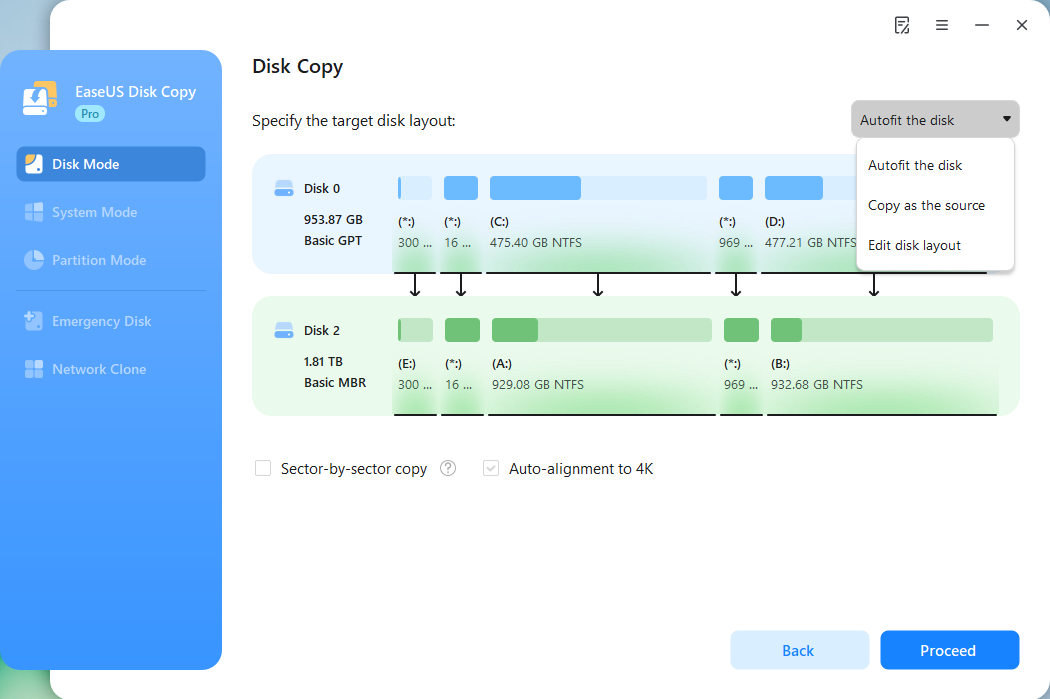
*If the target disk is an SSD, the option "Auto-alignment to 4K" will be checked automatically to optimize the performance of your SSD.
Step 5. Start cloning.
Click Proceed, and a message will appear, warning you that data will be lost. Confirm the message by clicking Continue.
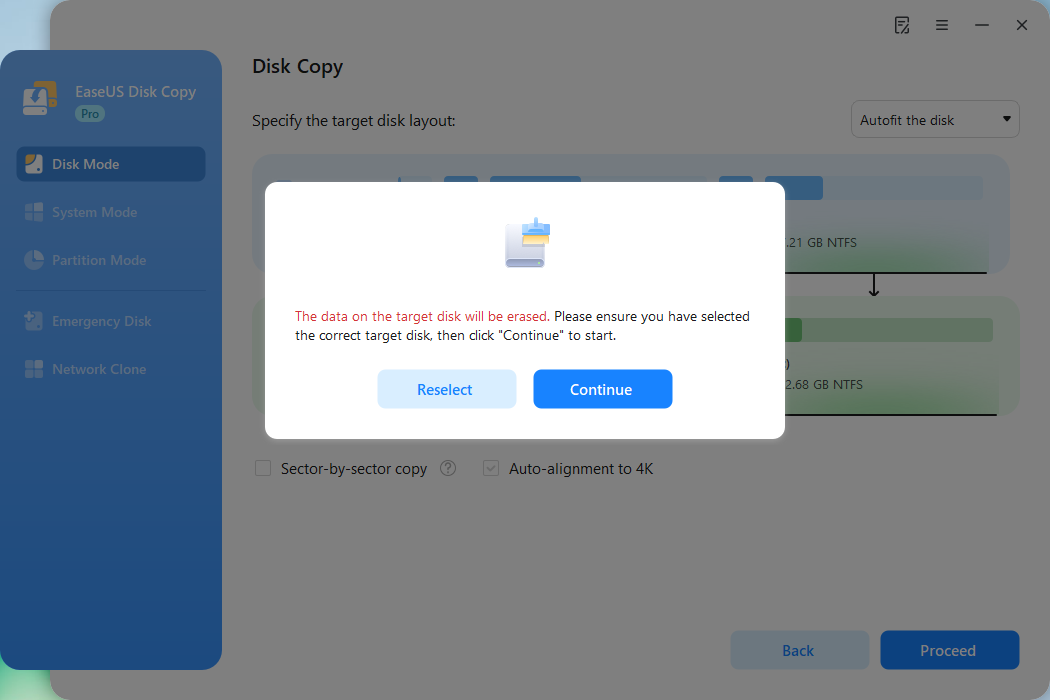
Now, it will start executing the cloning task.
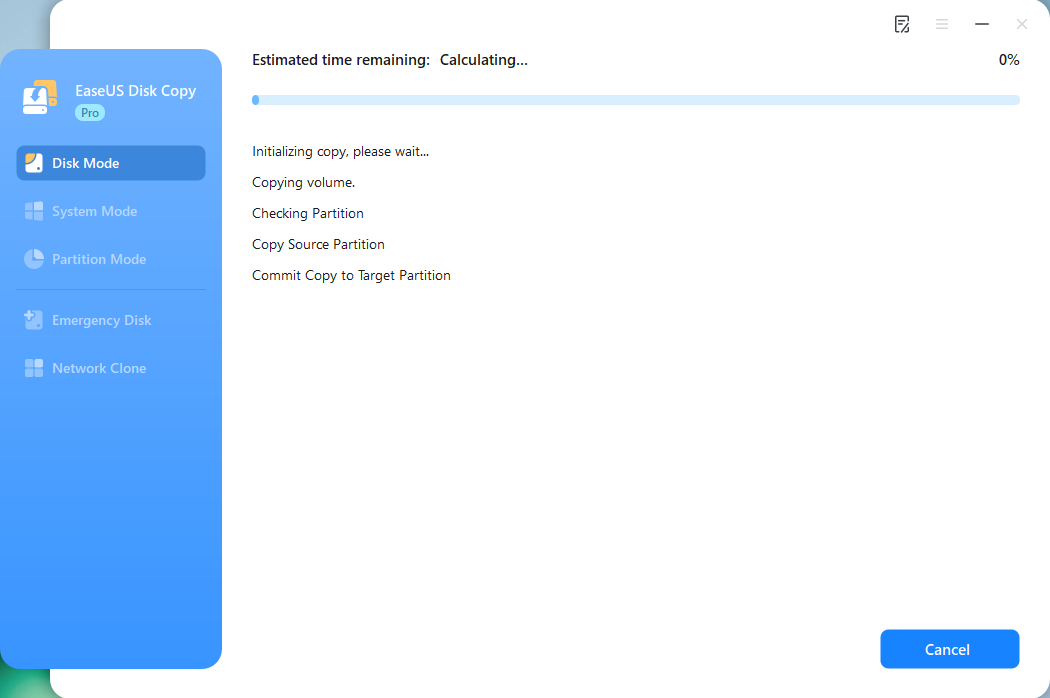
*The time it takes to clone a hard drive depends on how much data is on the source disk, and it will also be affected by the disk types, USB connection, etc.
After this, you may:
- Repeat Method 1 and Method 2 to install the cloned SSD correctly into your computer and set it as the boot drive.
- Then, reboot the PC, and the SSD will boot up successfully.
Stay Calm If Cloned SSD Won't Boot, Follow Fixes to Make SSD Bootable
On this page, we collected 6 reliable methods that work to help you fix the cloned drive not bootable error. To make the cloned SSD bootable again, which method is the best?
📖Here is Editor's Pick:
- Follow Method 1 and Method 2 to correctly install SSD and set it as a boot drive.
- If the OS disk was MBR, follow Method 3 to set the SSD OS drive as active.
- After this, your computer should be able to boot up from the new SSD now.
- If it's still not working, re-do the clone with EaseUS Disk Copy.
Free Download
Windows 11/10/8/7
FAQ on Cloned SSD Won't Boot
1. Will a cloned disk be bootable?
If you have made an image backup of your entire hard drive, you can clone the drive to another one, and it will be bootable. Remember that you need to ensure the destination disk is the same size or larger than the source disk. If you only clone a drive partition containing your operating system, it probably won't be bootable unless you use special software or perform additional steps.
2. How do I make my SSD bootable after cloning?
You need to do a few things to make your SSD bootable after cloning. Restart your PC, and press the key that opens the boot-device selection menu for your computer. Select the drive you want to boot from, which in this case is probably your SSD. If your BIOS does not have such a menu, check its documentation to see which key to press. Once you've selected the drive, it should boot from your SSD.
-
Updated by
Jean is recognized as one of the most professional writers in EaseUS. She has kept improving her writing skills over the past 10 years and helped millions of her readers solve their tech problems on PC, Mac, and iOS devices. …Read full bio