


Content
Page Table of Contents
About the Author
Hot Topics
Is it possible to transfer space from D to C? Sure! To move space from the D drive to the C drive, you can either use Disk Management or a third-party partition manager. With Disk Management, you'll need to shrink the D drive to create unallocated space, and then extend the C drive into that unallocated space. So, you can increase C drive from D drive. However, if the unallocated space is not directly adjacent to the C drive (on the right side), you may need to delete or move other partitions to make it contiguous.
Hence, to transfer space from the D drive to the C drive without data loss, use a reliable third-party tool like EaseUS Partition Master.
EaseUS Software noticed many users post on Reddit, Superuser, and Microsoft that they want to add more space to the C drive from D. We explored the possible causes and solutions on this page. Refer to the table below to determine the correct tool for allocating space from D to C.
| Comparison | EaseUS Partition Master | Disk Management |
|---|---|---|
| Data Loss | No | Yes, require deleting the partition |
| Premise | D drive and C drive are on the same physical disk |
D drive and C drive are on the same physical disk D drive is right behind the C drive |
| User Friendly | Yes, clear and simple interface | Yes, simple interface |
- If the D drive is right behind the C drive, you can delete it to add more space to the C drive, but this will cause data loss, so make sure you have a backup in advance.
- If you want to allocate space from D drive to C drive without data loss, EaseUS Partition Master is an easier and faster tool.
Select the proper tool based on your situation and dive into the instructions on how to move space from D drive to C drive on Windows 11/10/8/7.
How to Move Space from D Drive to C Drive Windows 11/10/8/7
Disk Management and EaseUS Partition Master can both transfer space from D to C drive, but Disk Management may cause data loss since it requires deleting D drive first. So, let's start with EaseUS Partition Master, which can add space to C drive from D drive without losing data.
Method 1. Move Space from D Drive to C Drive with Third-Party Software - EaseUS Partition Master
EaseUS Partition Master is one of the most well-known partition management programs, enabling all levels of users to easily partition hard drives on Windows computers and make full use of disk space.
Data Loss: No, without losing any data.
Premise: C drive and D drive are on the same disk. (If the C drive and D drive are on different disks, you can use EaseUS Partition Master to extend the C drive with another disk.)
Allocate Space from D Drive to C Drive Directly
You can use the new "Allocate Space" feature to increase C drive from D drive without deleting D drive to make unallocated space. No data loss at all.
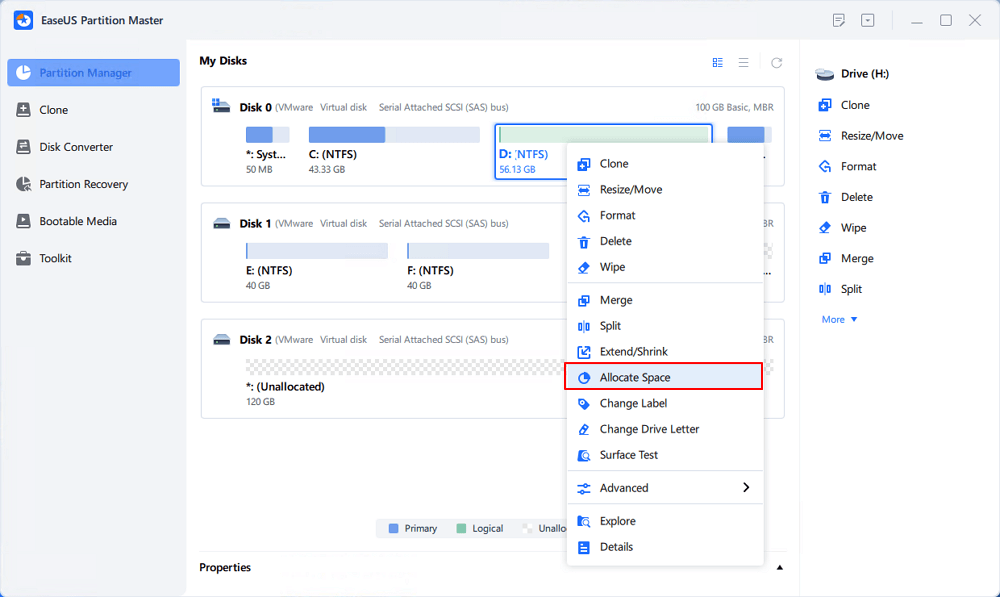
Step 1. Right-click on the D: partition with enough free space and select "Allocate Space".
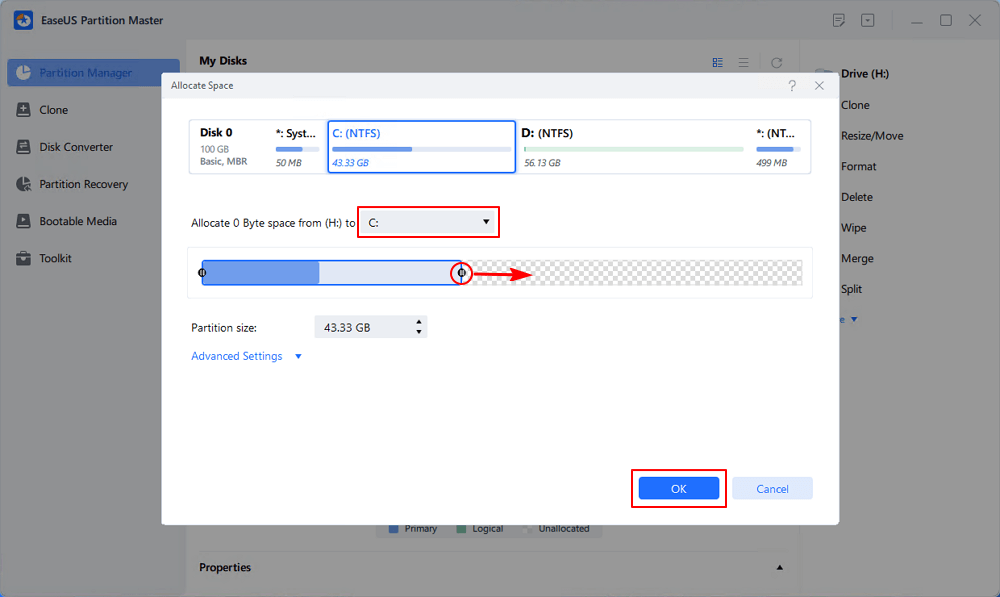
Step 2. Select the target partition - C: drive and drag the partition panel rightward to add the free space from D: drive to C: drive. Then click "OK" to confirm.
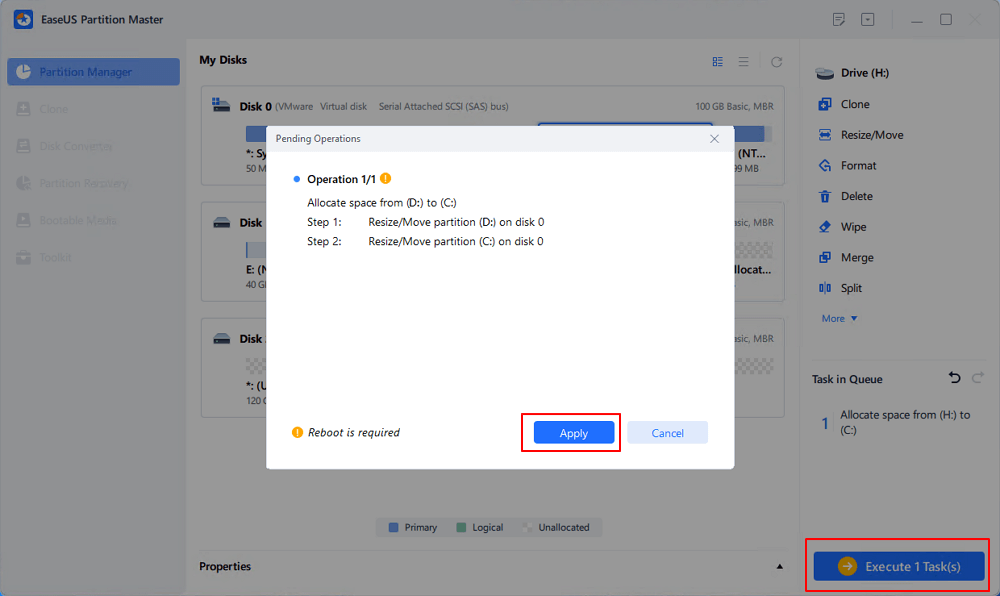
Step 3. Click the "Execute Task" button and click "Apply" to start the process of moving free space from D: drive to C: drive.
Video Tutorial: Move and Resize Space in Windows 11/10
You can use it to resize/move partitions, merge partitions, create/format/delete partitions, migrate OS to SSD/HDD to speed up Windows, and more. Use this competent partition management program to move space from D drive to C drive or any other data drive to C in two approaches.
Do you think this passage is helpful to move space from D drive to C drive? If you like it, you can also share it with other people in need!

Method 2. Transfer Space From D to C with Free Tool - Limited
Can I transfer the space from the D drive to the C drive for free? Yes! Disk Management can do it by deleting the D drive and extending C drive. This will cause data loss. So make sure you have backed up your important data before you get started.
- Premise: C Drive and Drive are on the same disk. D drive is right behind the C drive. (If C and D are non-adjacent, you will see the Extend Volume greyed out.)
- Data Loss: Yes, need to back up in advance.
Now, let's learn how to move space from D drive to C drive with this free tool.
Step 1. Backup your data:
Before making any changes to your disk partitions, it's crucial to back up your important data from both the C and D drives in case of any data loss.
Step 2. Open Disk Management:
- Search for "Disk Management" in the Windows search bar and open the application.
- Right-click the Windows icon and select Disk Management if you use Windows 11.
Step 3. Delete D Drive:
Right-click on the D drive and select "Delete Volume". Confirm the deletion when a data loss warning pops up.
- Notice:
- Many tutorials say they can shrink D drive and extend C drive with the unallocated space. However, in fact, if you shrink D drive, the unallocated space is right behind the D drive, nonadjacent to the C drive. In this case, Disk Management can't add the nonadjacent unallocated space to the C drive, unless you use third-party software to do it or move the unallocated space right behind the C drive.
Step 4. Extend C drive:
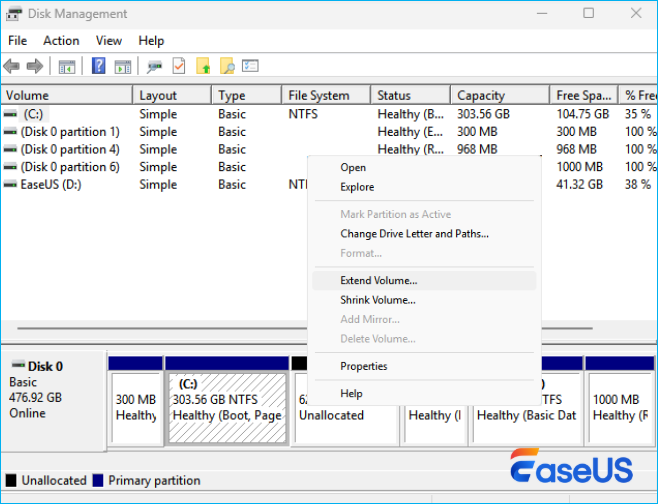
Then, right-click on the C drive and select "Extend Volume". Follow the wizard to extend the C drive into the unallocated space created by shrinking the D drive.
Why Can't I Move Space from D Drive to C Drive?
You may not be able to move space from D drive to C drive because the available space on D is not the same as unallocated space, or the unallocated space is not in the right position. Windows Disk Management has strict requirements for extending a partition, so some disk layouts prevent you from adding D drive space to C drive directly.
| Problem | Why It Happens | What You Can Do |
| The unallocated space is not next to the C: drive | Windows can extend the C: drive only into adjacent unallocated space. | Use a partition manager to move the unallocated space next to the C: drive. |
| You shrink the D: drive but cannot extend the C: drive | Shrinking the D: drive usually creates unallocated space after D:, not immediately after C:. | Move the unallocated space before extending the C: drive. |
| A recovery partition is between C: and D: | The recovery partition separates the C: drive from the unallocated space created from D:. | Move the recovery partition or use partition management software. |
| C: and D: are on different physical disks | Free space on another physical disk cannot be directly added to the C: drive. | Move data between disks or upgrade or migrate the system disk. |
| The D: drive does not have enough free space | The D: drive cannot provide more space than its available capacity allows. | Free up space on the D: drive before resizing the partition. |
| The partition layout has other restrictions | Some system or special partitions can prevent Windows from resizing the C: drive as expected. | Check the disk layout and use a partition manager when necessary. |
Why C Drive Is Getting Smaller
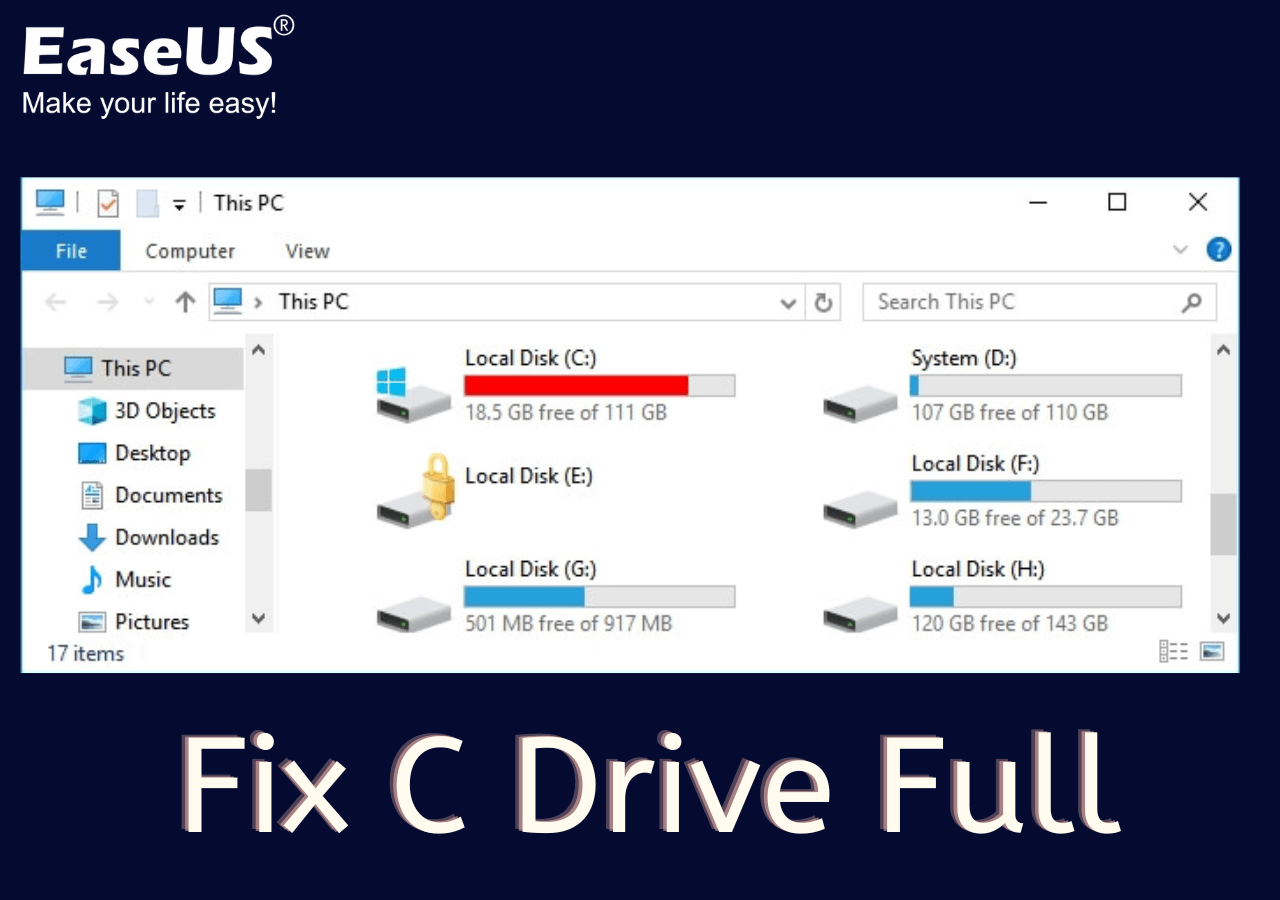
In general, the C drive is the system disk on a computer. When the Windows operating system runs, it will generate a lot of junk files. Whether you use it or not, the C drive space will become smaller to a certain extent, and you can even see C drive shows red bar. There are many reasons why the remaining space of C drive is becoming less and less. The following aspects are summarized for you:
1. Files in the recycle bin take up space. The more data stored temporarily in the recycle bin, the more space on the C drive will be taken up. You can delete the files in the recycle bin, then C drive space will increase accordingly. You can recover deleted files from emptied recycle bin if you remove them mistakenly.
2. Is system restore enabled on your computer? The system restore setting will reduce the C drive's space; you can disable it if not necessary.
3. Page files and virtual memory. The page file is relatively large. If the page file is stored in the C drive, it may make the computer's virtual memory reaches a certain limit. Therefore, you need to run the Task Manager at any time to see if the computer's memory is almost exhausted. If so, you should transfer the page files to another disk.
4. Too many temporary files. You can use the disk cleaning program that comes with the C drive system to clean up junk files because this will not delete the files that should not be removed by mistake. See how to solve there is not enough space on C drive.
5. Installing software to the C drive will definitely consume memory. Although sometimes you choose to install to other disks, the relevant registration files will be placed in the system folder, which will cause the capacity of the C drive to become smaller and smaller. So, install applications outside of C drive, such as to the D drive.
If you have tried the solutions mentioned above, but the C drive still doesn't have enough free space, your data disk, such as the D drive, has a lot of available space, then why not try to move the free space of D drive to C drive to extend?
If you are running Windows 11 and experiencing a C drive full issue, refer to this link How to Extend C Drive in Windows 11, or follow the provided methods above for help.
Conclusion
Nowadays, computers have become an integral part of our lives and work. But the longer the computer works, the more we can perceive that the C drive indicates insufficient memory. When the C drive, which is equivalent to the human heart, runs out of memory, countless operational problems will follow, such as computer crashes, card freezes, etc. These problems upset many users. Fortunately, we bring two methods to move space from D to C, Disk Management and EaseUS Partition Master. If you don't want to lose any data and need to efficiently transfer space from D drive to C drive, use EaseUS Partition Master.
FAQs About How to Add Space to C Drive From D Drive
1. Can I transfer space from the D drive to the C drive?
Yes, you can transfer space from the D drive to the C drive by first shrinking or deleting the D drive to create unallocated space, and then extending the C drive with that space. However, this only works if the unallocated space is directly adjacent to the C drive. If it's not, you'll need third-party partition software to move the space before extending C.
2. How to move space from the D drive to the C drive without losing data?
To move space from D drive to the C drive without data loss:
Step 1. Open EaseUS Partition Master, right-click the D drive, and select Allocate Space.
Step 2. Determine how much space you want to allocate from D to C.
Step 3. Click OK and execute the task.
3. How to move unallocated space next to C drive?
Disk Management can't move a partition or make the nonadjacent unallocated space adjacent to the C drive. To move unallocated space next to the C drive, use reliable third-party disk management tools such as EaseUS Partition Master.
4. Can I move only part of the D drive to C drive?
Yes. You can choose how much space to take from D and add to C. You do not need to transfer the entire D partition. Keep enough free space on D for the files and applications stored there.
5. Can I move space from D drive to C drive if D is almost full?
You can only move the available capacity that D can safely give up. If D is almost full, free up some space on D first or use another storage solution. You should not shrink D to the point where its remaining space is insufficient for your files and applications.
6. Does moving space from D to C improve computer performance?
Moving space to C can prevent problems caused by a critically low system drive, but it does not directly make the computer faster. If C drive is nearly full, adding space can give Windows more room for temporary files, updates, applications, and system operations.
7. How much free space should I leave on the C drive?
There is no single amount that works for every computer. Windows, installed applications, updates, and temporary files all need available space, so you should avoid filling C drive to near capacity. If C repeatedly runs out of space, consider increasing its capacity or moving large files and applications to another drive.
How Can We Help You
About the Author

Updated by Joey Albert
Joey is an enthusiast of science and technology. With a passion for uncovering the latest tech innovations, she creates clear, engaging how-to guides that make technology accessible and enjoyable for all.

Cedric Grantham is a senior editor and data recovery specialist of EaseUS. He mainly writes articles and how-to tips about data recovery on PC and Mac. He has handled 10,000+ data recovery cases and is good at data recovery of NTFS, FAT (FAT32 and ExFAT) file systems, and RAID structure reorganization.
Product Reviews
-
I love that the changes you make with EaseUS Partition Master Free aren't immediately applied to the disks. It makes it way easier to play out what will happen after you've made all the changes. I also think the overall look and feel of EaseUS Partition Master Free makes whatever you're doing with your computer's partitions easy.
Read More -
Partition Master Free can Resize, Move, Merge, Migrate, and Copy disks or partitions; convert to local, change label, defragment, check and explore partition; and much more. A premium upgrade adds free tech support and the ability to resize dynamic volumes.
Read More -
It won't hot image your drives or align them, but since it's coupled with a partition manager, it allows you do perform many tasks at once, instead of just cloning drives. You can move partitions around, resize them, defragment, and more, along with the other tools you'd expect from a cloning tool.
Read More
Related Articles
-
Why Can't shrink C Drive with All of the Space Free and How to Fix
![author icon]() Cici/2026/08/13
Cici/2026/08/13 -
How to Move Unallocated Space to the Right/Left/Next to C Drive
![author icon]() Brithny/2026/09/20
Brithny/2026/09/20 -
How to Delete D Drive and Extend C Drive Safely Without Data Loss
![author icon]() Cici/2026/09/16
Cici/2026/09/16 -
How to Check What Is Using Up My C Drive Space [2026 Tutorial]
![author icon]() Cici/2026/08/17
Cici/2026/08/17
 Cici/2026/08/13
  Brithny/2026/09/20