


Page Table of Contents

PAGE CONTENT:
Can You Clone a Larger HDD to a Smaller SSD?
"Can I clone Windows 10 HDD to a smaller SSD? My computer becomes slower and slower after upgrading to Windows 10. I've heard that SSD works more efficiently than HDD, then I bought a new 128 GB SSD (smaller than the old HDD), trying to resolve the issue by cloning OS from HDD to the smaller SSD. But the problem is I don't know how to do it. Can anyone show me how to make it?"
Yes. You can clone a larger HDD to a smaller SSD as long as the actual data being transferred, including the required system partitions, fits on the destination SSD. The total capacity of your source HDD does not necessarily need to be smaller than the target SSD. For example, you can migrate Windows from a 1TB HDD to a 500GB SSD if the data and partitions you want to clone can fit within the SSD's available capacity.
How to migrate Windows 10 from HDD to smaller SSD? Can you clone a larger hard drive to a smaller SSD without reinstalling Windows? If you are having the same problem, relax! Here, you'll find an effective and simple method to clone OS to SSD.
Preparation Before Cloning Larger HDD to a Smaller SSD
If your HDD has more storage capacity than the new SSD, prepare the source disk before starting the migration.
- 1. Check the Used Space: Open File Explorer or Disk Management to review the data stored on the source drive.
- 2. Remove Unnecessary Files: Delete temporary files, unused applications, and other data you do not need to migrate.
- 3. Check the Partition Layout: Open Disk Management and confirm that the partitions you want to transfer can fit on the target SSD.
- 4. Shrink the Source Partition if Necessary: If the partition is larger than the available space on the target SSD, reduce its size when possible.
- 5. Back Up Important Data: Save important files before cloning in case the process is interrupted or the wrong destination disk is selected.
Once the required data and partitions fit on the target SSD, you can start the cloning process.
Best Software to Clone Windows 10 to Smaller SSD
EaseUS Disk Copy is a perfect and professional tool for disk and partition cloning. Its disk clone feature automatically selects the current HDD and target SSD to be cloned, ensuring that the disk can be properly started after migration. This cloning software supports resizing partitions when copying a disk and cloning HDD to SSD with different sizes. You can use it to copy an HDD to a smaller SSD and clone a corrupted hard drive.
 Free Download
Windows 11/10/8/7
Actually, how to clone HDD to smaller SSD is a simple task. One important thing is that the smaller SSD hard disk has enough capacity to fit the contents of the HDD disk. Another primary feature of EaseUS Disk Copy is partition clone. If your important files are all stored in one partition, you can use it to accomplish the partition clone.
In addition to these main functions, EaseUS Disk Copy can clone NVMe SSD to NVMe SSD and create a bootable disk, which can solve the problem that OS can not be used. When you finish creating a bootable disk, you can go ahead and do the disk/partition clone.
How to Migrate Windows 10 from HDD to Smaller SSD
You can follow the video tutorial or detailed steps provided below to migrate OS (Windows 10/8/7) to smaller SSD without reinstalling Windows. If you need to clone a laptop HDD to SSD, you can click it to get further reading.
Clone OS from HDD to Smaller SSD Step by Step
- Warning
- All operations are performed on the current computer. Do not take the HDD disk to another device for migrating to smaller SSD.
Step 1. Run Disk Cloning Software
- Download and install EaseUS Disk Copy.
- Launch EaseUS HDD to SSD cloning software and select Disk Mode.
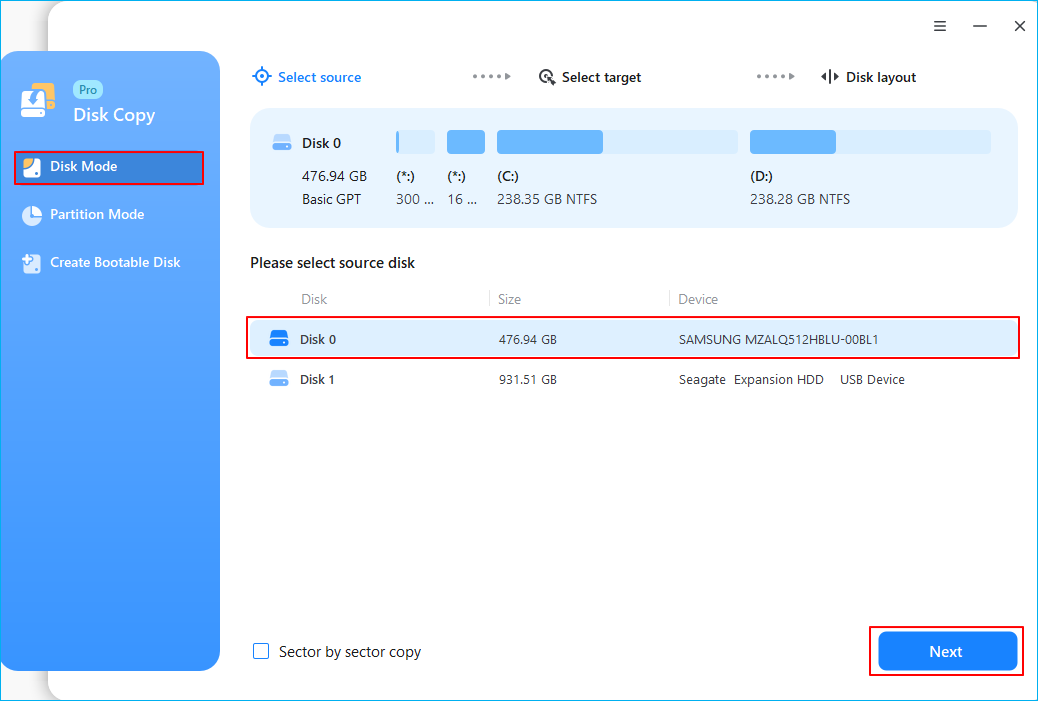
Step 2. Select Source and Target Drives
- Select the HDD as the source disk.
- Select the SSD as the destination disk.
Step 3. Adjust Disk Layout (Optional)
- Choose "Autofit the disk" to make full use of the larger capacity on the target disk.
- Choose "Copy as the source" to use the "Sector-by-sector copy" feature.
- Choose "Edit disk layout" to manually resize the layout on destination drive.
Step 4. Start Cloning
- Confirm the warning message (all data on the destination disk will be wiped) and start cloning.
- Wait for the cloning process to be done.
- After cloning, all your data will be transferred to the new disk, including data, Windows, settings, and programs.
After this, insert your new SSD into your computer, reboot the PC, and change the boot order in BIOS to set computer to boot from new SSD with Windows 10 system:
- Restart the PC and press F2 or F8 to enter BIOS settings.
- In the Boot option, select the new SSD as the new boot drive and save all the changes.
- Exit BIOS and restart the computer; you should be able to see Windows 10 running on your new disk without any problems.
Tips About Cloned SSD Won't Boot:
Method 1: Change HDD or fix the source disk error.
The HDD hard drive itself may have disk errors. You shall change a new HDD disk or fixing HDD errors before cloning to a smaller SSD.
Method 2: Do not take out HDD to another computer.
If you insert HDD to another computer, the HDD's operating environment will change, so your cloned SSD won't boot after cloning hard drive to smaller SSD.
Method 3: Use a common sata cable for connecting SSD.
If you use a USB cable to connect the target hard drive, the computer will recognize it as an external disk. So, the cloned disk won't boot after the cloning process is completed.
To Wrap Things Up
This article details how to clone OS from HDD to smaller SSD via cloning. Cloning can help you migrate Windows to smaller SSD without reinstalling the OS again or losing any data. To achieve this, you will need to find a reliable HDD to SSD cloning software because Windows does not have built-in cloning solutions.
EaseUS Disk Copy is an efficient cloning solution for all Windows PC users. It can help you clone HDD to smaller SSD or bigger SSD in just 3 steps. Download and try this easy-to-use OS migration software!
Free Download
Windows 11/10/8/7
FAQs on How to Clone HDD to Smaller SSD
1. How to clone a larger disk to a smaller one?
To clone a larger disk to a smaller one, you must turn to professional disk clone software, such as Clonezilla or EaseUS Disk Copy, for help. This is because Windows has no built-in cloning solutions.
2. How long does it take to clone a 1TB hard drive to SSD?
It depends. It will take about 1 or 2 hours. The data size and method of transfer will affect the transferring speed largely.
3. What to do before cloning HDD to SSD?
Check the hard drive's storage. Ensure that there is adequate space on the hard drive you are copying to accommodate all of your data on the old drive. Space issues are common, especially when switching from an HDD to an SSD. If the previous HDD with a capacity of 1TB, make sure your new SSD can accommodate the 1TB capacity.
4. Can I clone a 1TB HDD to a 500GB SSD?
Yes. You can clone a 1TB HDD to a 500GB SSD if the data and required partitions being transferred fit within the target SSD's available capacity.
5. Does the target SSD need to be larger than the source HDD?
No. The target SSD does not necessarily need to match the source HDD's total capacity. What matters is whether the data and partitions being cloned can fit on the destination drive.
6. Why does cloning to a smaller SSD fail?
Cloning may fail if the used data exceeds the destination capacity, the source partitions cannot be resized appropriately, or the target SSD is not properly recognized. Check the source disk's used space, partition layout, and SSD compatibility before trying again.
-
Updated by
Tracy became a member of the EaseUS content team in 2013. Being a technical writer for over 10 years, she is enthusiastic about sharing tips to assist readers in resolving complex issues in disk management, file transfer, PC & Mac performance optimization, etc., like an expert.…Read full bio