

Page Table of Contents

- 🚀Quick Answer: How to Clone NVMe SSD to NVMe SSD with EaseUS Disk Copy
- 1️⃣Step 1. Download and install EaseUS Disk Copy.
- 2️⃣Step 2. Connect the new NVme SSD to your computer.
- 3️⃣Step 3. Run EaseUS NVMe cloning software.
- 4️⃣Step 4. In Disk Mode, select old NVMe SSD as the source disk and click Next.
- 5️⃣Step 5. Select new NVMe SSD as the target disk and click Next.
- 6️⃣Step 6. Adjust the disk layout and click Proceed to clone NVMe drive.
Running out of space on your NVMe SSD or upgrading to a larger, faster drive? You don't have to reinstall Windows, applications, and files from scratch. Cloning your NVMe SSD to a new NVMe SSD lets you transfer your entire system to the new drive and keep your existing setup.
This guide shows you how to clone NVMe SSD to NVMe SSD step by step, including how to prepare the new drive, clone your data, and boot from the cloned SSD successfully

For anyone planning an NVMe SSD upgrade, we documented the all-in-one clone disk manual here.
What to Prepare for NVMe to NVMe Cloning
Before cloning, you need to prepare certain hardware and software to transfer data from one NVMe to another seamlessly.
1. A new NVMe SSD
Choose an SSD that is compatible with your computer and has enough space for the data you want to clone. If the target SSD already contains files, back them up first, as cloning will overwrite the target drive.
2. A way to connect the new SSD
If your computer has only one M.2 slot, use a compatible M.2 NVMe enclosure or USB-to-NVMe adapter to connect the new SSD externally. If you have two available M.2 slots, you can install both SSDs directly.
3. NVMe cloning software
Windows does not provide a built-in tool for cloning an entire NVMe SSD. A dedicated cloning tool such as EaseUS Disk Copy can copy the OS, applications, files, and required partitions to the new SSD in a few steps.
 Free Download
Windows 11/10/8/7
NVMe SSD Compatibility Checklist
An M.2 slot that does not support the required PCIe/NVMe interface may not detect the new SSD at all. PCIe lane allocation can also affect performance and compatibility. Before you install the new drive, check these items to avoid compatibility problems.
| M.2 size | Make sure the physical size, such as 2280, fits your device. |
| Interface | Confirm the M.2 slot supports PCIe/NVMe. |
| PCIe generation | Check whether your motherboard supports PCIe 3.0, 4.0, or 5.0. |
| PCIe lanes | Verify the M.2 slot provides the lanes required by the SSD. |
| Boot support | Make sure the system supports booting from an NVMe SSD. |
| Available slot | Check whether you have a second M.2 slot or need an external enclosure. |
Important: Don't assume that every M.2 slot supports every M.2 SSD. Always check your motherboard or laptop specifications.
How to Clone NVMe to NVMe SSD in Windows 11/10
Now, it's time to clone your NVMe SSD. Download the EaseUS Disk Copy from the button below, and follow the guide step-by-step to clone NVMe drive to a target NVMe disk.
Before cloning:
- If your computer has only one SSD slot, connect the target SSD to your machine via a USB-to-SATA/NVMe adapter.
- If your computer has an extra slot, install the target SSD into the empty slot properly, making sure it is compatible.
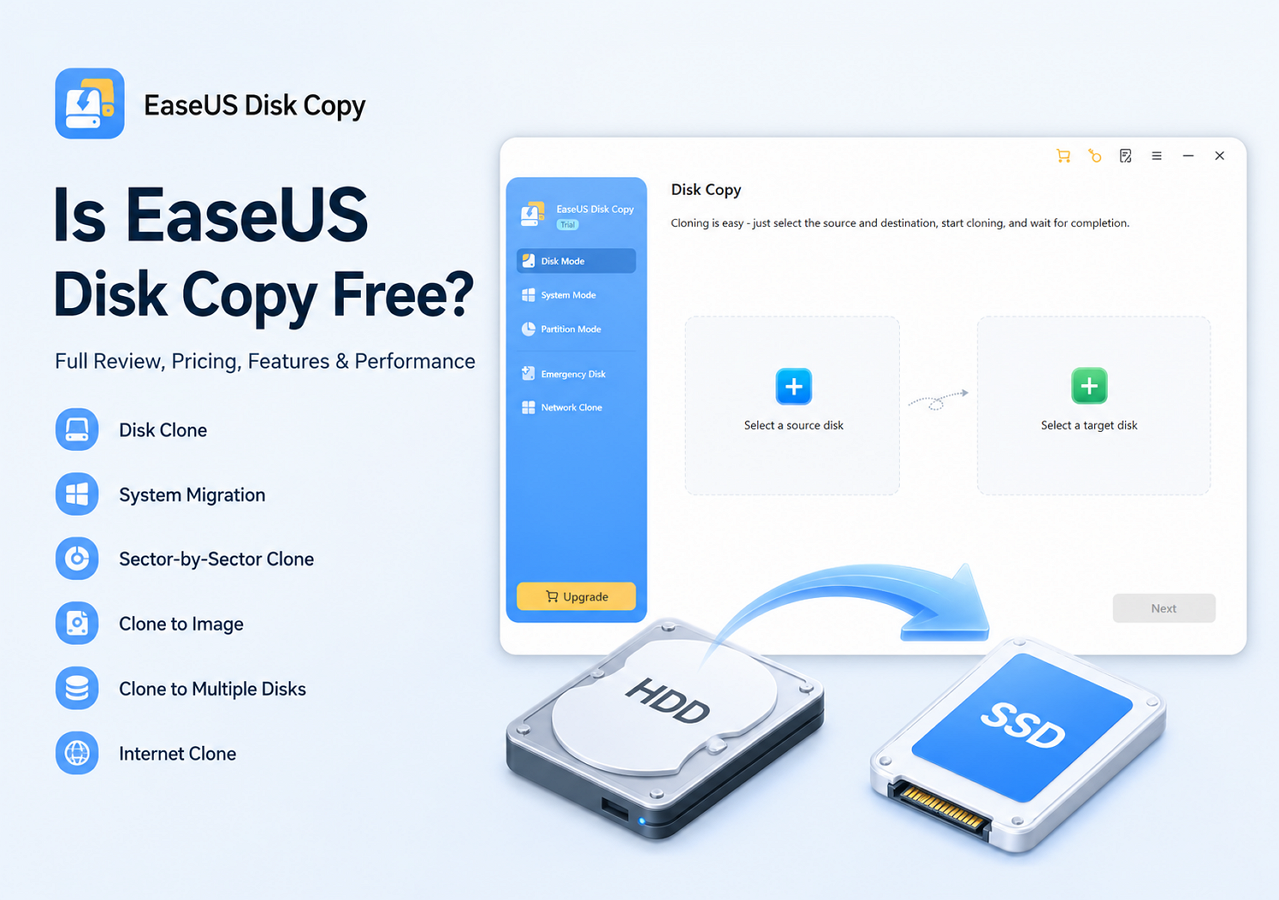
Step 1. Launch EaseUS Disk Copy and choose Disk Mode.
Install EaseUS Disk Copy SSD cloning software on your Windows computer, launch it, and choose Disk Mode.
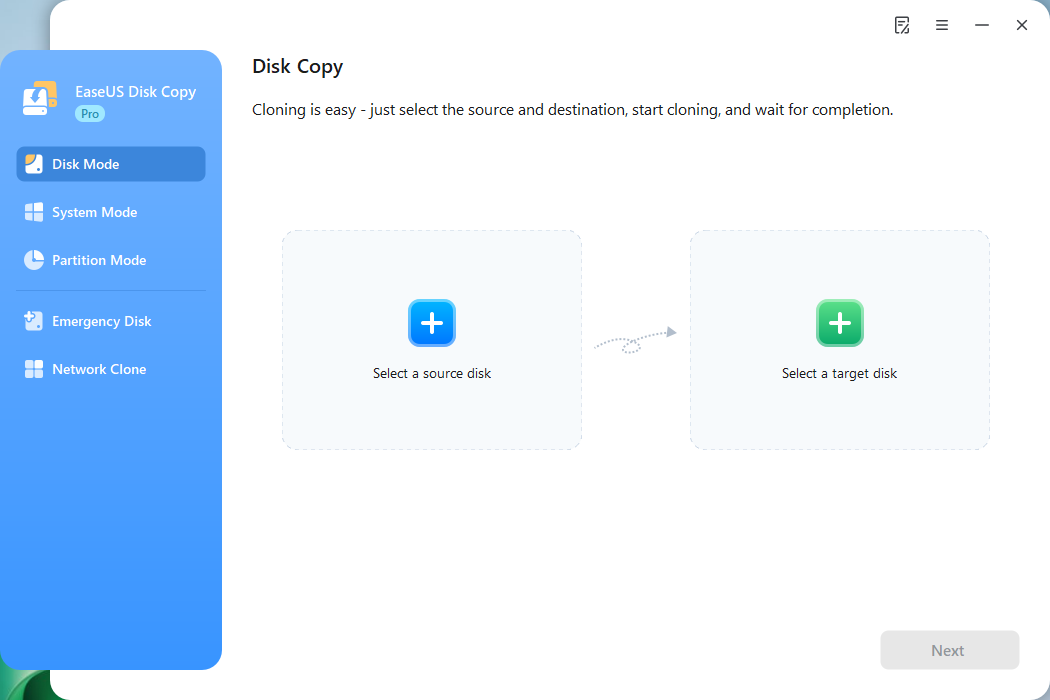
Step 2. Select the source and target SSDs.
- Source - the old/smaller SSD you want to make a copy.
- Destination - the new/larger SSD that you want to clone data to.
*Note that the used space of the source disk should be less than the target disk capacity.
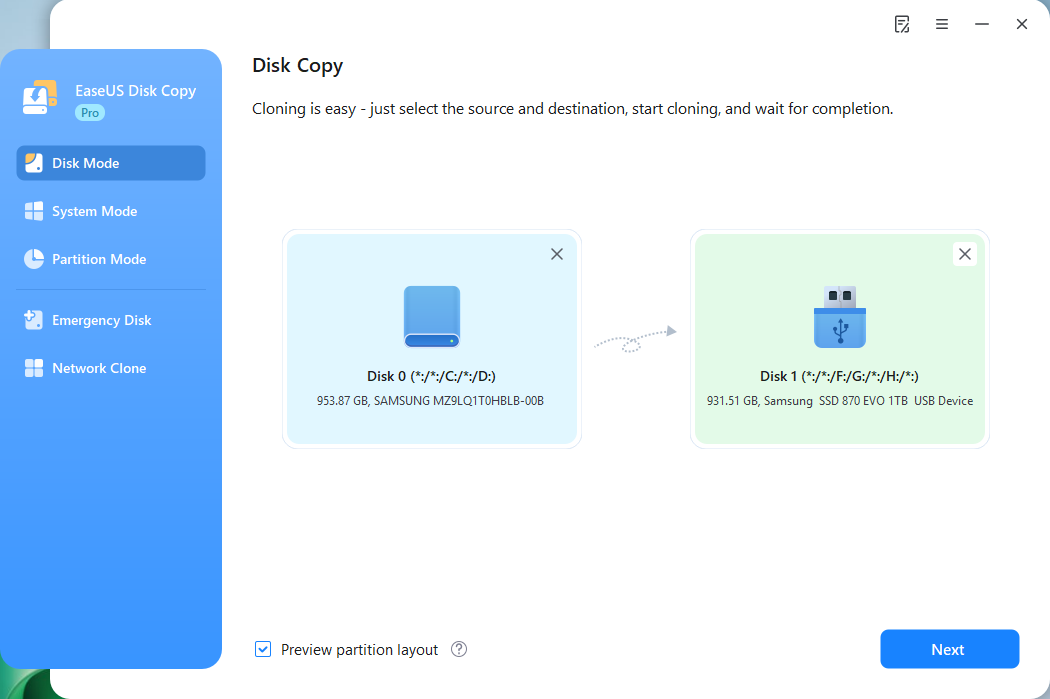
Step 3. Adjust target SSD layout.
Specify the SSD layout as your preference. You can choose among:
- Autofit the disk: makes some changes by default on the destination disk layout so that it can work at its best.
- Copy as the source: create a 1-to-1 copy of your source disk, the layout is the same as the source disk.
- Edit disk layout: allows you to manually resize/move the partition layout on this destination disk.

*The option "Auto-alignment to 4K" will be checked automatically to optimize the performance of your SSD.
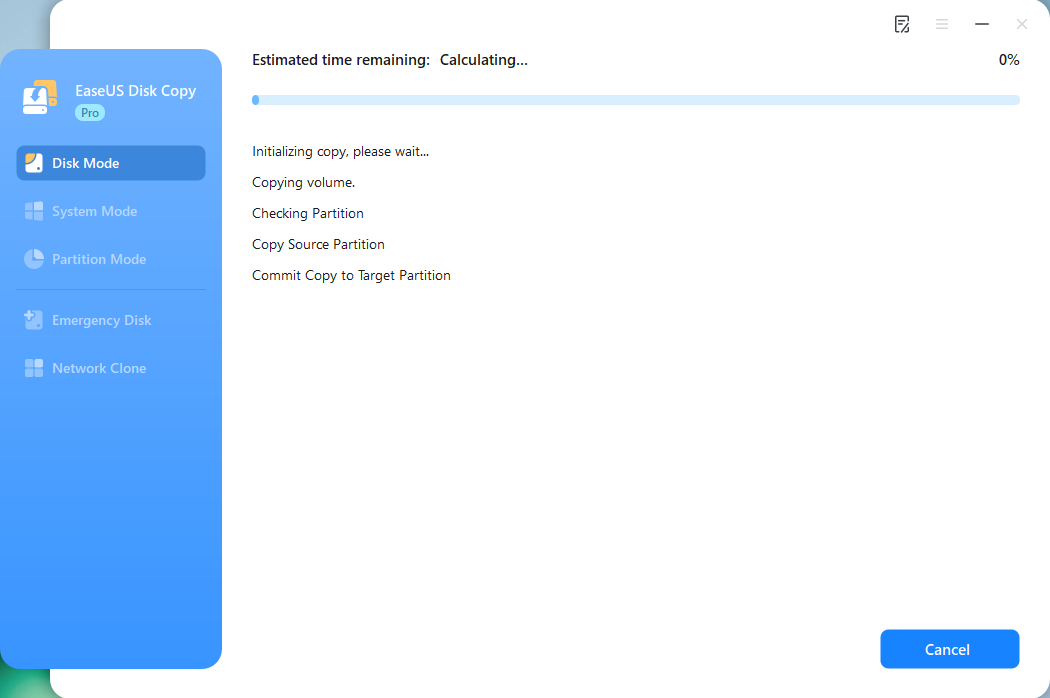
Step 4. Start cloning.
Click Proceed, and a message will appear, warning you that data will be lost. Confirm the message by clicking Continue. Now, it will start executing the SSD cloning task.

Now, it will start executing the SSD cloning task.
📽️Video Tutorial
If you want a video guide, this 90s YouTube video shows you how to easily perform an NVMe to NVMe cloning operation to move all your data to a new SSD, ensuring a seamless ssd clone without reinstalling Windows.
If you like this post, you can share it on your social platforms to help more people.

Bonus: Clone NVMe SSD with SSD Duplicator
When it comes to NVMe SSD cloning, many users may think of using disk duplicator. Cloning an NVMe SSD with an SSD duplicator is a fast and efficient way to create an exact copy of your drive. These devices support high-speed transfers, ensuring minimal downtime. Simply connect both drives, initiate the duplication process, and enjoy a seamless, bit-for-bit replica without needing a computer.
There are many kinds of SSD duplicators/cloners out there, and their prices range from tens of dollars to hundreds of dollars. Purchase one from platforms like Amazon, and use it to clone an NVMe SSD to another NVMe SSD.
⚠️While using a duplicator to clone an NVMe SSD, it may have the following limitations:
- You can't adjust or resize the disk layout of the new NVMe SSD.
- Some dedicated duplicators can cost hundreds of dollars.
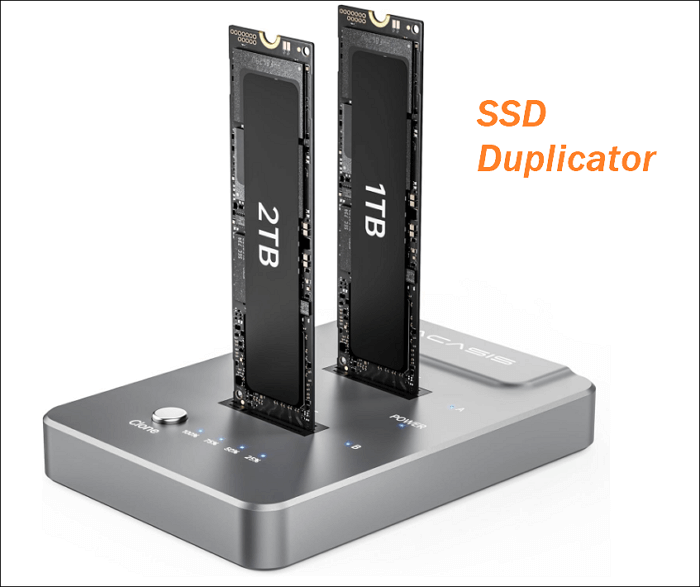
Step 1. Take the old NVMe SSD out of your computer or laptop.
Step 2. Install both NVMe SSDs into the duplicator, and follow the cloner's instructions to copy the SSD.
Step 3. When the cloning process is complete, remove both SSDs and install the cloned one on your computer.
How to Boot From the Cloned NVMe SSD
Cloning the data successfully does not always mean the computer will automatically boot from the new drive.
If You Replace the Old NVMe SSD
After shutting down the computer, remove the old SSD and install the cloned NVMe SSD in its place. On a compatible system, Windows should normally boot from the new drive.
If You Keep Both NVMe SSDs
Restart the computer and enter BIOS/UEFI. Depending on your motherboard, this may require pressing F2, Delete, F10, F11, or another key during startup.Then:
- Open the Boot settings.
- Find Windows Boot Manager associated with the new NVMe SSD.
- Move it to the top of the boot order.
- Save the changes and restart.
NVMe boot support depends on the system firmware and configuration. Older systems may require UEFI support or firmware updates to boot from a PCIe NVMe SSD.
Cloned NVMe SSD Won't Boot: What to Check
If the cloning process completes but Windows does not start from the new NVMe SSD, check the following.
- Check the Boot Order - Make sure the new SSD or its Windows Boot Manager entry is selected as the first boot option.
- Check UEFI Settings - Modern Windows installations commonly use UEFI-based boot configurations. Make sure the firmware boot mode is compatible with the cloned system. NVMe booting is dependent on appropriate UEFI and firmware support.
- Make Sure the Required System Partitions Were Cloned - Don't assume that copying only the C: drive is enough to create a bootable Windows SSD. A Windows installation may also rely on an EFI/System partition and other system partitions. For a complete disk migration, cloning the entire source disk is generally safer than copying only personal files or the C: partition.
- Temporarily Disconnect the Old SSD - If both SSDs are installed, temporarily disconnecting the old drive can help determine whether the computer is actually booting from the new SSD.
Once the new drive boots correctly, you can reconnect or repurpose the old SSD.
If you like this post, you can share it on your social platforms to help more people.
Will Cloning Make a New NVMe SSD Faster?
Not necessarily. Cloning transfers your existing system to another drive, but it does not change the hardware limitations of your computer. For example, if you install a PCIe 4.0 NVMe SSD in a system that only supports PCIe 3.0 on that M.2 slot, the SSD will operate within the supported PCIe configuration rather than at its full PCIe 4.0 capability. PCIe lane availability can also affect performance.
If the new SSD is not performing as expected, check:
- PCIe generation supported by the motherboard
- M.2 slot specifications
- PCIe lane configuration
- SSD firmware
- SSD temperature
- Available free space
In other words, cloning changes where your data is stored; it does not upgrade the PCIe interface itself.
FAQs
1. Does cloning a drive make it bootable?
Yes, your hard drive will become bootable after cloning. Cloning a hard drive entails making an exact duplicate of the original disk, complete with the operating system, programs, and settings.
2. How do I migrate from NVMe to NVMe Windows 10?
If you want to migrate your Windows 10 from NVMe to another, you can use professional disk clone software, like EaseUS Disk Copy or Clonezilla, to help you. It allows you to migrate Windows from one SSD to another without Windows reinstallation.
3. Can you transfer data from one m 2 SSD to another?
You can transfer data from one M.2 SSD to another SATA SSD by cloning. But you must use professional disk cloning software, like EaseUS Disk Copy. This is because Windows does not offer such a tool to help you.
4. Can you combine two NVMe SSDs?
Yes. Two NVMe SSDs can be combined using RAID. Most systems support RAID 0 for speed or RAID 1 for redundancy when using matching NVMe drives. This requires motherboard or BIOS support, and combining drives erases all data during setup, so proper backups are essential.
5. What is the lifespan of an NVMe drive?
NVMe SSD lifespan depends on TBW ratings, NAND type, and usage patterns. Most consumer NVMe drives last 5–10 years under typical workloads. Modern controllers and wear-leveling significantly extend endurance, and SMART monitoring helps track remaining health over time.
Conclusion
That's it! Now you know how to clone NVMe SSD to NVMe SSD. The improvisation in SSDs has offered multiple benefits to users. You can pick an NVMe SSD and work without any hassle. The throughput speed and low latency features of the NVMe SSD make it a better alternative than a standard SATA SSD. Also, you can clone the entire content of your storage device into a new target disk.
EaseUS Disk Copy offers simple steps and a minimal interface for a unique experience for the cloning process. If your origialnal NVMe drive is your system drive, you can boot from the cloned SSD after cloning. You can also back up your data with the help of software before initiating the cloning process.
Free Download
Windows 11/10/8/7
-
Updated by
Jean is recognized as one of the most professional writers in EaseUS. She has kept improving her writing skills over the past 10 years and helped millions of her readers solve their tech problems on PC, Mac, and iOS devices. …Read full bio