

Page Table of Contents

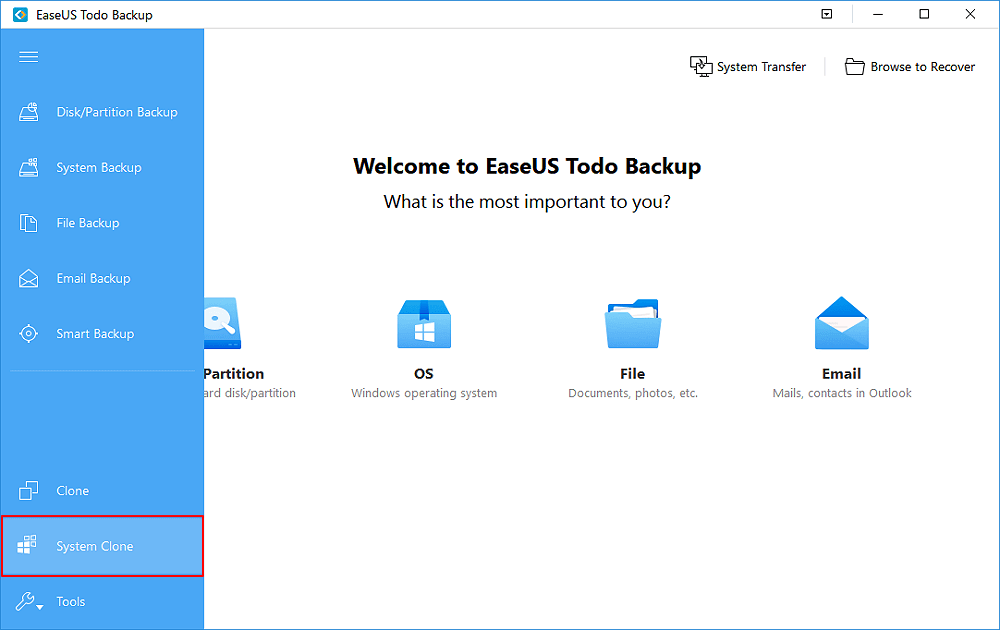
EaseUS Clone vs System Clone
Customers who downloaded the latest version of EaseUS Disk Copy would greatly benefit from the its robust feature, which is called "System clone".
What's the special existence of "system clone"? Besides the largely demanded file backup, disk/partition backup and mail backup, EaseUS Disk Copy software's HDD/ SSD to SSD cloning feature helps customers resolve many complex migration affairs, especially when they need to upgrade hard disk from an old to a new, a smaller to a larger or a hard disk drive to a solid state drive, however, strong demand not reinstalling OS.
So, EaseUS Todo Backup offers a smart choice for its users to do system clone, whether they're trying to migrate OS from the original hard drive to a Samsung, Kingston, Seagate, Crucial or SanDisk SSD, they can easily accomplish the job by only one-click.
 Free Download
Windows 11/10/8/7
How to Migrate OS to HDD/SSD, Clone System Drive to HDD/SSD
To do system clone on two separate disk partitions, there are some tips that shall raise your attention.
- If the source disk contains the system partition, please shut down the computer after the clone.
- To remove either the source disk or destination disk from the computer to make the computer boot normally if the source disk contains boot partition.
- If you want to boot from the destination disk, we recommend you to replace the source disk with the destination disk.
- If the computer fails to boot from the destination disk after the clone, we suggest you clone the source disk to another disk with the same HDD interface.
- If you choose to clone a hidden partition, the cloned one will be unhidden.
Detail steps for OS migration:
Before cloning:
- Install or connect the destination disk that you want to move OS to your computer, and make sure it can be appropriately recognized.
- Ensure the target HDD or SSD has enough capacity to accommodate your system files.
Step 1. Launch EaseUS Disk Copy and choose System Mode.
Install EaseUS Disk Copy system migration software on your computer, launch it, and choose System Mode. EaseUS Disk Copy will select the current system you use by default, including all system-related files and boot sectors.
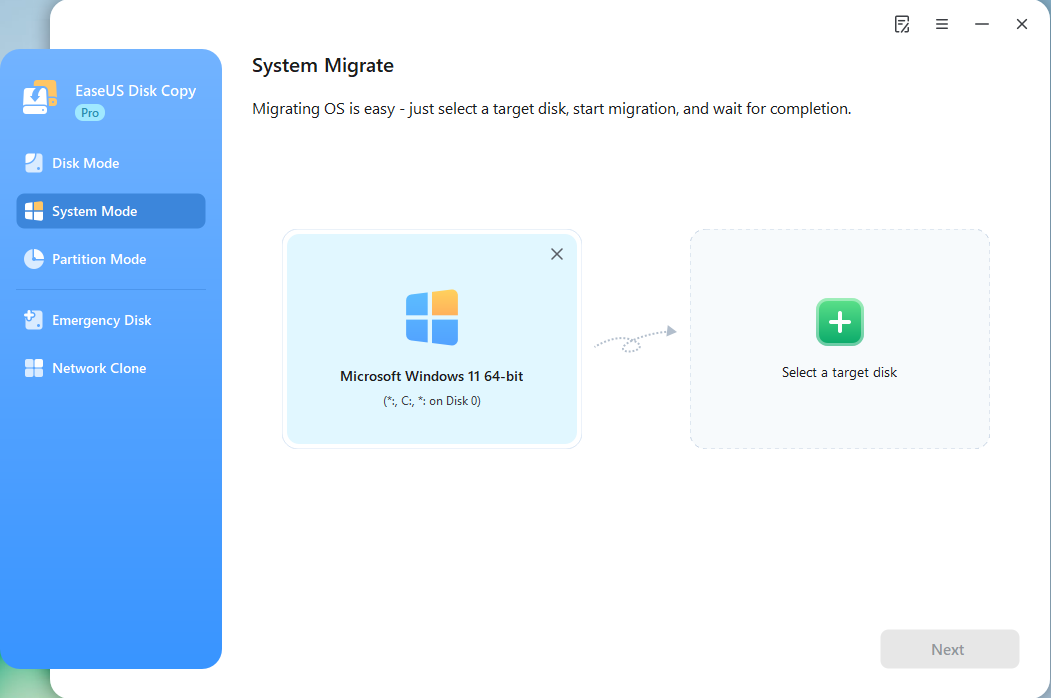
*If you apply dual-boot system, you can select another system by yourself.
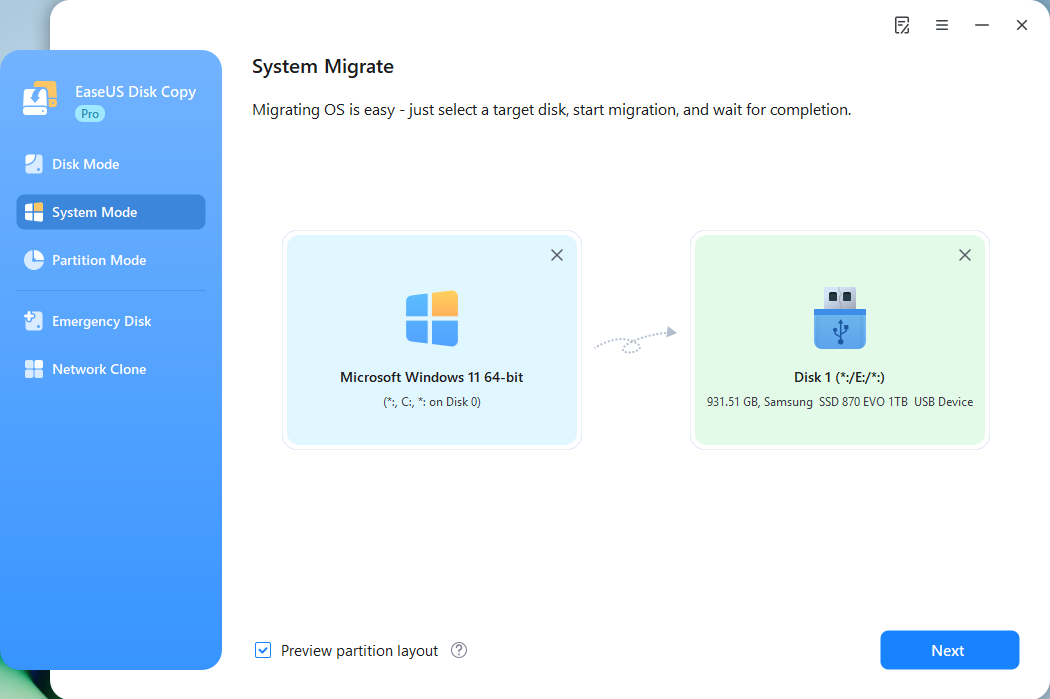
Step 2. Select the target HDD/SSD.
Choose the destination HDD/SSD that you want to move OS to.
Step 3. Adjust target disk layout.
Specify the target layout as your preference. You can choose among:
- Autofit the disk: makes some changes by default on the destination disk layout so that it can work at its best.
- Copy as the source: create a 1-to-1 copy of your source disk, the layout is the same as the source disk.
- Edit disk layout: allows you to manually resize/move the partition layout on this destination disk.
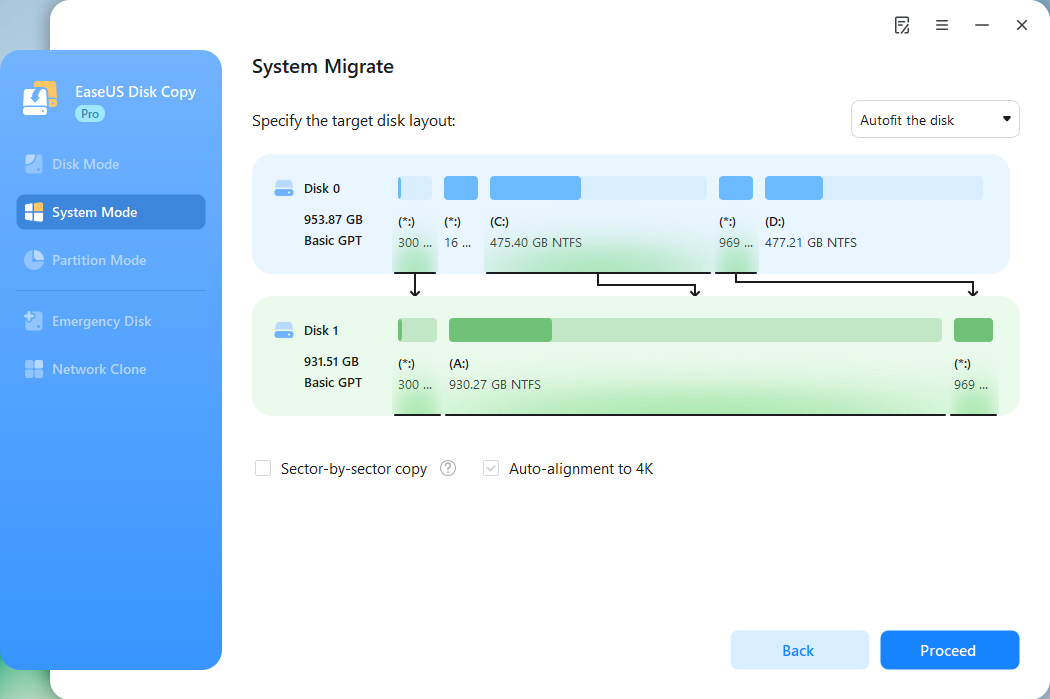
*The option Auto-alignment to 4K will be checked automatically to optimize the performance of your SSD.
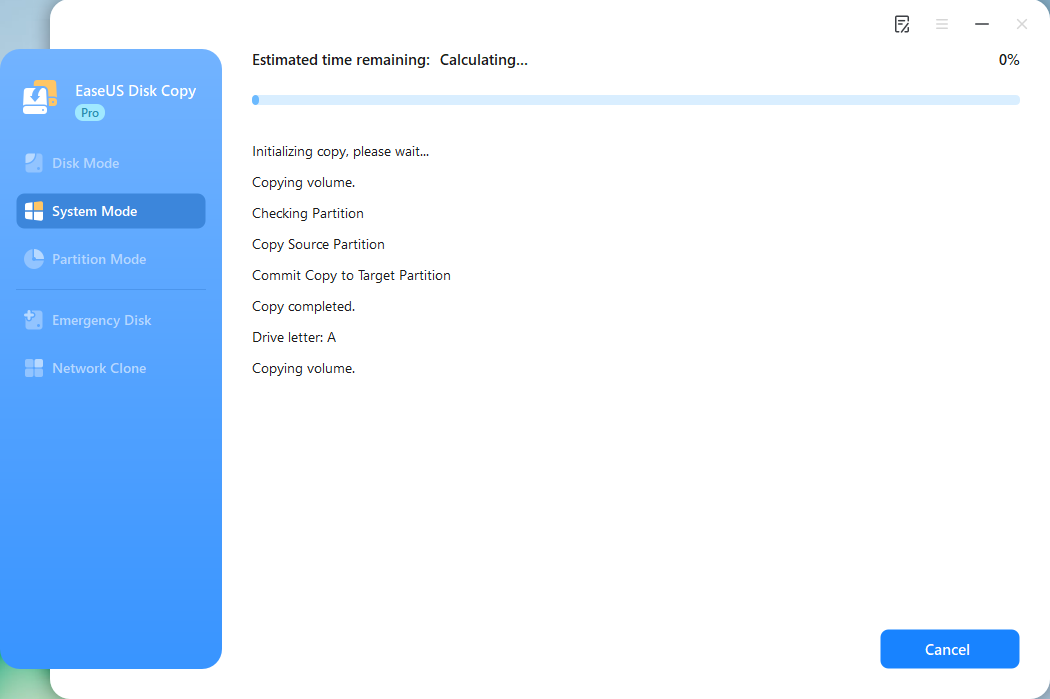
Step 4. Start cloning OS.
Click Proceed, and a message will appear, warning you that data will be lost. Confirm the message by clicking Continue. Now, it will start cloning OS to the new disk.
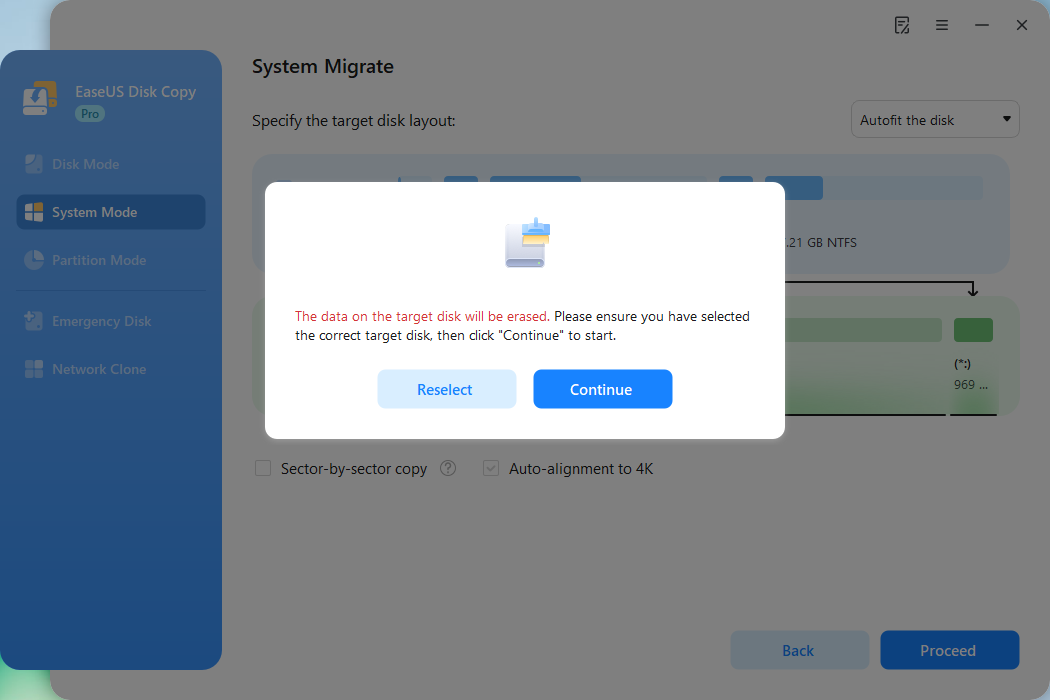
Now, it will start cloning OS to the new disk.
Conclusion
Migrating Windows to a new HDD or SSD doesn't have to mean reinstalling the operating system and applications from scratch. With a system cloning tool, you can transfer the Windows system, boot-related files, and other required data to a new drive in a few simple steps.
EaseUS Disk Copy's System Mode simplifies the process by automatically selecting the current Windows system and allowing you to choose a destination HDD or SSD. Before starting the clone, make sure the target drive is properly connected, recognized by the computer, and has enough capacity for the system files. You can also adjust the destination disk layout according to your needs.
Whether you are upgrading from an HDD to an SSD, replacing an old drive, or moving Windows to a larger disk, system cloning provides a convenient way to migrate your operating system without performing a fresh Windows installation.
Free Download
Windows 11/10/8/7
FAQs
1. What is system cloning?
System cloning is the process of copying an operating system and its required system and boot files from one drive to another. It allows you to migrate Windows to a new HDD or SSD without reinstalling the operating system.
2. What is the difference between system clone and disk clone?
A system clone focuses on migrating the operating system and related files needed to boot Windows, while a disk clone creates a copy of the source disk and its partitions. System cloning can be useful when your primary goal is to move Windows to a new HDD or SSD.
3. Can I clone Windows from an HDD to an SSD?
Yes. You can migrate Windows from an HDD to an SSD using system cloning software. Before cloning, make sure the SSD is properly connected and recognized by the computer and has enough capacity to accommodate the system files.
4. Do I need to reinstall Windows after cloning to an SSD?
No. System cloning is designed to migrate the existing Windows installation to another drive, so you can avoid performing a fresh Windows installation. After cloning, you may need to set the new drive as the boot drive or replace the original drive so that the computer boots from the cloned disk.
-
Updated by
Jean is recognized as one of the most professional writers in EaseUS. She has kept improving her writing skills over the past 10 years and helped millions of her readers solve their tech problems on PC, Mac, and iOS devices. …Read full bio