


Content
Page Table of Contents
About the Author
Hot Topics
- Apply to:
- 🔥Add disk space to the C drive from another disk
- 🔔Extend C drive with new SSD/HDD
- 🎞️Increase C drive space when extend volume greyed out
- 🧑💻Extend C drive with nonadjacent partition
- 🧩Extend C drive with unallocated space
Can I Extend C Drive From Another Disk?
We found many similar cases on Microsoft and Super User.
So, is it possible to extend the C: drive from a different physical disk? No. You cannot directly extend the C: partition using unallocated space from a completely separate physical disk. Windows Disk Management can only extend a partition with unallocated space on the same physical disk, and the unallocated space must be immediately after the partition.
For example, if your C: partition is on Disk 0 and you have 500 GB of unallocated space on Disk 1, Windows cannot add that 500 GB directly to C:.
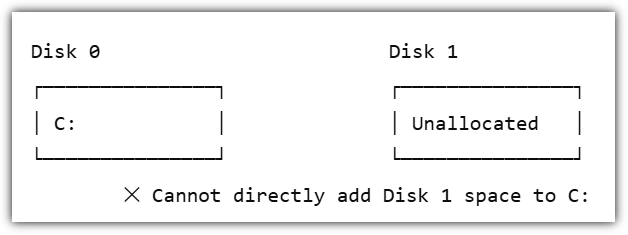
However, "another disk" and "another drive" are not necessarily the same thing. A single physical disk can contain multiple partitions or volumes, such as C: and D:. If the available space is on the same physical disk as C:, you may be able to use it to extend C:.
For example:
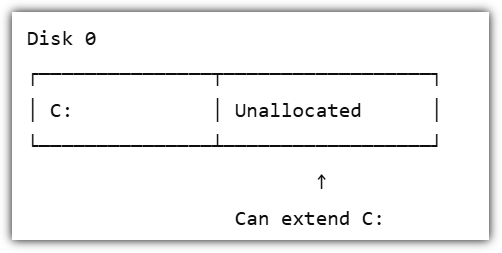
In short:
| Where is the available space | Can you directly extend C: |
|---|---|
| Unallocated space immediately after C: on the same disk |
Yes |
| Unallocated space on the same disk but separated by another partition | Yes, with third-party partition manager software. (Disk Management can't do it directly) |
| Free space inside D: on the same disk | Yes, but D: must first be resized to create unallocated space |
| Unallocated space on another physical disk | No, but you can move data or migrate Windows |
Share this post to help more people if you found it helpful.

What If the Free Space Is on Another SSD or HDD?
If you cannot directly add the space on a second SSD or HDD to your C: partition, you can still use that disk to reduce the amount of data stored on C:. The best method depends on what is taking up space and whether you want a quick fix or a more permanent solution.
Method 1: Move Personal Files to the Second Disk
If large personal files are filling up your C: drive, moving Windows user folders to the second disk is a straightforward way to free up space. You can move folders such as Documents, Downloads, Pictures, and Videos without changing the location of Windows itself.
- Open File Explorer and go to Home > Documents.
- Right-click Documents and select Properties.
- Open the Location tab and click Move....
- Select a folder on your second SSD or HDD, then click Select Folder.
- Click Apply, then select Yes when Windows asks whether you want to move the existing files.
- Repeat the process for other supported user folders, such as Downloads, Pictures, and Videos.
This method frees up space on C: while keeping your personal files accessible from their usual Windows folders. However, it does not increase the capacity of the C: partition. It simply moves your data to another disk so that less space is used on C:.
Method 2: Batch Transfer Files/Folders/Apps to Another Disk
Instead of manually moving folders to another disk one by one, EaseUS Partition Master lets you batch-transfer programs, large files, games, and other data from the current disk to a different disk.
Step 1. Launch EaseUS Partition Master, navigate to "Partition Manager," right-click the C drive, and select "Data Migration."
Step 2. Select the data (such as large apps and games) that takes up much disk space and click "Next" to continue.
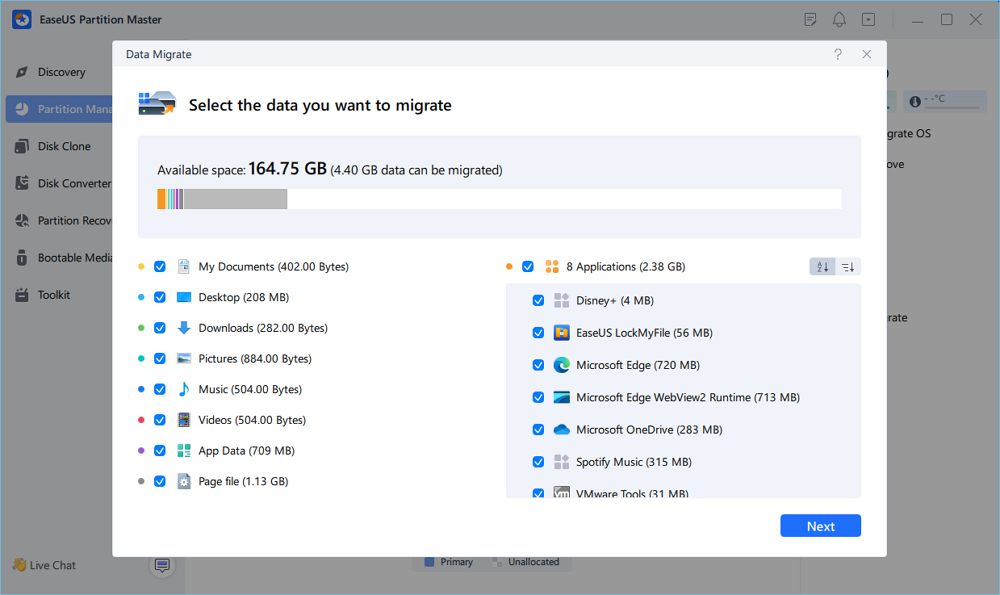
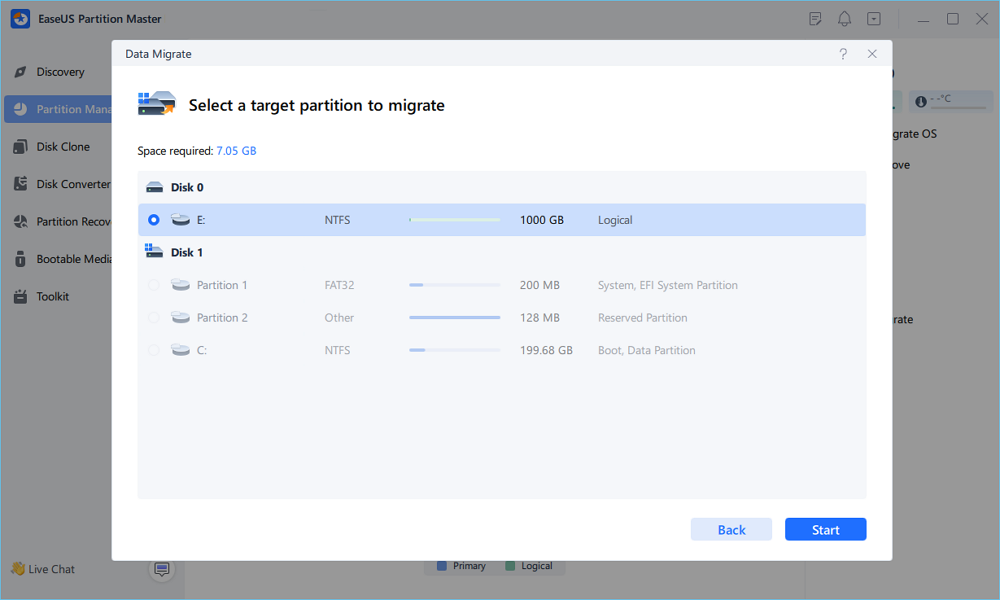
Step 3. Select a target partition on another disk to migrate and click "Start" to execute the task. After the migration, the files or applications are moved to the target partition, freeing up space on the C: drive.
Method 3: Clone Windows to a Larger SSD
Moving personal files is useful when data is the main reason your C: drive is running low. But if the entire system disk is too small, a larger SSD is a more permanent solution. A larger SSD gives Windows more physical disk capacity for the system partition. This is different from adding capacity from a second physical disk to the existing C: partition.
For example, if Windows is installed on a 128 GB SSD and you have upgraded to a 1 TB SSD, you can clone or migrate the existing system to the larger drive. In this case, EaseUS Partition Master can help.
- Notice:
- Back up important files before cloning or migrating a system disk. Also, make sure the new SSD has enough capacity for the data being transferred.
- Install the new, larger SSD in your computer, or connect it using a suitable adapter or enclosure.
- Install and open the disk cloning software - EaseUS Partition Master. Navigate to "Disk Clone" and select "Clone OS Disk."
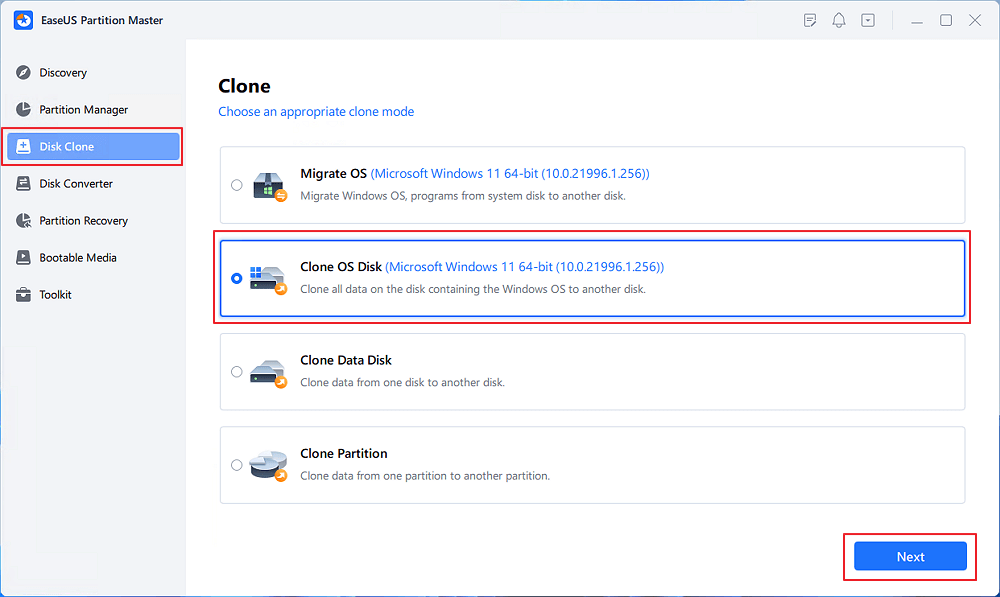
- Select the source disk and the destination disk correctly. Click Start. During the cloning process, adjust the destination partition size so that the C: partition can use the additional space on the larger SSD.
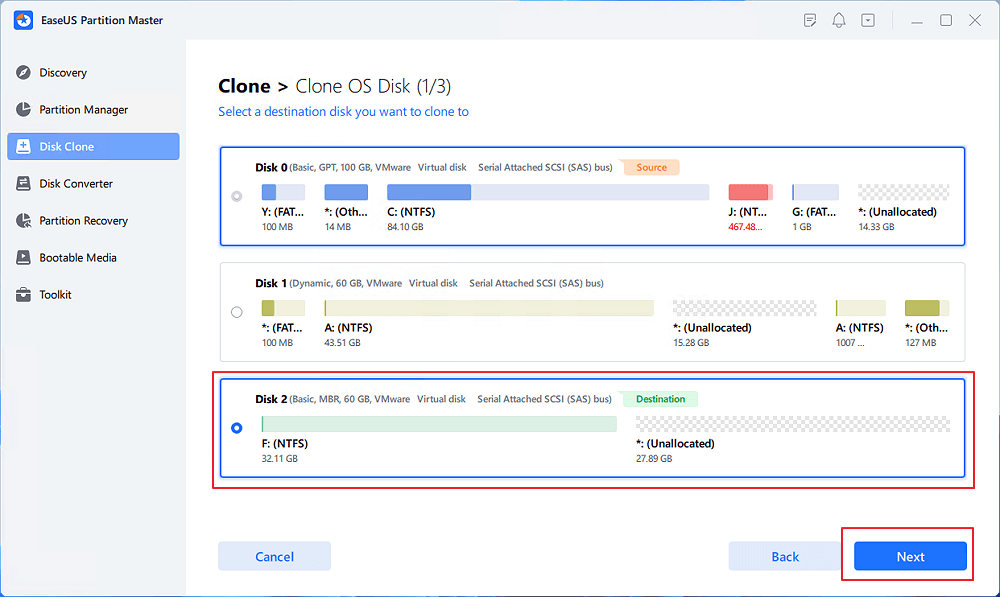
- After the operation is complete, shut down the computer and configure it to boot from the new SSD.
- Once Windows starts successfully from the new drive, verify that your files, applications, and system settings are intact before wiping or reusing the old disk.
After the migration, you can use the additional capacity for the Windows system and C: partition instead of trying to combine two separate physical disks.
Method 4: Change Where New Apps and Files Are Saved
If you have already moved existing data but C: continues to fill up, changing Windows' default storage locations can help prevent the same problem from happening again.
Windows allows you to choose another drive for certain types of new content, including apps and personal files.
- Press Windows + I to open Settings.
- Go to System > Storage.
- Select Advanced storage settings > Where new content is saved.
- Choose your second disk from the drop-down menu for the types of content you want to store there.
- Apply the changes and use the new location for future files or supported apps.
This approach is most useful as a long-term space-management measure. Instead of repeatedly cleaning up a nearly full C: drive, you can direct supported new content to the larger secondary disk.
💡Keep in mind: changing the default save location does not move everything off C:. Windows and some applications will continue to use the system drive for system files, updates, caches, and other data.
How to Extend C Drive Using Space From Another Partition
If the available space is on another partition of the same physical disk, you may be able to use it to extend C:. The process depends on where the unallocated space is located and whether it is adjacent to the C: partition. EaseUS Partition Master can resize or move partitions when Windows Disk Management cannot extend C: directly.
Select one based on your case:
Here, you can get an in-depth guide and some notes. Remember not to select external devices during execution, and do not abort partition creation.
Guide 1. Extend C Drive With Non-Adjacent Unallocated Space.
- Time: Around 1Min
- Difficulty: Low
- Appy to: C drive gets full but unable to extend it with unallocated space.
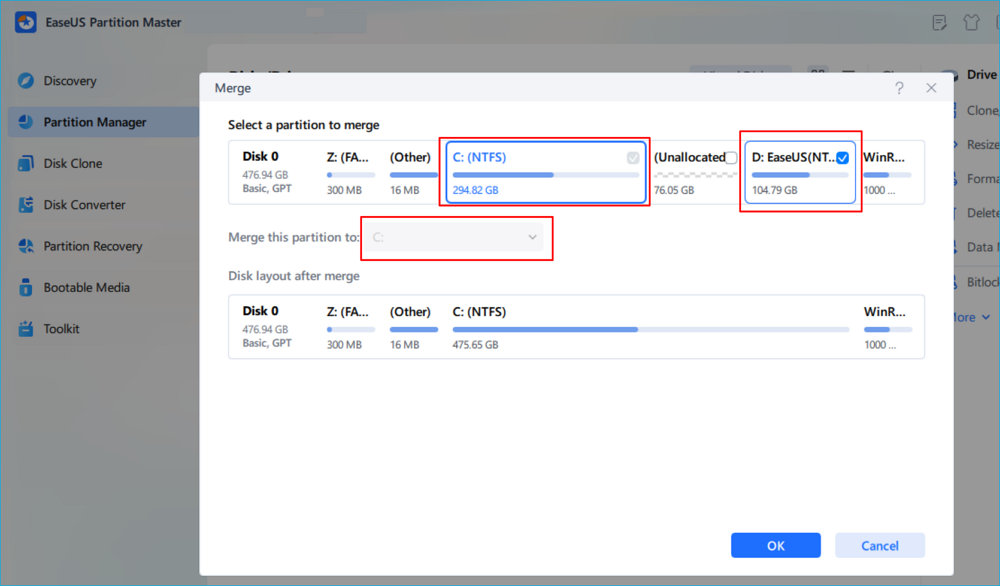
Step 1. Go to Partition Manager, right-click the C drive, and select "Merge." Then, select the target non-adjacent partition to merge and click "OK".
Step 2. Select the C drive as the target partition you want to keep, and click "OK" to merge the non-adjacent partition into the C drive.
Step 3. Click the "Execute Task" button and click "Apply" to start merging partitions.
Can You Extend C Drive With Windows Disk Management?
Yes, but only when suitable unallocated space is immediately after the C: partition on the same physical disk. If another volume, such as a recovery, EFI, or other protected partition, is in the way, Disk Management cannot extend C.
In practice:
- You cannot shrink D, E, or F and directly add that space to the C drive.
- Windows Disk Management cannot move partitions, so unallocated space created by shrinking a distant partition cannot be merged with C.
- To safely extend the C partition when the unallocated space is not adjacent, you typically need a third-party partition tool such as EaseUS Partition Master.
Guide 2. Extend C Drive From D Drive
If D: is another partition on the same physical disk as C:, you can reduce space from D: and allocate it to C:. This does not combine two physical disks; it reallocates space between partitions on the same disk.
- Time: 1 Min - 3 Min
- Difficulty: Low
- Apply to: Extend volume greyed out and unable to increase C drive space
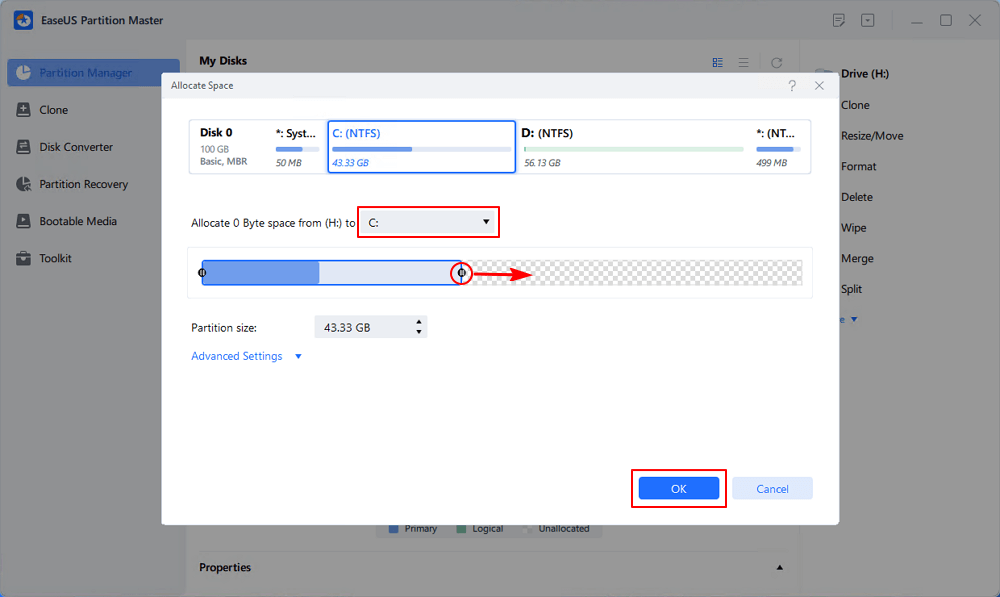
Step 1. Right-click on the D drive with enough free space and select "Allocate Space."
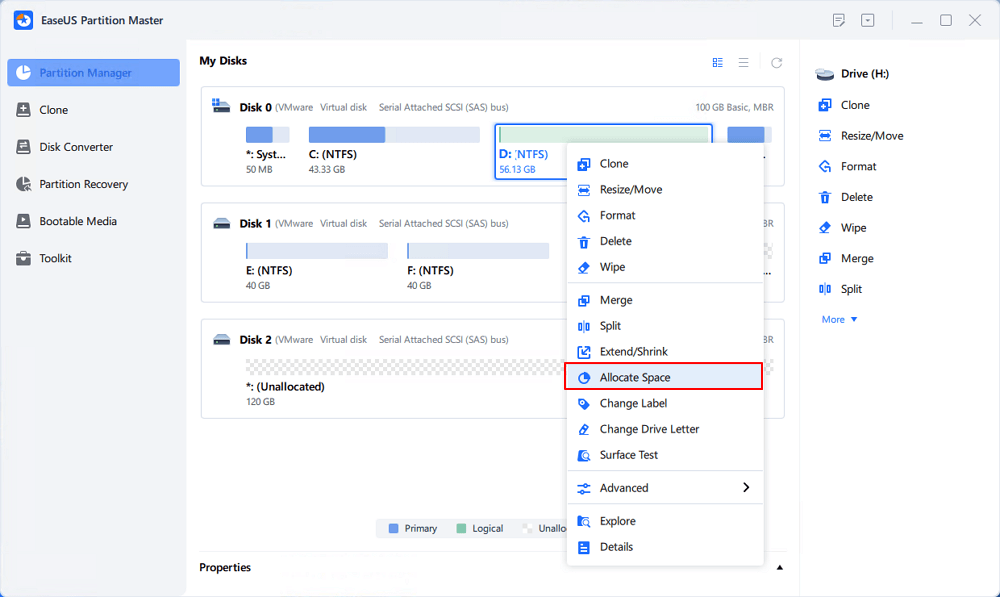
Step 2. Select the C: drive and drag the partition panel rightward to determine how much disk space you want to add to C from D. Then click "OK" to confirm. Finally, click "Execute Task" and click "Apply" to start moving free space from the D drive to the C drive.
Final Thoughts
If your goal is to free up space on C: using a second SSD or HDD, you can move personal files, apps, or games to the second disk. If your goal is to actually increase the capacity of the C: partition, the available space must be on the same physical disk, or you can migrate Windows to a larger SSD.
Extend C Drive From Another Disk FAQs
1. Can I extend the C: drive from another physical disk?
No. You cannot directly add unallocated space from a separate physical SSD or HDD to the existing C: partition. Windows requires the unallocated space to be on the same physical disk as C:.
If you have a second disk, you can instead move large files, apps, or games to it to free up space on C:. If the new SSD is larger than your current system disk, migrating or cloning Windows to the larger SSD is another option.
2. Can I extend the C: drive from the D: drive?
Yes, if C: and D: are partitions on the same physical disk. However, Windows Disk Management cannot directly take free space from D: and add it to C:.
You first need to shrink D: to create unallocated space, then make sure the unallocated space is positioned next to C:. A third-party partition manager can resize or move partitions when the unallocated space is not adjacent to C:.
3. Why is Extend Volume greyed out for the C: drive?
Extend Volume may be unavailable when there is no unallocated space immediately after the C: partition on the same physical disk. It can also happen when the available space is on another physical disk or another partition is located between C: and the unallocated space.
Check the partition layout in Disk Management before trying to extend C:. If the unallocated space is not adjacent to C:, you may need to resize or move the intervening partition.
4. Can I add a new SSD to increase C: drive space?
You cannot directly combine a new SSD with the existing C: partition to increase its capacity. A second SSD can, however, be used to store personal files, apps, games, and other data that would otherwise occupy space on C:.
If the new SSD is intended to replace a small system drive, you can migrate or clone Windows to the larger SSD and then use its additional capacity for the system partition.
5. How can I free up space on C: without deleting my files?
You can move large personal files and supported user folders to another disk, transfer large apps or games, or change Windows' default save locations for new content. These methods free up space on C: without deleting the data.
Keep in mind that freeing up space on C: does not increase the actual capacity of the C: partition. To increase the partition's capacity, you need suitable unallocated space on the same physical disk or need to migrate Windows to a larger disk.
How Can We Help You
About the Author

Sherly joined EaseUS in 2022 and she has always loved writing articles and enjoys the fun they bring. She receives professional training here, focusing on product performance and other relative knowledge. She has written over 200 articles to help people overcome computing issues.

Written by Tracy King
Tracy became a member of the EaseUS content team in 2013. Being a technical writer for over 10 years, she is enthusiastic about sharing tips to assist readers in resolving complex issues in disk management, file transfer, PC & Mac performance optimization, etc., like an expert.
Product Reviews
-
I love that the changes you make with EaseUS Partition Master Free aren't immediately applied to the disks. It makes it way easier to play out what will happen after you've made all the changes. I also think the overall look and feel of EaseUS Partition Master Free makes whatever you're doing with your computer's partitions easy.
Read More -
Partition Master Free can Resize, Move, Merge, Migrate, and Copy disks or partitions; convert to local, change label, defragment, check and explore partition; and much more. A premium upgrade adds free tech support and the ability to resize dynamic volumes.
Read More -
It won't hot image your drives or align them, but since it's coupled with a partition manager, it allows you do perform many tasks at once, instead of just cloning drives. You can move partitions around, resize them, defragment, and more, along with the other tools you'd expect from a cloning tool.
Read More
Related Articles
-
How to Extend C Drive in Windows Server 2019/2016
![author icon]() Tracy King/2026/09/16
Tracy King/2026/09/16 -
How to Increase C Drive Space in Windows Safely? 6 Fixes Here
![author icon]() Jean/2026/08/30
Jean/2026/08/30 -
How Do I Completely Wipe C Drive [Full Guide]
![author icon]() Oliver/2026/06/30
Oliver/2026/06/30 -
Why Can't shrink C Drive with All of the Space Free and How to Fix
![author icon]() Cici/2026/08/13
Cici/2026/08/13
 Jean/2026/08/30
  Oliver/2026/06/30
  Cici/2026/08/13