

Page Table of Contents

Cloning a hard drive is common nowadays. But how can you clone a hard drive if you are using a laptop or desktop computer running Windows 7? Do not worry! This article explains how to easily clone a hard drive in Windows 7. Let's have a quick glance!
Why Do You Need to Clone a Hard Drive
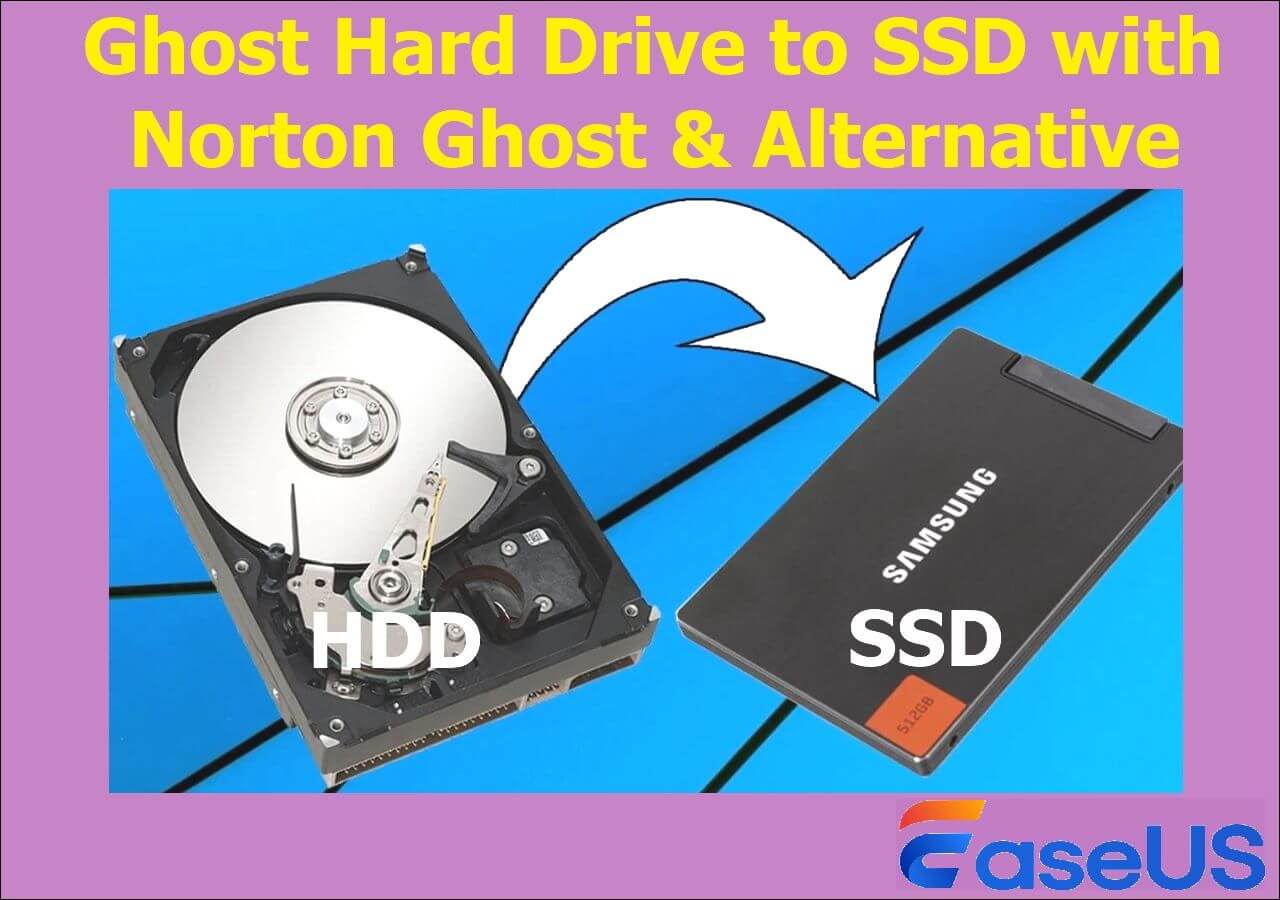
Hard drive cloning is a process of moving all the data from your old hard drive to another HDD/SSD. This can be useful if you're upgrading from an older storage device to a newer, larger one. It can also come in handy if you're trying to recover data from a failing hard drive. You may need to clone Windows 7 to another drive for many reasons, including:
- Upgrade HDD to SSD: Moving from a mechanical HDD to a solid-state drive can cut boot times from minutes to seconds, dramatically improving system responsiveness.
- Get more storage space: With increasing usage, your Windows 7 computer's hard drive may fill up. Cloning hard drives enables you to upgrade to a larger drive without losing data or reinstalling the OS.
- Hard drive backup: When the hard disk fails, shows signs of imminent failure, or is attacked by a virus, you can use the cloned disk to replace the original hard drive.
- Replace a failing HDD: If your old drive shows bad sectors or unusual noises, cloning before total failure prevents data loss.
- Avoid reinstalling Windows & programs: Reinstalling Windows 7, drivers, and applications is time-consuming and often frustrating. Cloning saves hours.
If you like this post, you can share it on your social platforms to help more people.

Can You Clone a Hard Drive in Windows 7?
Yes, but Windows 7 does NOT include a true disk cloning tool. The built-in "System Image Backup" is often confused with cloning, but it:
- Requires restoring instead of direct boot
- Is slower and less flexible
- Cannot directly migrate to a new disk
That's why most users use a dedicated disk cloning tool to:
- Copy OS + apps + data
- Keep the system bootable
- Avoid reinstalling Windows
However, not all disk cloning software works on Windows 7 or Windows 8. Therefore, you need to find cloning software compatible with Windows 7, as the Reddit post suggests.
Is there any cloning software still compatible with Windows 7?
by u/Ill_Swan_3209 in cloningsoftware
If you are looking for a disk cloning program for Windows 7, EaseUS Disk Copy is what you need. With it, you can clone a hard drive on Windows 11/10/8/7, and clone the system or entire disk and boot from the new HDD or SSD successfully.
🔥EaseUS Disk Copy: Best Cloning Software for Windows
- Simple interface: Clone one disk to another in 3-4 steps.
- Disk Mode: Clone to a new, larger SSD for full disk transfer.
- System Mode: Clone OS to another disk without boot issues.
- Auto 4K Alignment: 4K alignment for better SSD performance.
- Sector-by-sector clone: Clone HDD or SSD with bad sectors.
 Free Download
Windows 11/10/8/7
EaseUS Disk Copy works well on Windows 11/10/8/7 and is compatible with various brands, including Samsung, WD, SanDisk, Crucial, and Kingston, for SATA, NVMe, PCIe, and M.2 interfaces. Download it to clone a hard drive in Windows 7!
How to Clone Hard Drive in Windows 7
Before cloning, you must make some preparations to ensure a smooth cloning process. Please check and confirm that:
- A New HDD/SSD with Enough Disk Space: Your target disk is large enough to accommodate everything on the source disk. If not, delete some unimportant files to free up space.
- Make Sure Proper Connection: You may need a USB-to-SATA cable or an external disk enclosure to connect the new disk to your PC.
- Back Up Data in Advance: Data on the target disk will be wiped out after cloning. Back up important files before cloning.
Now, follow the detailed steps below to clone your hard drive in Windows 7:
Step 1. Connect New Disk
- Insert the new disk into the USB adapter/external disk enclosure and connect it to your computer via the USB port.
- If your PC has 2 slots, you can install it internally.
Step 2. Launch Cloning Software
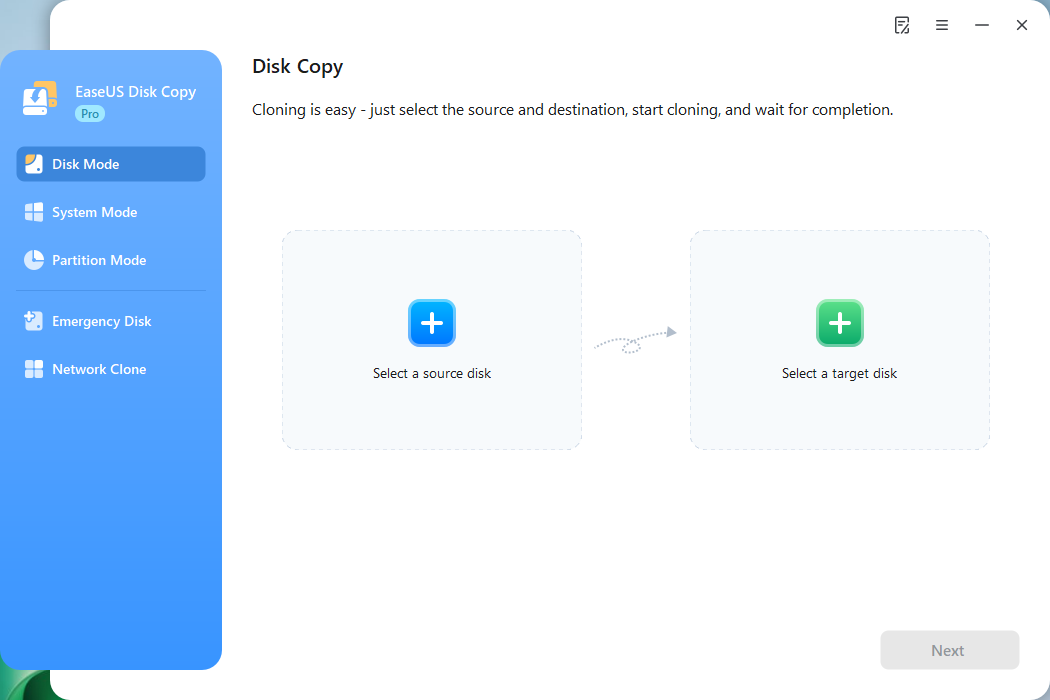
- Download & install EaseUS Disk Copy, open it, and select Disk Mode.
Step 3. Select Source and Target Disks
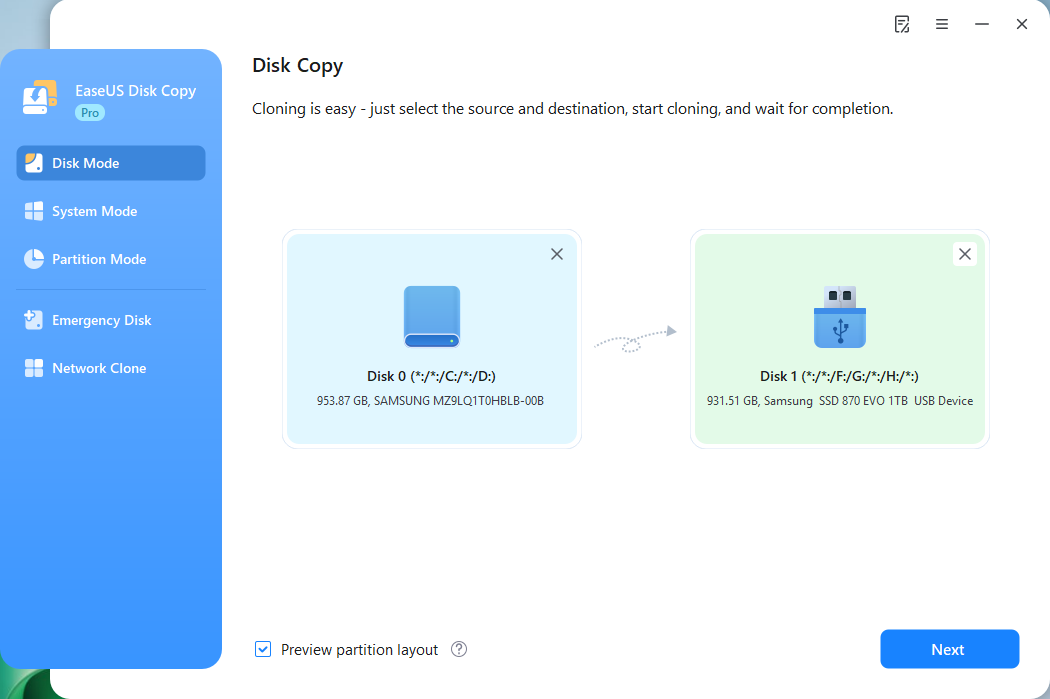
- Select your old disk as the Source Disk.
- Select the new disk as the Target Disk.
- Enable "Preview partition layout" for advanced cloning features, including sector-by-sector copy, and Auto-4K SSD Alignment.
Step 4. Adjust Disk Layout (Optional)
- If your new disk is larger, you can select "Auto-fit the disk" to use the bigger space.
- Select "copy as the source" to use the sector-by-sector copy feature for an exact copy of your old disk.

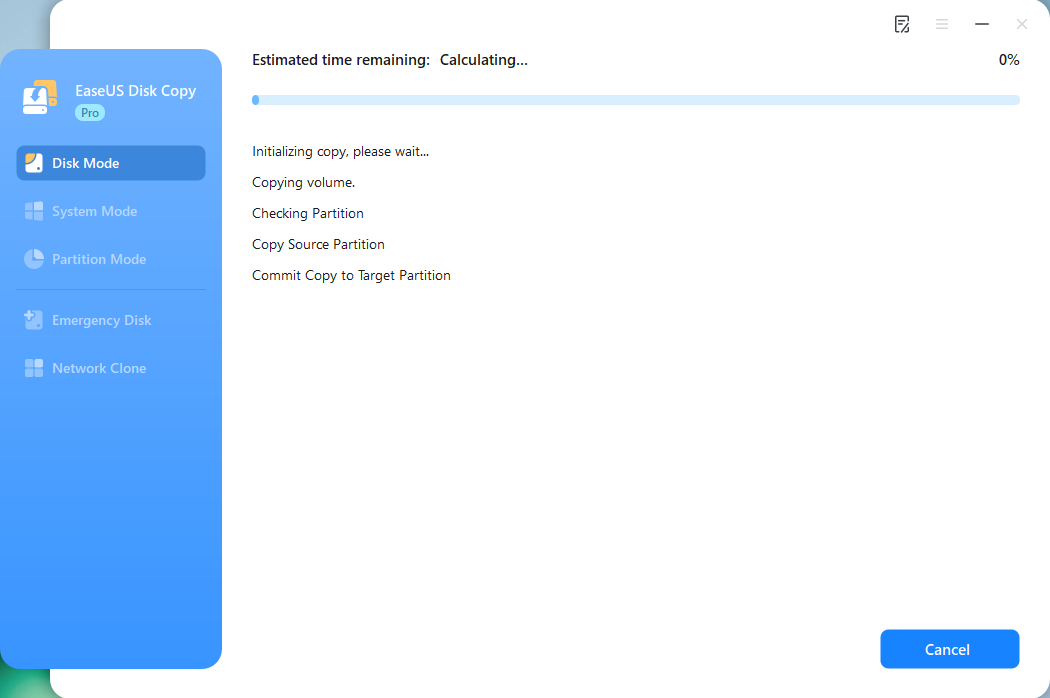
Step 5. Start Cloning Disk
- Click Proceed to clone the hard drive in Windows 7 and wait for the process to complete.
Step 6. Replace & Boot from New Disk
If your goal is to upgrade your old M.2 SSD with a new or larger one, you'll also need to swap SSDs after cloning. Here is how:
- After cloning, shut down your computer, locate the old SSD, remove the old SSD, and install the new SSD internally.
- Restart your computer, and it will automatically boot from the new cloned SSD.
- If not booting, enter the BIOS by pressing the BIOS key (F1, F2, Esc, Del) during startup, then choose the new SSD as the primary boot device.
This video shows how to clone a hard drive using EaseUS Disk Copy:
If you like this post, you can share it on your social platforms to help more people.
Troubleshooting: When the Cloned Disk Won't Boot
Even with correct steps, issues may occur. Here are solutions to common problems:
Problem 1: Cloned SSD not booting
- Solution: Enter BIOS, set SSD as the first boot device. Run bootrec /fixmbr if needed.
Problem 2: Blue screen after cloning
- Solution: Boot into Safe Mode, update drivers. Check AHCI settings in BIOS.
Problem 3: SSD not detected
- Solution: Reconnect cables, try another SATA port, or check UEFI/Legacy mode.
Problem 4: Target disk is smaller than the source
- Solution: Use an intelligent clone (auto-fit disk) instead of copying as the source. Resize partitions.
MBR vs GPT & BIOS vs UEFI: What You Need to Know
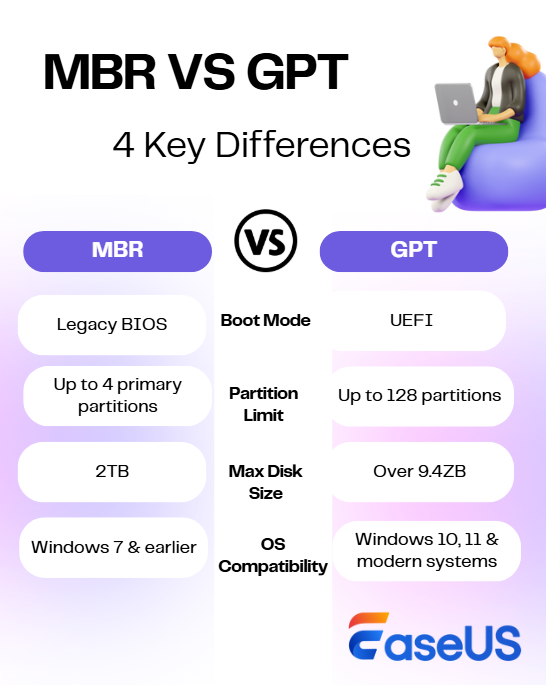
One of the most common reasons cloned disks fail to boot is a partition style mismatch.
- MBR (Master Boot Record): Most Windows 7 PCs use MBR with Legacy BIOS.
- GPT (GUID Partition Table): Required for UEFI booting and disks larger than 2TB.
How to Check:
- Right-click This PC → Manage → Disk Management.
- Right-click disk → Properties → Volumes.
Compatibility Tips:
- If your old HDD is MBR and your new system requires UEFI/GPT, convert the target disk to GPT before cloning.
- Ensure BIOS boot mode matches (Legacy vs UEFI).
If you like this post, you can share it on your social platforms to help more people.
Wrapping Up
That's all about how to clone a hard drive in Windows 7. Please ensure you prepare well in advance to make the process smoother. The disk cloning software, EaseUS Disk Copy, is reliable and easy to use. With its user-friendly interface and simple steps, you can clone your hard drive to a larger one without reinstalling Windows 7 OS or any applications.
Free Download
Windows 11/10/8/7
FAQs Related to Cloning A Hard Drive in Windows 7
1. Can Windows 7 clone to SSD?
Of course, you can clone Windows 7 to SSD directly. If you want to upgrade the system disk from HDD to SDD, you should migrate OS to SSD without reinstalling Windows and applications.
2. How do I copy my Windows 7 operating system?
EaseUS Disk Copy allows you to choose which section to clone. You need to select the operating system disk as the source disk and then copy and move it to another HDD or SSD.
3. How do I manually clone a hard drive?
To manually clone a hard drive, you can use the Windows built-in Backup and Restore feature to create a system image and then restore it to the new hard drive. However, according to some users' feedback, using Backup and Restore may result in data loss or stuck issues. We still recommend that you use cloning software, which can avoid data loss and improve your work efficiency.
4. Can I clone Windows 7 to a smaller SSD?
Yes, you can clone Windows 7 to a smaller SSD as long as the used space on the source drive is less than the SSD's total capacity. However, there are a few important things to check before cloning:
- Make sure the used space (not the total disk size) fits within the SSD
- Delete unnecessary files or move large data (videos, backups) beforehand
- Shrink partitions if needed using Disk Management
- Use a cloning tool that supports intelligent (auto-fit disk) cloning
5. Do I need to reactivate Windows 7 after cloning?
In most cases, you do NOT need to reactivate Windows 7 after cloning, because the system hardware signature remains the same. However, reactivation may be required if:
- You replace major hardware (especially the motherboard)
- The system detects significant hardware changes
- You're using an OEM license tied to specific hardware
-
Updated by
![]()
Larissa
Larissa has rich experience in writing technical articles and is now a professional editor at EaseUS. She is good at writing articles about data recovery, disk cloning, disk partitioning, data backup, and other related knowledge. Her detailed and ultimate guides help users find effective solutions to their problems. She is fond of traveling, reading, and riding in her spare time.…Read full bio