


-
![]() Old Myspace Photos Not Loading? Recover Old Myspace Photos, Messages, and Videos
Old Myspace Photos Not Loading? Recover Old Myspace Photos, Messages, and Videos September 20,2026
 6 min read
 -
![]()
-
![]() How to Recover Lost Genshin Impact Data and Account [2026 Ultimate Guide]September 20,20266 min read
How to Recover Lost Genshin Impact Data and Account [2026 Ultimate Guide]September 20,20266 min read -
![]()
-
![]() Where Are Screenshots Saved Windows 11 | Screenshots Default LocationSeptember 20,20266 min read
Where Are Screenshots Saved Windows 11 | Screenshots Default LocationSeptember 20,20266 min read -
![]() There Is a Problem with This Drive. Scan the Drive Now and Fix ItJuly 23,20266 min read
There Is a Problem with This Drive. Scan the Drive Now and Fix ItJuly 23,20266 min read -
![]()
-
![]()
-
![]()
-
![]() 2026 Tips: How to Stop Windows 11 from Automatically Deleting FilesSeptember 20,20266 min read
2026 Tips: How to Stop Windows 11 from Automatically Deleting FilesSeptember 20,20266 min read
Page Table of Contents
PAGE CONTENT:
Accidentally deleted an important file and emptied the Recycle Bin? Don't panic. Recycle Bin recovery may still be possible if the deleted data has not been overwritten.
When you delete a file in Windows, it usually moves to the Recycle Bin first. If you empty the Recycle Bin or permanently delete the file, Windows makes the storage space available for reuse. The original data may remain on the drive until new data overwrites it. That means the most important thing to do after accidental deletion is simple: stop using the affected drive as soon as possible.
In this guide, you'll learn how to recover deleted files from the Windows Recycle Bin, including files deleted after emptying the Recycle Bin or using Shift + Delete. We'll cover Windows' built-in recovery options, backups, and free and paid data recovery software.
Can You Recover Files After Emptying the Recycle Bin
Yes, you may be able to recover files after emptying the Recycle Bin. However, recovery is not guaranteed. When you empty the Recycle Bin, Windows does not necessarily erase every byte of the deleted file immediately. Instead, the space the file occupied becomes available for new data.
If that space has not been reused, recovery software may be able to locate and reconstruct the deleted file. Your chances of recovery depend on several factors:
- Whether the deleted data has been overwritten
- How long ago the file was deleted
- How much the computer has been used since deletion
- Whether the storage device is an HDD or SSD
- Whether TRIM has affected deleted data on an SSD
- Whether the file system is still intact
- Whether a backup or previous version is available
For this reason, stop writing new data to the affected drive before attempting recovery.
What to Do Immediately After Emptying the Recycle Bin
If you have just emptied the Recycle Bin and realize that an important file is missing, take these steps before doing anything else:
- Stop using the affected drive.
- Do not download or install unnecessary applications.
- Do not copy new files to the affected drive.
- Check Windows backups and File History.
- Check OneDrive or another cloud-storage service.
- If no backup is available, use a data recovery tool to scan the affected drive.
- Save recovered files to a different drive.
Download Recycle Bin Recovery Software Full Version for Free
EaseUS Data Recovery Wizard can help solve more data loss issues, including accidentally deleting Office documents, pictures, videos, and music; formatting a disk partition without a backup; virus and malware infection; operating system crash; sudden power outage, etc.
After upgrading to the full version, you can recover unlimited data files with full functionality, for example:
- Recover deleted files from the Recycle Bin after emptying it
- Recover files and folders deleted by Shift + Delete Key
- Recover files too large for Windows recycle bin
- Recover files from the corrupted Recycle Bin
The general recovery process is: Select the drive → Scan for deleted files → Preview the results → Recover files to another location
Here is how you can recover data from the Recycle Bin with this data recovery software:
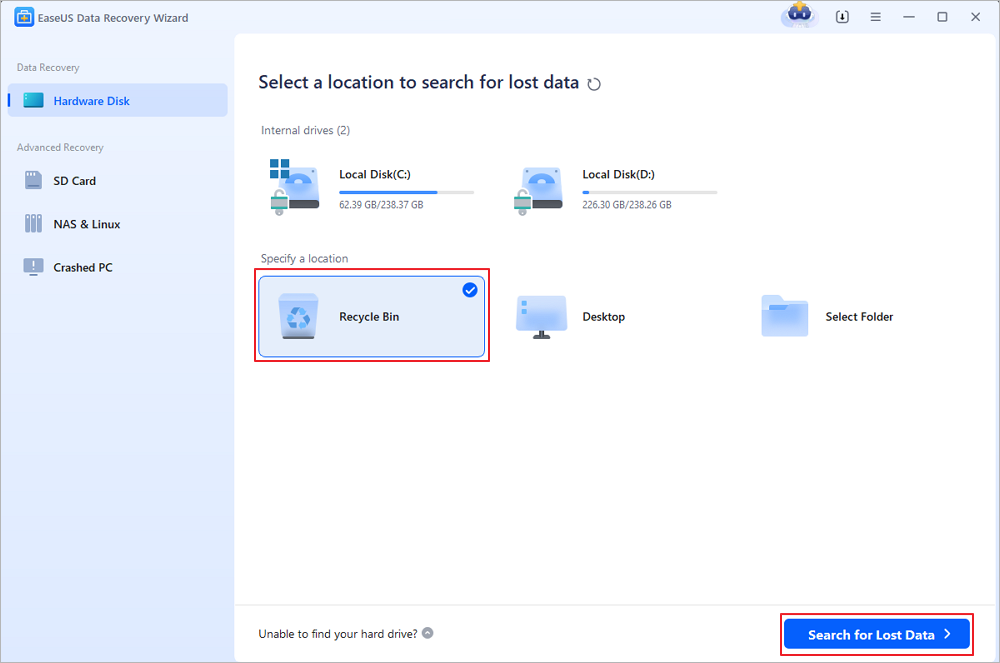
Step 1. To specifically recover files from emptied Recycle Bin on Windows 11/10/8/7, hover the mouse pointer over the "Recycle Bin" option under the "Hardware Disk" section and click "Search for Lost Data".
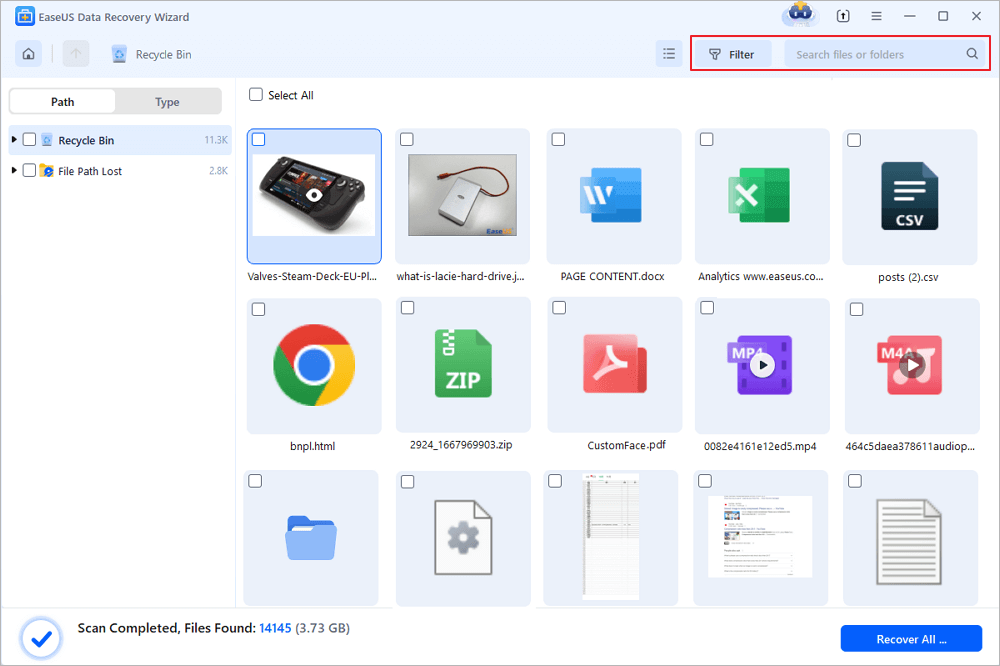
Step 2. EaseUS data recovery software will start a quick scan immediately for all deleted files, and later a deep scan will launch automatically to scan more lost files. After the scanning process, you can use the "Filter" feature to select a specific file type, such as Pictures, Word, videos, etc.
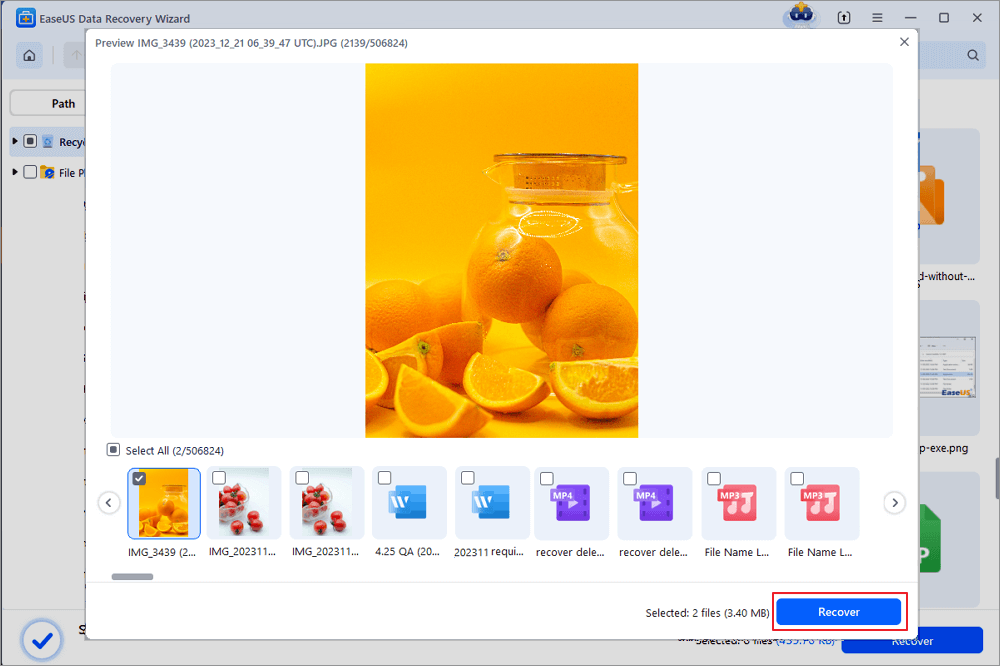
Step 3. Once you locate the files you want to restore, you can double-click it for a full preview. Then, select the target files and click "Recover". We suggest you select a different volume or an external USB drive to save the recovered files to avoid data overwriting. You can choose a cloud storage, such as OneDrive, Google Drive, etc., and click "Save" to save your recovered files.
Method 1. Restore a File from the Recycle Bin
If the file is still in the Recycle Bin, you don't need recovery software.
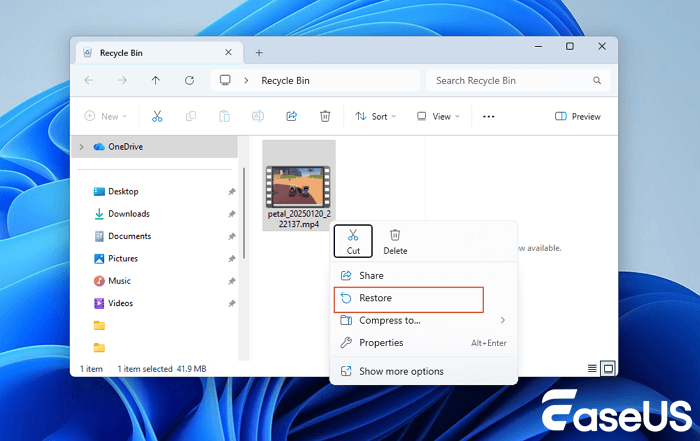
Step 1. Open the Recycle Bin by double-clicking the Recycle Bin icon on your Windows desktop.
Step 2. Look through the files and folders or use the available sorting options to locate the item you want to recover.
Step 3. Right-click the file and select "Restore".
![recover-deleted-videos-from-recycle-bin.png]()
This is the safest and easiest form of Recycle Bin recovery because the file has not been permanently removed from the normal Windows recovery path.
Method 2. Perform Recycle Bin Recovery with File History
If File History was enabled before the file was deleted, you may be able to restore an earlier version. File History can maintain copies of files in selected folders, allowing you to recover previous versions without scanning the disk for deleted data. To check for an available previous version:
Step 1. Open the folder where the file was originally stored.
Step 2. Right-click the file or its containing folder.
Step 3. Look for the option to restore or view previous versions.
Step 4. Select an appropriate version, if available, and choose "Restore personal files."
Step 5. Restore the file to its original or another safe location.

The exact options available depend on your Windows configuration and whether File History was enabled before the deletion occurred.
Can You Recover Files Deleted with Shift + Delete
Sometimes. The Shift + Delete shortcut bypasses the normal Recycle Bin process. As a result, the deleted file will not appear in the Recycle Bin. However, bypassing the Recycle Bin does not necessarily mean that the underlying data is immediately overwritten. If the deleted data remains intact, recovery software or Windows File Recovery may be able to locate it.
The recommended procedure is:
- Stop using the drive.
- Check available backups.
- Try Windows File Recovery if appropriate.
- Scan the affected drive with recovery software if necessary.
- Preview the results.
- Save recovered files to another drive.
Recycle Bin Recovery Software vs. Windows File Recovery
Both approaches can be useful, but they are designed for different users.
| Feature | Data Recovery Software | Windows File Recovery |
|---|---|---|
| Cost | Depends on the product/version | Free |
| User interface | Graphical | Command line |
| File preview | Usually available | Limited |
| File filtering | Usually available | Command-based |
| Ease of use | Easier for most users | Better for technical users |
| Recovery scenarios | Broad | Supported Windows recovery scenarios |
| Best for | Users who want a visual recovery process | Users comfortable with commands |
If you are comfortable with the Windows command line, Windows File Recovery is worth considering.
If you prefer a visual interface that lets you scan, filter, preview, and selectively recover files, a dedicated data recovery application may be easier.
What Is the Best Way to Recover Deleted Files
The best method depends on what happened to the file.
| Situation | What to try first |
|---|---|
| File is still in Recycle Bin | Right-click → Restore |
| File was recently deleted | Check Recycle Bin and backups |
| Recycle Bin was emptied | Check backups, then recovery software |
| File History is available | Restore from File History |
| File is in OneDrive | Check OneDrive recycle bin/version history |
| File was deleted with Shift + Delete | Windows File Recovery or recovery software |
| No backup exists | Data recovery software |
| Data is on an SSD | Stop using the SSD immediately |
| Drive is physically damaged | Professional data recovery |
How to Prevent Future Data Loss
The best Recycle Bin recovery strategy is to maintain a backup before data loss happens.
Consider the following practices:
- Back up important files regularly.
- Keep at least one backup on a separate storage device.
- Use a trusted cloud-storage service for important documents.
- Enable appropriate Windows backup features.
- Check the Recycle Bin before emptying it.
- Keep multiple copies of irreplaceable files.
- Avoid storing the only copy of important data on your computer.
A backup is generally much more reliable than attempting to recover deleted data from a storage device.
FAQs on Recycle Bin Recovery
Read the questions and answers below to get additional help for Recycle Bin recovery.
1. Can I recover files after emptying the Recycle Bin?
Yes, you may be able to recover files after emptying the Recycle Bin if the deleted data has not been overwritten. Check backups first, then consider Windows File Recovery or data recovery software.
2. How do I recover permanently deleted files from the Recycle Bin?
Stop using the affected drive, check File History and other backups, and then scan the original storage device with a suitable recovery tool if no backup is available.
3. Can I recover deleted files without software?
Yes, if the file is still in the Recycle Bin or if another copy exists in File History, Windows Backup, OneDrive, or another backup service. If the Recycle Bin has been emptied and no backup exists, recovery software may be necessary.
4. Is there free Recycle Bin recovery software?
Yes. Windows File Recovery is a free Microsoft utility. Some third-party recovery applications also provide free scanning, previewing, or limited recovery. Check the current limitations before starting the recovery process.
Was this page helpful?
-
Dany is an editor of EaseUS who lives and works in Chengdu, China. She focuses on writing articles about data recovery on Mac devices and PCs. She is devoted to improving her writing skills and enriching her professional knowledge. Dany also enjoys reading detective novels in her spare time. …




 Why Trust EaseUS
 Editor Reviews

20+
Years of experience

160+
Countries and regions

72 Million+
Downloads

4.9 +
Trustpilot Score