


Content
Page Table of Contents
About the Author
Hot Topics
Resizing a partition on Windows computers is an effective way for PC owners to extend or create new partitions to make full use of their disk drive space. However, sometimes, when the C drive gets low disk space, or the Extend Volume is greyed out, users can easily run out of solutions to resize their NTFS partitions on Windows 11 or older computers.
Follow this page, and we'll show you 4 reliable methods for flexibly adjusting NTFS partition space for free in Windows 11 without losing any data.
How Do I Resize NTFS Partition Without Losing Data? 4 Ways with Practical Tips
Can NTFS be resized without losing data? Of course. You can easily resize NTFS partition in Windows 11/10 with the correct methods offered by EaseUS software as shown below.
Here in this section, I will introduce 4 methods to assist you in adjusting your volume size for free, including three Windows built-in disk tools and professional third-party software - EaseUS Partition Master. Check the comparison table to choose the most suitable option.
| Comparison | EaseUS Partition Master | Disk Management | Windows Storage Settings | Diskpart |
|---|---|---|---|---|
| Extend Partition | No limit, work both with or without unallocated space | Unallocated space must be behind the target NTFS Volume | Unallocated space must be behind the target NTFS Volume | Unallocated space must be behind the target NTFS Volume |
| Shrink Partition | No limit | No limit | No Limit | No limit |
| Merge Partition | No limit | Two adjacent partitions, require deleting the right side volume | Two adjacent partitions, require deleting the right side volume | Two adjacent partitions, require deleting the right side volume |
| Operation Difficulty | Easy | Medium | Medium | Complex |
| Suitable Users | All Windows users | Windows Beginners | Beginners | Experienced Users |
According to this table, it's clear that EaseUS Partition Master exceeds the other 3 methods in resizing volumes on Windows PCs without having some basic limits. This tool breaks the limitations of Windows' built-in tools and can solve more problems of resizing NTFS partitions.
Practical Tips to Resize Partitions:
- ✅Back up data before you start
- ✅Double check which volume you'd like to resize and remember its drive letter
- ✅Don't interrupt the operation once you've started resizing the volume
Download this software and let's dive into the next part to start with the easiest way in resizing an NTFS partition on your own. Also, don't forget to share your desired method online to help your friends adjusting their partitions flexibly free.

Method 1. Resize NTFS Partition via Partition Manager Software - Easiest
EaseUS Partition Master, designed as a professional disk partition assistant, enables Windows users to fully control their disk drives, including resizing NTFS partitions quickly and efficiently. You can use the "Resize/Mover" function to drag the mouse to extend or shrink the size of NTFS partitions.
Step 1: Locate and select the target drive/partition
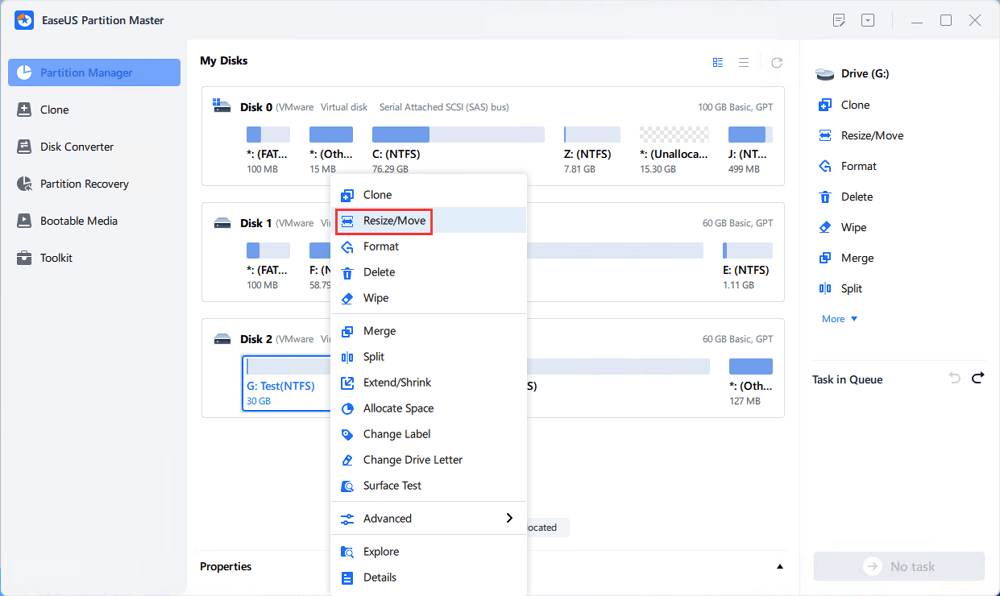
Launch EaseUS Partition Master and go to Partition Manager, select the target drive or partition you need to adjust its size, right-click on it and choose "Resize/Move".
Step 2: Resize or move the partition
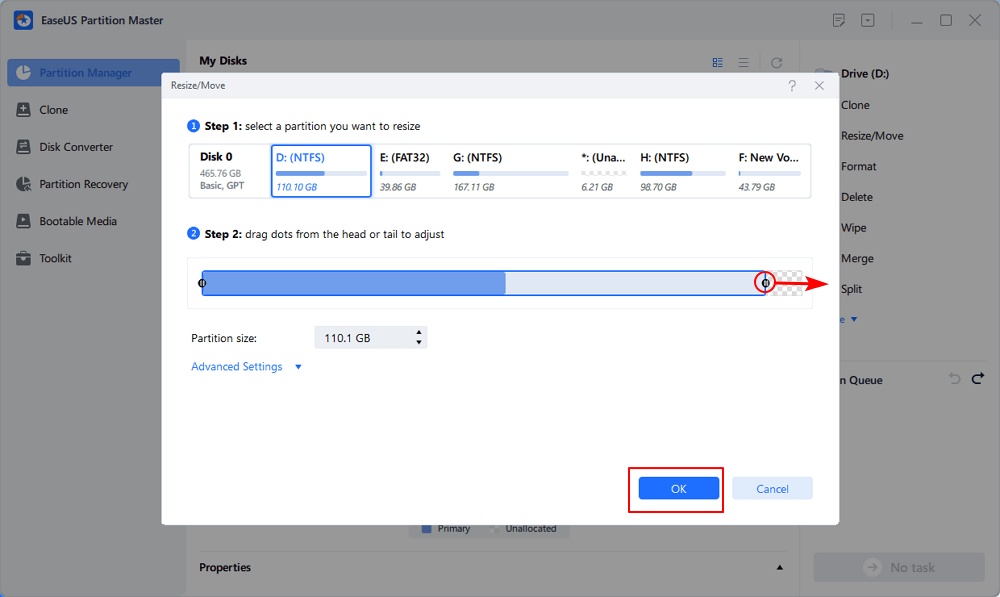
1.To shrink the partition, simply drag one of its ends to free up unallocated space. Once done, click "OK".
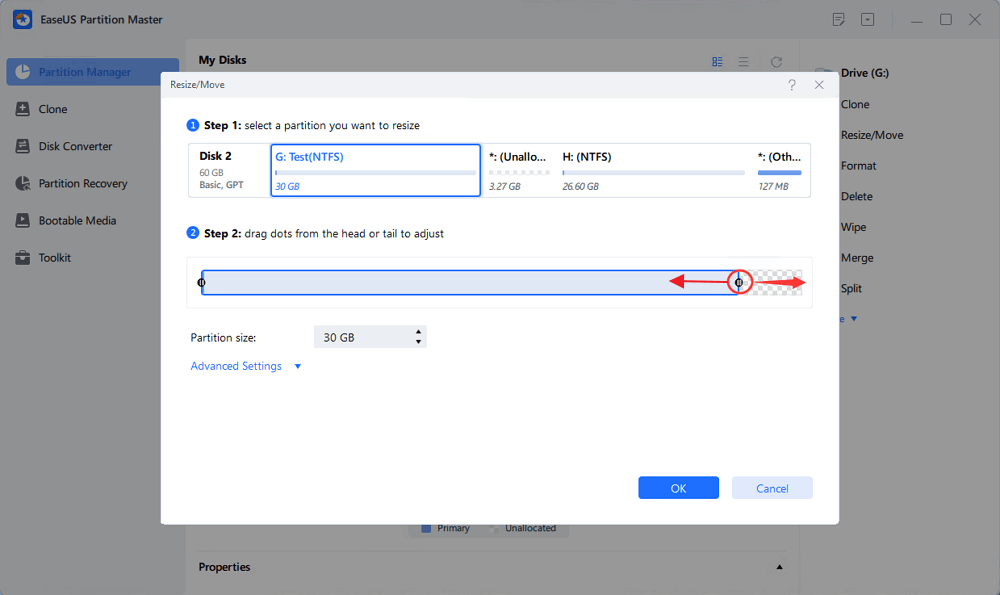
2. To extend the partition, make sure that there is unallocated space aside (if there isn't, follow the above steps to create some). In the same way, drag your mouse into the unallocated space. Click "OK".
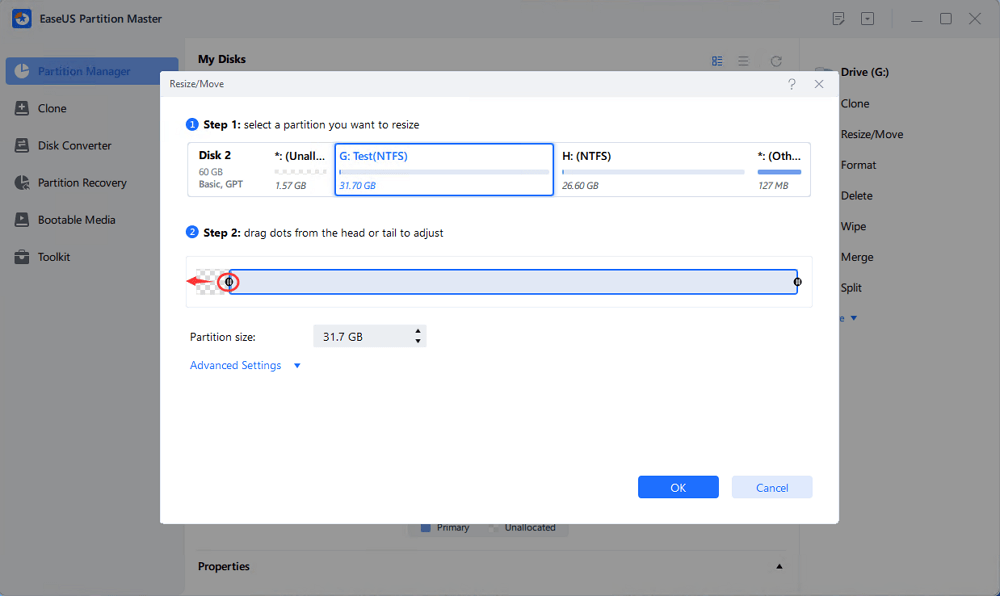
3. To move a partition position, suppose you have created and left the unallocated space next to the target partition. If no, free up some unallocated space first.
Then, right-click the target partition, select "Reize/Move". Then drag the whole partition leftward or rightward to adjust its position. Click "OK" to confirm.
Step 3: Confirm the result and apply changes
At this step, you will see the new disk partition information & diagram.
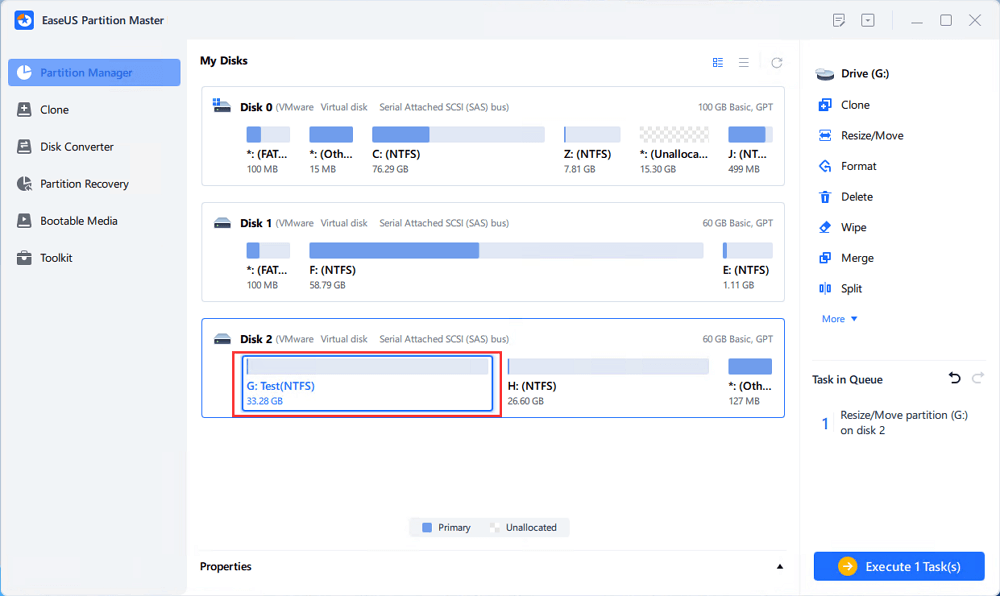
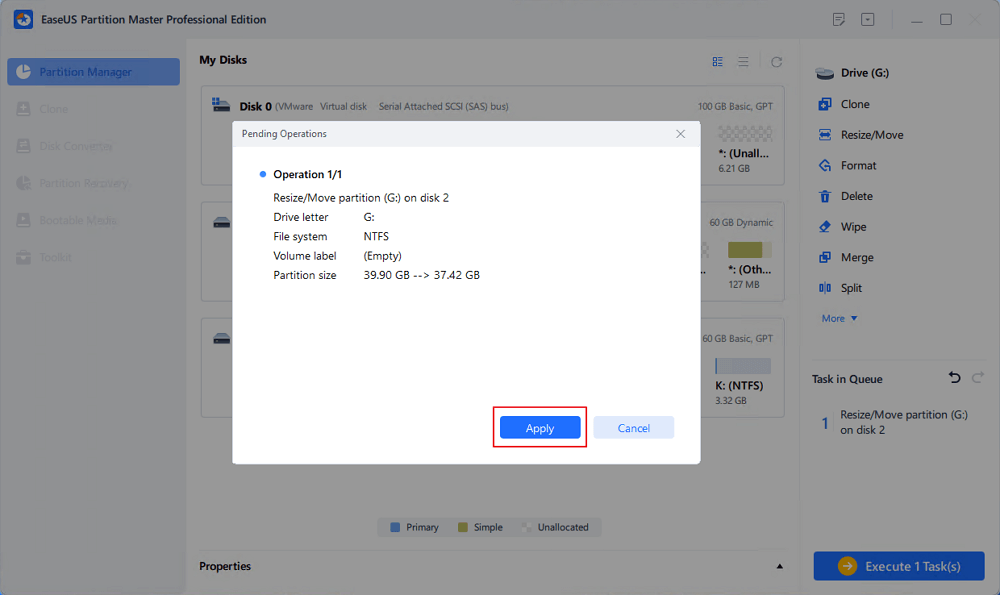
To save changes, click the "Execute Task" button and then "Apply".
With EaseUS Partition Master, you can easily manage your partitions even if you are new to computers. It can not only quickly resize partition on SSD but also easily resize encrypted partitions. Follow the steps here and learn how to resize your partitions like an expert:
You May Also Like: How to Partition a Hard Drive or SSD?
Method 2. Resize NTFS Partition Using Disk Management
Disk Management is a free utility for managing disks and partitions that the Windows operating system provides. You can use "Extend Volume" or "Shrink Volume" to resize NTFS partitions.
- Notice:
- To extend a partition in Disk Management, ensure unallocated space is next to the target partition, sitting on its right side. Otherwise, you will see the Extend Volume greyed out. If the unallocated space is on the left side of the target volume, turn to EaseUS Partition Master for help.
Now, follow the steps below to complete the task of resizing the NTFS partition.
Guide 1. Extend NTFS Partition with Unallocated Space
Step 1. Right-click on the Windows button and select "Disk Management."
Step 2. Right-click on the NTFS partition you want to adjust and select "Extend Volume."
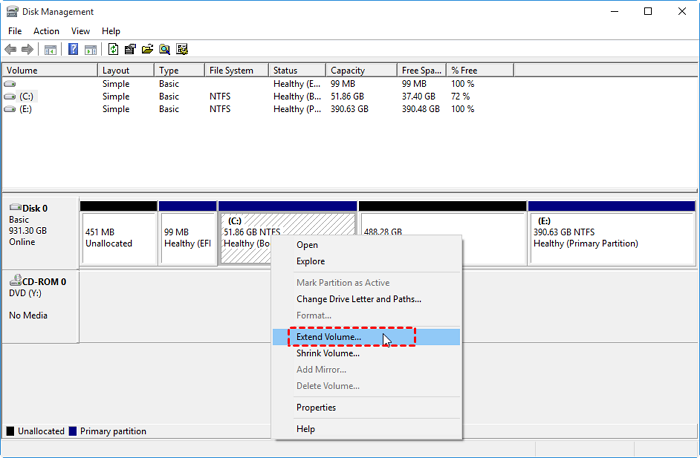
Step 3. Click "Next" in the "Extend Volume Wizard."
Step 4. Set the space size of the NTFS partition and click "Next."
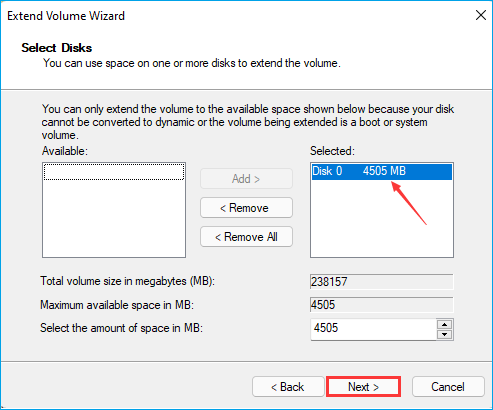
Step 5. Click "Finish" to finish extending the NTFS partition.
Guide 2. Shrink NTFS Partition
Step 1. Open Disk Management and right-click on the NTFS partition and choose "Shrink Volume."
Step 2. Select the space you want to shrink and click "Shrink. "
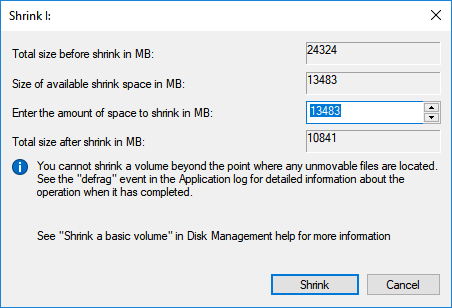
- Tip
- Windows Disk Management can't shrink volume if the partition file system is FAT32. You need to use EaseUS Partition Master to resize FAT32 partition.
Method 3. Resizing Partition in Storage Settings
Windows 11 or Windows 10 users can also take Windows Settings to adjust and resizing volumes with the Storage features. Here are the guidelines you can apply to extend or shrink a volume:
#1. Extend Volume
- Right-click on Windows icon on the taskbar and select "Settings".
- Click "System" > "Storage" > "Advanced storage settings".
- Click "Disks & volumes" > Select the target volume you intend to extend and click "Properties".
- Then, click "Change size" > Enter the size you'd like the target volume to be > Click "OK" to finish.

#2. Shrink Partition
- Right-click on the Windows icon on the taskbar and select "Settings".
- Click "System" > "Storage" > "Advanced storage settings".
- Click "Disks & volumes" > Select the target volume you need to shrink and make unallocated space, and click "Properties".
- Then, click "Change size" > Enter the size you'd like the target volume to be > Click "OK" to finish.
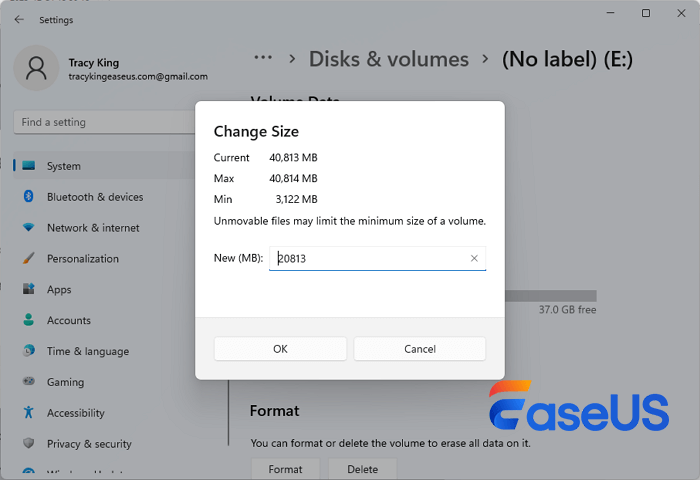
If you like this method to resize partition in Windows computer, share it online to help more of your friends taking control of their disk partition space now:
Method 4. Resize Partition via Diskpart
Diskpart is a command-line tool that comes with Windows. Diskpart has more functions than Disk Management, but it is not suitable for users who are not computer savvy. You must be careful to type commands to avoid data loss. If you want to resize an NTFS partition using Diskpart, please follow the instructions below.
Step 1. Right-click on the Windows icon and select "Run."
Step 2. Type "diskpart" and press Enter.
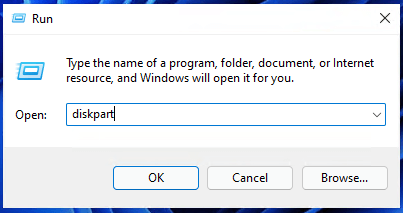
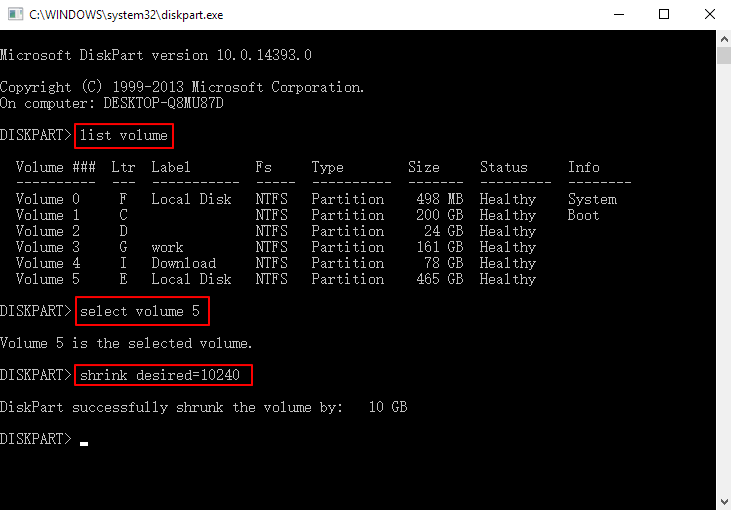
Step 3. Type the following commands in turn and press "Enter" after each command.
list volume
select volume 5
shrink desired=10240
"list volume" can make you see all the partitions on the computer. "5" can be replaced by another target volume number. "10240" can be changed to a suitable size.
If you want to extend the NTFS partition, type the following command:
list volume
select volume x
extend size
Step 4. Type "exit" to close the command window.
Diskpart is also a great tool for resizing the NTFS partition, but it is unable to resize FAT32 partition. If Diskpart fails to extend the volume, you need to resort to EaseUS Partition Master.
BONUS: When to Use NTFS Partition in Windows
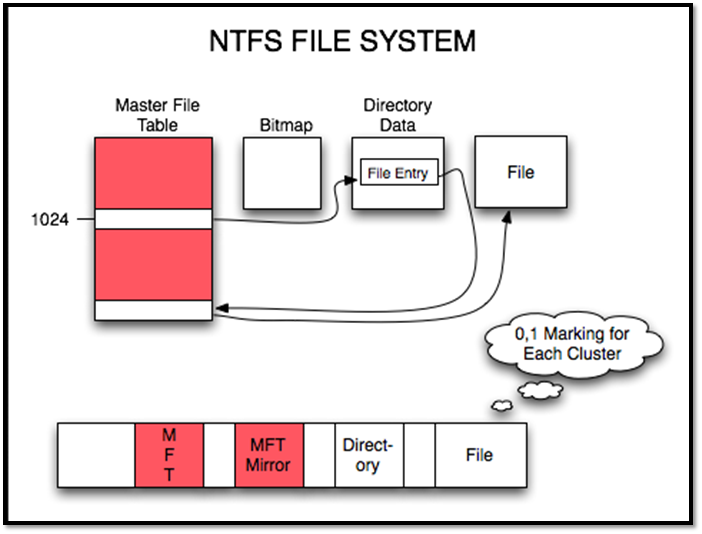
NTFS refers to New Technology File System, and it is the default standard file system of Windows with excellent performance and reliability. It has gained a lot of praise as the file system of choice for Windows. And it is widely used on various disks. For example, it may be set as the file system format for partitions on SSD or HDD.
So, when should I use NTFS as the partition file system, and when should I change NTFS to other formats?
Here is a list of situations for you to refer to and decide when to use NTFS and other formats:
| NTFS |
exFAT or FAT32 |
|---|---|
|
|
🚩Bonus Tip: To get the best out of an NTFS partition, you may want to shrink other partitions to extend the NTFS partition. To keep your data safe and intact, don't adjust the cluster size of the target volume size.
Conclusion
On this page, we've learnt four practical ways to resize NTFS partitions on Windows computers. Among the four methods, EaseUS Partition Master is the most comprehensive and easiest method for all levels of users.
It breaks the limitations of Diskpart and Disk Management and brings more features. Besides the ability to resize partitions, it can also merge non-adjacent partitions.
- Experienced usres can apply Disk Management and Storage settings to execute some basic partitioning tasks.
- As for advanced administrators, you can use any of the tools to turn your ideas into your PC.
- But if you prefer the DiskPart method, you must be careful with the command lines when using it.
FAQs About How to Resize NTFS Partition
Resizing NTFS partitions in Windows 11/10 is a very easy task. I hope this article has solved your problem. If you have any other questions, please read on.
1. Can NTFS be resized?
Of course, there are three ways to resize NTFS partitions within Windows. EaseUS Partition Master is the most recommended method. Disk Management and Diskpart are also possible, but be aware of their limitations.
2. What is the max partition size for NTFS?
The maximum partition size for NTFS is 16TB. If you are unable to create an NTFS volume larger than 2TB, you can check your disk format. If it is in MBR format, you need to convert MBR to GPT to create NTFS partitions larger than 2TB.
3. How do I resize an existing partition?
To resize an existing partition, you can use EaseUS Partition Master to do it quickly. If you want to use the tools that come with Windows, follow these steps:
Step 1. Open Disk Management.
Step 2. Right-click on the existing partition to be resized and select "Extend Volume" or "Shrink Volume."
Step 3. Enter the size of the space to be resized.
4. Will I lose data while resizing a partition in Windows 11?
It depends on how you do it. If it's a simple shrinking and extending volume operation, it could be safe, and your data could be intact. However, if you need to delete an existing volume to resize or extend a target volume, this could be risky, and you may lose vital files in the source partition.
Therefore, no matter which tool you decide to use, we highly recommend you create a backup of all your important files on the source and target volume in advance.
How Can We Help You
About the Author

Updated by Joey Albert
Joey is an enthusiast of science and technology. With a passion for uncovering the latest tech innovations, she creates clear, engaging how-to guides that make technology accessible and enjoyable for all.

Cici is the junior editor of the writing team of EaseUS. She accepted the systematic training on computers at EaseUS for over one year. Now, she wrote a lot of professional articles to help people resolve the issues of hard drive corruption, computer boot errors, and disk partition problems.
Product Reviews
-
I love that the changes you make with EaseUS Partition Master Free aren't immediately applied to the disks. It makes it way easier to play out what will happen after you've made all the changes. I also think the overall look and feel of EaseUS Partition Master Free makes whatever you're doing with your computer's partitions easy.
Read More -
Partition Master Free can Resize, Move, Merge, Migrate, and Copy disks or partitions; convert to local, change label, defragment, check and explore partition; and much more. A premium upgrade adds free tech support and the ability to resize dynamic volumes.
Read More -
It won't hot image your drives or align them, but since it's coupled with a partition manager, it allows you do perform many tasks at once, instead of just cloning drives. You can move partitions around, resize them, defragment, and more, along with the other tools you'd expect from a cloning tool.
Read More
Related Articles
-
How to Fix Dell Stuck on Dell Logo in 7 Ways | Step-by-Step
![author icon]() Cici/2026/08/13
Cici/2026/08/13 -
How to Move Partition in Windows Server
![author icon]() Daisy/2026/09/23
Daisy/2026/09/23 -
How to Check Hard Drive Health in Windows [Six Working Solutions]
![author icon]() Cici/2026/09/17
Cici/2026/09/17 -
Top 7 Best Free USB Formatter Software for Windows Recommend 2026
![author icon]() Tracy King/2026/06/21
Tracy King/2026/06/21
 Daisy/2026/09/23
  Tracy King/2026/06/21