



Content
Page Table of Contents
About the Author
Hot Topics
Whether you're selling an external hard drive, switching encryption methods, or simply no longer need BitLocker protection, removing BitLocker is straightforward, as long as you have the password or recovery key.
So can you remove BitLocker without losing data? If you still have your BitLocker credentials, you can decrypt the drive without losing any files. If you've forgotten them, you can't simply bypass BitLocker, but you can erase and reformat the drive to remove the encryption, although this permanently deletes all data.
This guide explains when you can safely remove BitLocker while keeping your files, when formatting is your only option, and the easiest ways to do it in Windows.
How to Remove BitLocker from External Hard Drive? 5 Ways
Depending on your choice and the tools available, removing BitLocker from an external hard drive can be accomplished in several ways. Here are the 5 simple methods to assist you in unlocking your external drive. Given the simplicity of the Control Panel, it is advised for users seeking the fastest and most effective method. However, BitLocker unlock software like EaseUS Partition Master will be the best choice if you have forgotten your BitLocker recovery key or password.
Here are the 5 methods to remove BitLocker from an external hard drive:
| Methods | Best for | Requirements | Data Loss |
|---|---|---|---|
| Control Panel | Users who prefer the traditional Windows interface to disable BitLocker encryption | You must have administrator privileges and be able to unlock the drive | No data loss |
| File Explorer |
|
The drive must be unlocked; you need the BitLocker password or recovery key | No data loss |
| Command Prompt | Advanced users who want to remove BitLocker from the command line or troubleshoot encryption issues | Administrator access is required; the drive must be accessible in Windows | No data loss |
| PowerShell | IT administrators managing BitLocker drives with scripts or multiple devices | Administrator privileges; PowerShell access; BitLocker drive must be recognized by Windows | No data loss |
| EaseUS Partition Master | Users who forgot the BitLocker password, can't find recovery key, or want to reuse the drive | Formatting is required if the encryption key is unavailable; all existing data will be erased | ⚠️ Data will be permanently deleted |
In most cases, you should choose a decryption method if you still have the BitLocker password or recovery key. If the key is lost and you no longer need the files, formatting the drive is the only way to remove BitLocker encryption and make the drive usable again.
If your external hard drive contains no important data, you can directly refer to Method 5 to remove BitLocker from the external hard drive in a few simple clicks.
Now let's talk about each method in detail, look at their advantages, and how they work.
#1. Using Control Panel
One simple tool in Windows that allows users to adjust BitLocker encryption and other system settings is the Control Panel. Because of its simplicity and convenience of use, this strategy is especially beneficial for those who prefer graphical interfaces over command-line tools.
- Advantages:
- Accessible to users with minimal technical knowledge.
- Provides a direct way to disable BitLocker without needing to enter complex commands.
- No additional software needed as it utilizes built-in Windows features.
Steps to remove BitLocker from external hard drive with Control Panel:
- Press Windows Key + R to open the Run dialog, and type control and press Enter to open the Control Panel.
- Click on System and Security, and Select BitLocker Drive Encryption
- Find your external hard drive in the list of available drives. Click on "Turn off BitLocker" next to the drive.
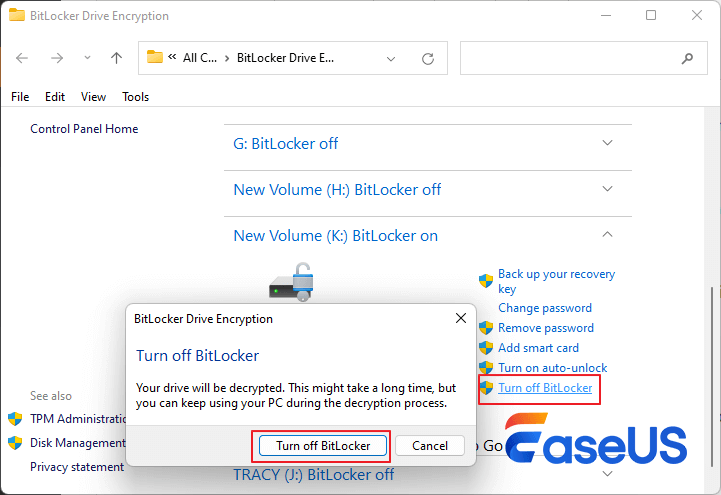
- Click Yes or Turn off BitLocker when the prompt appears.
Ensure your external drive is connected throughout the entire process to avoid any interruptions. Feel free to follow this link if you see no option to turn off BitLocker on Windows 11. It's because Microsoft doesn't fully support BitLocker on Windows 11 Home and older Home systems.
#2. Using File Explorer
Using File Explorer is the quickest way to turn off BitLocker on an external hard drive if you can already access the drive. This method uses Windows' built-in interface, so you don't need to run commands or install additional tools.
- Advantages:
-
Simple and beginner-friendly: No technical commands are required. You can disable BitLocker with just a few clicks.
Built into Windows: No third-party software installation is needed.
Keeps your files intact: As long as you have the correct password or recovery key, the drive can be decrypted without deleting your data.
Steps to turn off BitLocker on an external hard drive using File Explorer:
- Plug the external drive into your PC and unlock it using your password.
- Open File Explorer and go to This PC.
- Right-click the external drive and select Manage BitLocker (choose Show more options first on Windows 11).
- Click Turn off BitLocker and confirm your choice. Wait for the decryption process to finish.
Share this post to help more people remove BitLocker without losing data smoothly.

#3. Using Command Prompt
The Command Prompt is a utility in Windows responsible for performing a large number of commands, including the management of BitLocker encryption. This method is perfect for those users who are familiar with the command prompt and require more control over the decryption process.
- Advantages
- Allows for specific commands to manage the decryption process.
- Helpful for users who prefer or require a command-line interface.
- Can be used for scripting and automation in more advanced scenarios.
Steps to remove BitLocker from external hard drive via CMD:
- Type cmd in the search box. Right-click on Command Prompt and select Run as administrator.
- Type: manage-bde-astatus and hit enter.
- It will display the encryption status of all drives..
- Identify the drive letter of your external hard drive from the status report.
- Type the following command and press Enter: manage-bde -off K: (replace K: with your drive letter)
It will initiate the decryption process.
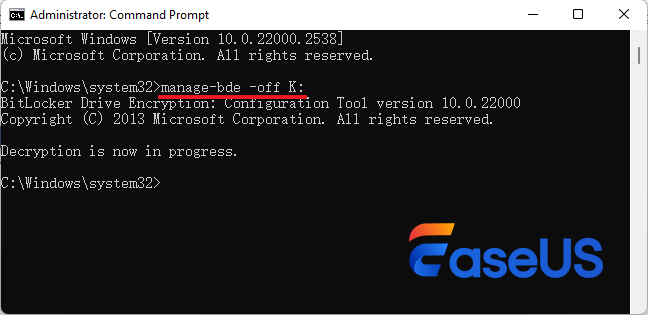
The process may take some time, depending on the drive size and amount of data. Ensure the external drive remains connected throughout the decryption process. You will receive a notification once the decryption is complete.
#4. Running PowerShell
PowerShell is a scripting language that can be used in system administration and automation in systems with the Windows OS. It is more complex and provides enhanced features for working with BitLocker encryption; it can be used for decryption by users who are familiar with the command-line interface and need more detailed settings for the decryption process.
- Advantages
- Allows BitLocker control with several commands.
- Create scripts to automate decryption.
- Options are more detailed than Command Prompt.
Steps to remove BitLocker from an external hard drive via Powershell:
- Right-click Windows PowerShell in search results and choose Run as administrator.
- Enter the following command: Get-BitLockerVolume lists all system volumes' BitLocker state.Identify your external hard drive's drive letter or volume ID from the status report.
- Identify your external hard drive's drive letter or volume ID from the status report.
- Type the following command and press Enter: Disable-BitLocker -MountPoint "X:" (replace X: with your drive letter or volume ID)
This command starts the decryption process.
Ensure the external drive remains connected throughout the decryption process. PowerShell will notify you once the decryption is complete.
If you encounter issues, verify that PowerShell is running with administrative privileges and that the drive letter is correct.
#5. Trying Free BitLocker Unlock Software
Reliable BitLocker unlock software like EaseUS Partition Master Free can be effectively helpful for users who have forgotten their BitLocker password or recovery key. Without the original password or recovery key, it allows you to tackle BitLocker encryption problems and manage disk partitions. It's a great way to get BitLocker out of external hard drives and overcome access issues.
- Advantages
- Allows BitLocker encryption to be removed without password or recovery key.
- Offers a simple graphical interface for non-command-line users.
- Adds disc partition management and optimization features.
Steps to remove BitLocker from external hard drive by formatting:
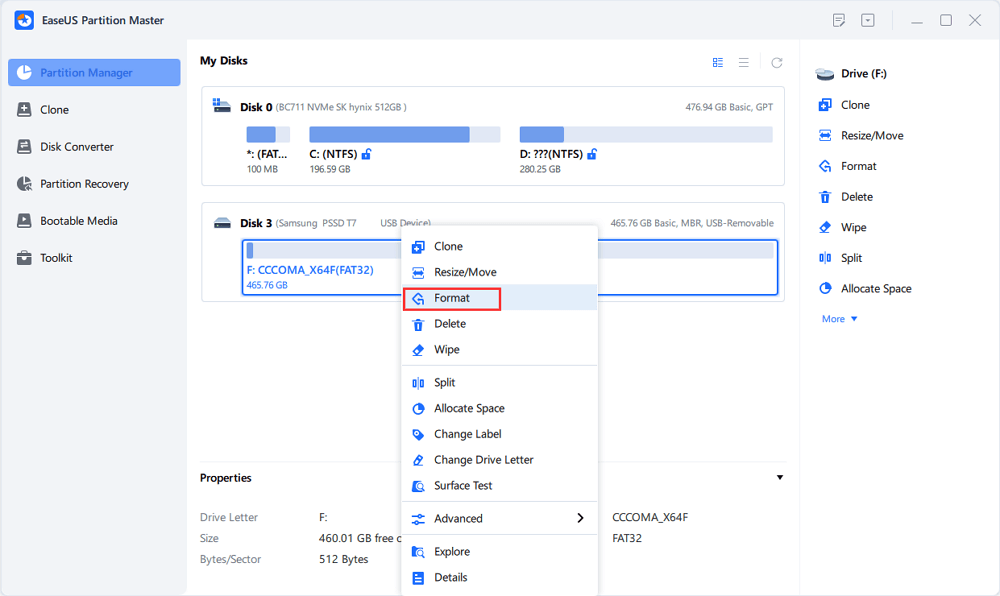
Step 1. Launch EaseUS Partition Master, right-click the partition on your external hard drive/USB/SD card which you want to format and choose the "Format" option.
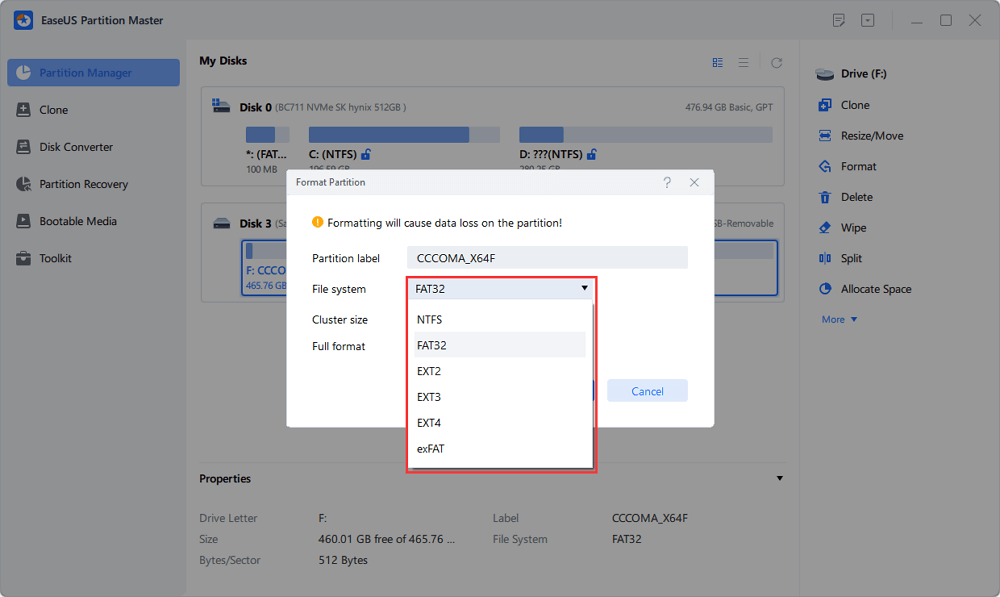
Step 2. Assign a new partition label, file system (NTFS/FAT32/EXT2/EXT3/EXT4/exFAT), and cluster size to the selected partition, then click "OK".
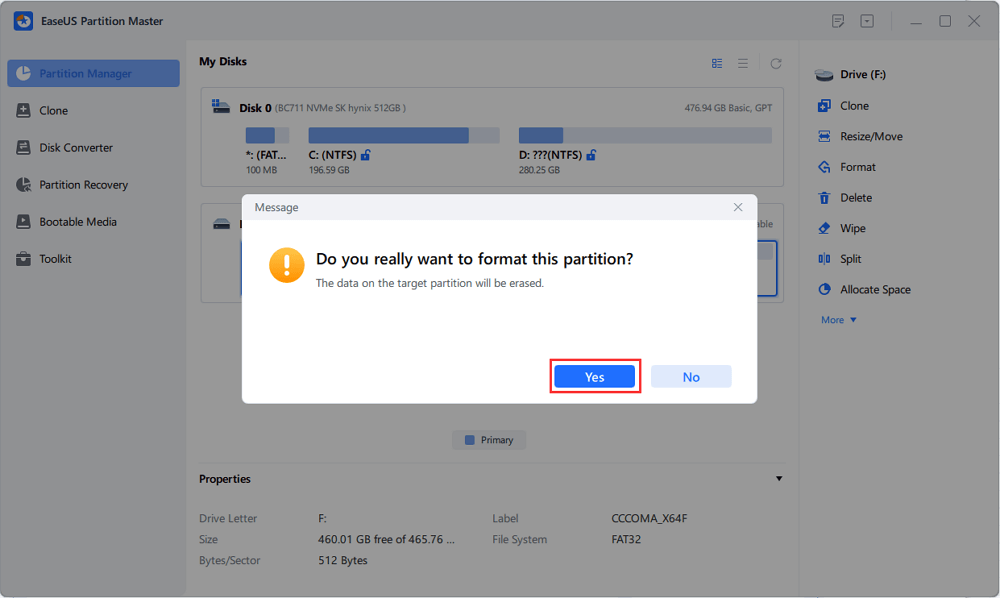
Step 3. In the Warning window, click "Yes" to continue.
Step 4. Click the "Execute 1 Task(s)" button in the top-left corner to review the changes, then click "Apply" to start formatting your external hard drive/USB/SD card.
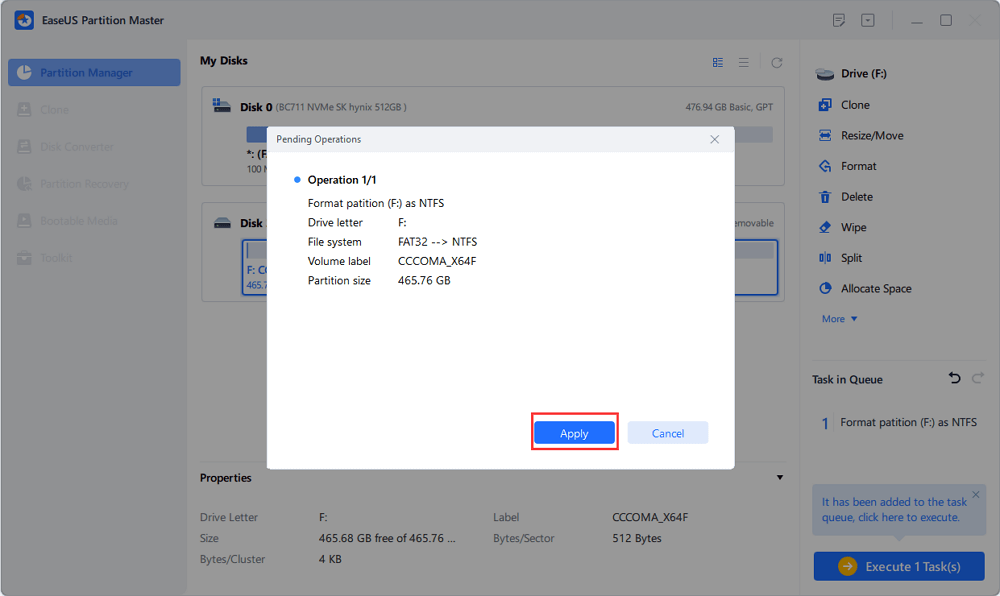
EaseUS Partition Master is a very useful tool for users who have problems gaining access because it can uninstall BitLocker without requiring a password. To prevent compatibility issues, make sure you have the most recent version of the software.
|
Want to learn more about BitLocker in one place, start with our BitLocker troubleshooting guide here. |
Overview of BitLocker
To safeguard your data, Windows comes equipped with BitLocker. It is an encryption tool that encrypts the entire drive. In particular, it strengthens the defenses against theft or loss of external drives by making it more difficult for unauthorized users to access the contents stored on those devices. Though BitLocker offers strong security, it may not be practical for many users.
Advantages and Disadvantages of BitLocker:
| Advantages👍 | Disadvantages👎 |
|---|---|
|
|
Many users get rid of BitLocker from their external hard drives because of these drawbacks. Typical reasons include streamlining access across several devices, avoiding possible data recovery problems, or enhancing general system performance.
PLUS, if you are a Mac user, follow this link to give it a try: Open BitLocker Drive on Mac.
Conclusion
Choosing the appropriate method might make removing BitLocker from an external hard drive easy. Most users find the Control Panel technique easiest and most user-friendly. The graphical interface makes decryption quick and easy.
Command Prompt and PowerShell give command-line users additional control and flexibility. These techniques work but require greater technical understanding.
If you forget your BitLocker password or recovery key, EaseUS Partition Master is advised. Its reliable BitLocker encryption removal without the original password or recovery key makes it an invaluable tool for access concerns.
Overall, the Control Panel is better for speed and convenience. Command Prompt and PowerShell are great for advanced users. For easy password or key troubles, use EaseUS Partition Master.
Choose the method that suits your situation and technical comfort. If you need help, use expert products like EaseUS Partition Master.
FAQs on Removing BitLocker from External Hard Drive
If you have other queries about removing BitLocker from an external hard drive. These often asked questions and answers can help you.
1. Can I remove BitLocker from an external hard drive without a password?
No, you cannot decrypt or remove BitLocker encryption from an external hard drive without the correct password or recovery key while keeping the data. BitLocker is designed to protect your files from unauthorized access, so there is no legitimate way to bypass the encryption.
If you no longer need the data on the drive, you can format the BitLocker-encrypted drive to remove the encryption and make it usable again. However, formatting permanently deletes all files stored on the drive.
2. Does formatting an external hard drive remove BitLocker?
Yes. Formatting an external hard drive removes the BitLocker-encrypted partition and creates a new file system, which removes BitLocker protection from the drive. However, formatting also permanently erases all files stored on the drive. If you still need the data, make sure you have the BitLocker password or recovery key and decrypt the drive instead of formatting it.
3. Does turning off BitLocker remove encryption from an external hard drive?
Yes. Turning off BitLocker decrypts the external hard drive and removes BitLocker protection. During this process, Windows decrypts the data and converts the drive back to a normal unencrypted state.
The time required depends on the drive size, storage speed, and the amount of encrypted data. You can continue using the drive after the decryption process is complete, and your files will remain unchanged.
How Can We Help You
About the Author

Sherly joined EaseUS in 2022 and she has always loved writing articles and enjoys the fun they bring. She receives professional training here, focusing on product performance and other relative knowledge. She has written over 200 articles to help people overcome computing issues.

Written by Tracy King
Tracy became a member of the EaseUS content team in 2013. Being a technical writer for over 10 years, she is enthusiastic about sharing tips to assist readers in resolving complex issues in disk management, file transfer, PC & Mac performance optimization, etc., like an expert.
Product Reviews
-
I love that the changes you make with EaseUS Partition Master Free aren't immediately applied to the disks. It makes it way easier to play out what will happen after you've made all the changes. I also think the overall look and feel of EaseUS Partition Master Free makes whatever you're doing with your computer's partitions easy.
Read More -
Partition Master Free can Resize, Move, Merge, Migrate, and Copy disks or partitions; convert to local, change label, defragment, check and explore partition; and much more. A premium upgrade adds free tech support and the ability to resize dynamic volumes.
Read More -
It won't hot image your drives or align them, but since it's coupled with a partition manager, it allows you do perform many tasks at once, instead of just cloning drives. You can move partitions around, resize them, defragment, and more, along with the other tools you'd expect from a cloning tool.
Read More
Related Articles
-
How to Tell If a Hard Drive Is Dead [Step-by-Step-Guide]
![author icon]() Tracy King/2026/09/23
Tracy King/2026/09/23 -
Mac Install Disk Creator Free Download | 2026 New🔽
![author icon]() Sherly/2026/08/17
Sherly/2026/08/17 -
10 Best Free ISO Burner Software for Windows [New Checklist]
![author icon]() Cici/2026/08/02
Cici/2026/08/02 -
Solved: Xbox 360 Hard Drive Not Detected [5 Ways] 💡
![author icon]() Sherly/2026/09/23
Sherly/2026/09/23
 Cici/2026/08/02