



Content
Page Table of Contents
About the Author
Hot Topics
- New SSD or HDD Is Not Detected
- New SSD or HDD Cannot Be Initialized or Partitioned
- New SSD or HDD Won't Format or Is RAW
- New SSD or HDD Shows Less Capacity Than Expected
- New SSD or HDD Is Slow or Keeps Disconnecting
- New Disk Has Access or I/O Problems
- SSD & HDD Compatibility Problems
- How to Troubleshoot a New SSD or HDD
- When Should You Replace a New SSD or HDD
- FAQs About New SSD & HDD Problems
Installing a new SSD or HDD should normally be a straightforward process, but a drive can still run into problems before it becomes fully usable. Windows may fail to detect the disk, initialization may return an error, or a newly installed SSD may perform far below expectations. In other cases, the drive is detected correctly but cannot be formatted, accessed, or used reliably.
Not every problem with a new drive means that the hardware is defective. A missing drive letter, an unallocated disk, an incompatible M.2 slot, and repeated I/O errors are very different situations and require different solutions.
This guide covers the most common problems that can occur with a new SSD or HDD and explains where to start troubleshooting. Select the symptom that most closely matches your situation, then follow the appropriate troubleshooting path.
Common Problems With New SSDs and HDDs
A new storage device can encounter problems at several stages, from the initial connection to everyday file transfers. Identifying the exact symptom first can save time and prevent unnecessary changes to the disk.
The following table summarizes the most common issues and the area that should be checked first.
| Problem Type | Common Symptoms | What to Check |
|---|---|---|
| Detection problems | New drive does not appear in Windows or BIOS | Connection, BIOS/UEFI, drivers, compatibility |
| Initialization problems | Disk shows as Unknown or Not Initialized | Disk status, partition style, connection, I/O errors |
| Partition problems | Cannot create, delete, or extend a partition | Partition layout, unallocated space, disk status |
| Formatting problems | Drive will not format or formatting fails | File system, write protection, disk errors |
| Capacity problems | Drive shows less space than expected | Capacity calculation, partitions, unallocated space |
| Performance problems | New drive is slower than expected | Interface, configuration, temperature, workload |
| Connection problems | Drive disconnects or disappears | Cable, port, power, enclosure, firmware |
| Access problems | Drive is visible but cannot be opened | File system, permissions, encryption, disk errors |
| Compatibility problems | Drive does not work with a particular PC | Interface, motherboard, M.2 slot, BIOS/UEFI |
A useful distinction is whether the problem occurs before Windows can see the drive or after it has already been detected. If the drive is missing from BIOS/UEFI, start with hardware and compatibility checks. If it appears in Disk Management but not File Explorer, the cause is more likely to involve initialization, partitioning, formatting, or the file system. Share this post
New SSD or HDD Is Not Detected
Detection problems are often the first obstacle after installing a new drive. However, "not detected" does not necessarily mean the same thing in every situation. A disk can be absent from File Explorer while still being visible in Disk Management, or it can disappear from Windows altogether while remaining visible in BIOS/UEFI.
That distinction gives you an important starting point for troubleshooting.
New SSD or HDD Not Detected in Windows
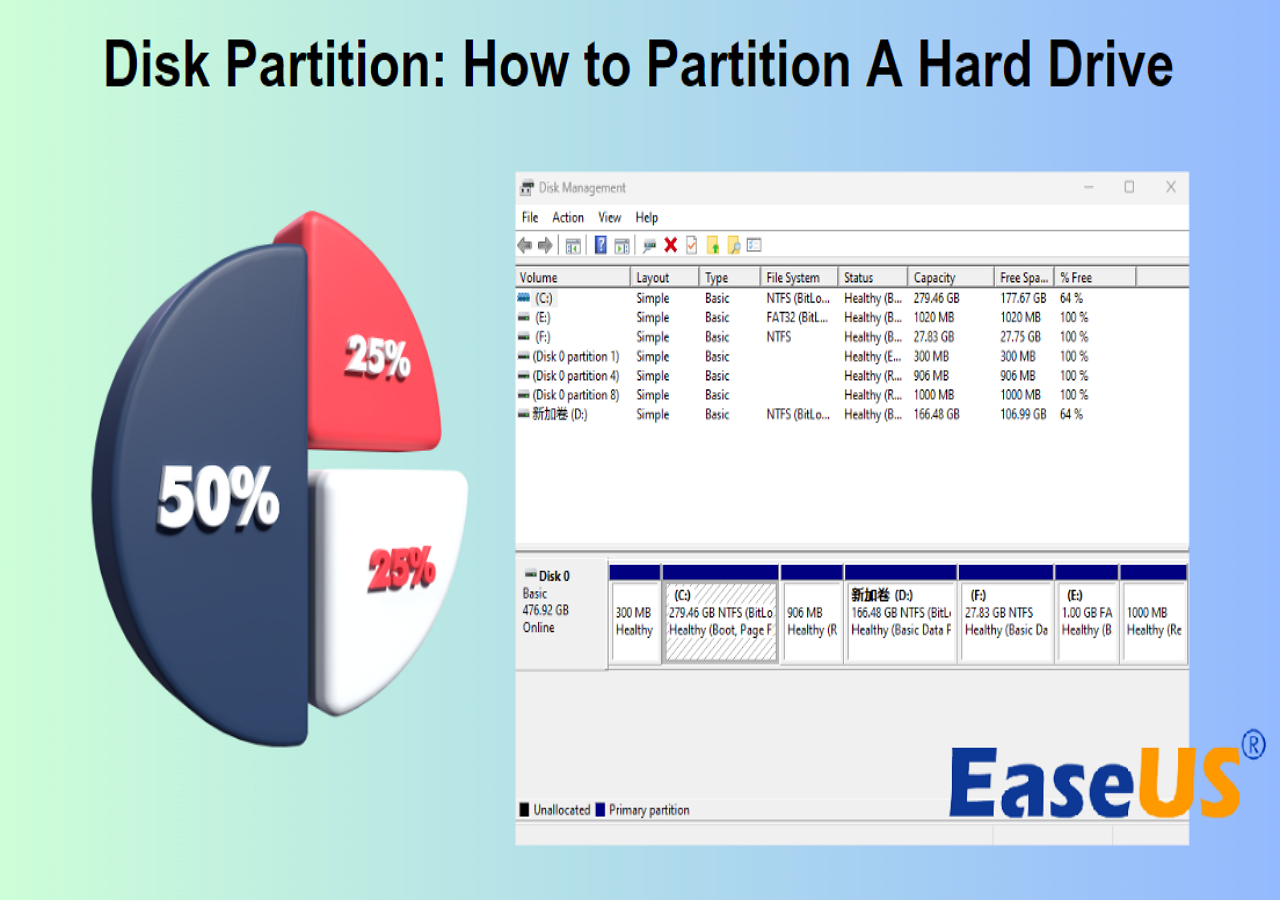
If a new SSD or HDD does not appear in File Explorer, check Disk Management before doing anything else. The drive may already be recognized by Windows but may not have a partition, file system, or drive letter.
If it is missing from Disk Management as well, check Device Manager and BIOS/UEFI to determine whether Windows or the hardware layer is failing to detect it.
New SSD or HDD Not Showing in Disk Management
A drive that is visible in BIOS/UEFI but missing from Disk Management may be affected by drivers, storage-controller configuration, or another Windows-level issue.
If the drive appears in Disk Management with a status such as Unknown, Not Initialized, Offline, or Unallocated, the disk has been detected and the next step is to address its configuration rather than its physical connection.
Learn the details in the full guide on how to fix a disk not showing in Disk Management.
New SSD or HDD Not Detected in BIOS/UEFI
If the drive is not detected by BIOS/UEFI, start with the physical installation. Check the SATA data and power connections for SATA drives, or reseat an M.2 SSD and confirm that the motherboard slot supports the type of drive being installed.
For external storage, test another cable, USB port, or compatible computer. If the drive remains completely undetected, hardware compatibility or a defective device becomes more likely.
New SSD or HDD Cannot Be Initialized or Partitioned
Once Windows recognizes a new disk, it may still need to be initialized and partitioned before it can store files. This stage is usually straightforward, but errors can occur when the disk has an incompatible partition configuration, an unstable connection, or an underlying I/O problem.
If the drive is brand new and empty, initialization and partitioning are normally safe configuration steps. If the disk contains existing data, however, be more cautious before changing its partition structure.
New SSD or HDD Won't Initialize
A new disk that appears as Unknown, Not Initialized may simply need an appropriate partition style. Modern Windows systems generally use GPT, particularly with UEFI-based configurations and large-capacity drives.
If initialization fails with an I/O error or the disk repeatedly disappears during the process, do not treat it as an ordinary partitioning problem. Check the physical connection and the drive's health first.
Cannot Create a Partition on a New Drive
After initialization, Windows may show the disk as unallocated. Creating a partition should normally be possible, but partition creation can fail because of the disk's current status, partition structure, or other configuration issues.
If the drive is empty, a partition manager can provide additional options for creating and configuring partitions when Windows' built-in tools are insufficient.
Cannot Delete or Extend a Partition
Partition operations depend on the existing disk layout. For example, Windows may not be able to extend a partition if the available unallocated space is not positioned directly next to it.
Before deleting a partition, identify what it contains. System, boot, or recovery partitions may be required by Windows, and removing them without understanding their purpose can create additional problems.
New Drive Has Unallocated Space
Unallocated space is not a sign that the drive is broken. It simply means that the space has not yet been assigned to a partition.
On an empty new drive, you can normally use the unallocated area to create a partition. If it sits next to an existing partition, you may also be able to use it to extend that partition.
New SSD or HDD Won't Format or Is RAW
Formatting gives a partition a file system that Windows can use for storing and managing files. A new drive may therefore need to be formatted before normal use, but a failed format should not automatically be followed by repeated formatting attempts.
The key question is whether the drive is empty or already contains data. Formatting an unused new drive is very different from formatting a disk that suddenly appears as RAW after files have been stored on it.
New SSD or HDD Won't Format
A failed format can result from partition problems, write protection, file-system errors, disk errors, or an unstable connection.
Start by checking the drive's status in Disk Management and note the exact error Windows reports. If the disk contains important data, avoid formatting until you have determined whether the data needs to be recovered.
Windows Cannot Complete the Format
When Windows starts formatting but cannot complete the operation, the problem may be related to the partition, file system, disk status, or hardware communication.
Testing the drive with another compatible system can also help separate a Windows configuration problem from a problem with the storage device itself.
Check our full guide on how to fix "the format didn't complete successfully."
New Drive Shows RAW
A RAW volume means Windows cannot currently identify a usable file system on that partition. On a completely empty new drive, formatting may resolve the issue. On a drive that already contains files, formatting can destroy access to the existing data and should not be the first troubleshooting step.
New Drive Is Write-Protected
A write-protected drive may remain readable while refusing write operations. The cause can be a software-level read-only setting, an adapter or device restriction, or a more serious problem with the storage hardware.
Determine where the write protection originates before attempting to remove it.
Cannot Format a Large Drive to FAT32
FAT32 has limitations in Windows' standard formatting tools, particularly for large partitions. If FAT32 is required for compatibility with a particular device, a dedicated formatting utility may be more appropriate.
New SSD or HDD Shows Less Capacity Than Expected
Storage capacity is another common source of confusion with newly installed drives. A drive advertised as 1 TB will not normally appear as exactly 1 TB in Windows because manufacturers and operating systems use different methods of calculating storage capacity.
That expected difference should not be confused with genuinely missing space.
New SSD or HDD Shows Less Capacity
First check the disk's total capacity in Disk Management. If the physical disk reports the expected size but File Explorer shows less usable space, inspect the partition layout.
Recovery partitions, system partitions, or unallocated space can all account for space that is not available as ordinary file storage.
1TB Disk Shows Less Than 1TB
This is generally normal. Drive manufacturers use decimal units when advertising capacity, while operating systems report storage using a different calculation.
If the difference is much larger than expected, however, inspect the disk for hidden or unallocated space rather than assuming that the discrepancy is simply a unit conversion.
New Drive Has Missing Space
When the total disk capacity is correct but some of the space cannot be used, open Disk Management and review the complete partition layout.
If the missing capacity appears as unallocated space, it has not actually disappeared. It can generally be assigned to a new partition or used to extend an existing one when the disk layout permits it.
New SSD or HDD Is Slow or Keeps Disconnecting
A new drive that performs poorly or repeatedly disconnects presents a different class of problem. Performance depends on more than the drive's advertised specification, while connection stability can be affected by everything from a cable to firmware.
It is therefore useful to separate a performance limitation from a stability problem before deciding that the drive is defective.
New Disk Is Slow
If a new SSD is slower than expected, check the interface, PCIe or SATA configuration, motherboard slot, temperature, firmware, and test conditions. An NVMe SSD installed in a lower-bandwidth slot, for example, cannot be expected to reach the same speed as it would under its ideal configuration.
HDD performance is influenced by factors such as rotational speed, workload, and disk technology. Benchmark results should therefore be compared with drives using similar specifications.
NVMe SSD Not Running at Full Speed
For an NVMe SSD, confirm the PCIe generation supported by both the SSD and the motherboard. Also check whether the M.2 slot shares bandwidth with another device or has specific motherboard limitations.
If the configuration is correct but sustained performance still drops significantly, temperature and firmware are worth checking next.
SSD Write Speed Drops
An SSD can deliver high write speeds during short tests and then slow down during long, sustained transfers. Cache behavior, thermal throttling, available free space, and the workload itself can all affect sustained write performance.
A drop in speed alone does not necessarily indicate that the SSD is failing.
Disk Keeps Disconnecting
Repeated disconnections should be investigated more carefully than a one-time detection failure. For an internal drive, check the data and power connections, motherboard slot, drivers, and firmware. For an external drive, test another USB cable and port and avoid unreliable hubs during troubleshooting.
If the drive repeatedly disconnects across different connections or computers, check its health and consider whether the device itself may be defective.
New Disk Has Access or I/O Problems
Some drives are detected correctly but become difficult or impossible to use. Windows may report I/O errors, refuse to read or write data, mark the disk as read-only, or freeze when the drive is accessed.
These symptoms deserve more attention because they can indicate problems below the normal partition or configuration layer.
New Disk Shows I/O Errors
I/O errors mean that Windows is having difficulty completing communication with the storage device. A faulty cable or connection can cause them, but recurring errors may also point to controller, firmware, or hardware problems.
Check the connection first, then review the drive's health and diagnostic information.
New SSD or HDD Cannot Be Read or Written
If Windows can see the disk but cannot reliably read or write data, check its file system, disk status, permissions, and available space.
When read or write errors continue after basic configuration issues have been ruled out, run an appropriate health diagnostic rather than repeatedly attempting the same file operation.
New SSD or HDD Is Read-Only
A drive can become read-only because of a disk attribute or operating-system setting. However, persistent write failures can also be a warning that the device is experiencing a more serious problem.
If the drive has started showing other errors at the same time, prioritize data protection and health diagnostics.
New SSD or HDD Cannot Be Accessed
A detected drive may still be inaccessible because its volume is RAW, lacks a drive letter, has file-system problems, or is affected by permissions or encryption.
Disk Management can help identify the state of the volume before you attempt a potentially destructive fix.
New Drive Causes Windows to Freeze
If Windows consistently freezes when the new drive is connected or accessed, disconnecting it temporarily can help determine whether the storage device is involved.
If the problem follows the drive across different ports or systems, investigate its health, firmware, and hardware condition.
SSD & HDD Compatibility Problems
Not every storage problem is caused by the drive itself. Compatibility issues are particularly common with M.2 SSDs because the M.2 form factor does not by itself specify the underlying storage interface.
Before troubleshooting a new drive as if it were defective, confirm that the drive, motherboard, interface, and operating system are actually compatible.
SSD or HDD Is Not Compatible With the PC
Check the drive's form factor and interface against the motherboard or computer specifications. For M.2 SSDs, confirm whether the slot supports SATA, NVMe, or both.
For SATA drives, check the available data and power connections as well as any motherboard-specific port limitations.
NVMe SSD Not Working in an M.2 Slot
An M.2 slot may have specific interface or PCIe requirements. Some slots support NVMe storage while others may support SATA-based M.2 devices, and some share resources with other motherboard connections.
The motherboard manual is the most reliable place to confirm the capabilities of a particular slot.
SATA SSD or HDD Not Detected After Installation
Check the SATA data cable, power connection, SATA port, and BIOS settings. If the drive is visible in BIOS but not Windows, move to Windows-level troubleshooting instead of repeatedly reconnecting the hardware.
SSD Not Recognized After Windows Installation
If an SSD was detected during Windows installation but behaves differently afterward, check storage-controller drivers, firmware, partition configuration, and Windows settings.
The fact that the installer detected the SSD is useful evidence: it suggests that the hardware was at least recognized at that stage.
How to Troubleshoot a New SSD or HDD
When a new drive does not work as expected, the safest approach is to move from the simplest possibilities toward more advanced diagnostics. Changing partitions or formatting the disk too early can sometimes make an existing problem harder to diagnose.
Use the following sequence as a general troubleshooting framework.
1️⃣. Check the Physical Connection
Inspect the SATA data and power cables, M.2 installation, motherboard slot, USB cable, or external enclosure, depending on the type of drive.
If possible, test another compatible cable or port. A simple connection problem can produce symptoms that look very similar to drive failure.
2️⃣. Check BIOS/UEFI Detection
Next, determine whether the computer can detect the drive before Windows loads.
If BIOS/UEFI recognizes the drive but Windows does not, focus on drivers, disk configuration, partitioning, and the operating system. If BIOS/UEFI cannot see the drive at all, investigate hardware connections, compatibility, firmware, and possible device failure.
3️⃣. Check Disk Management
Disk Management provides a clearer picture of how Windows sees the physical disk. Look for statuses such as Unknown, Not Initialized, Offline, Unallocated, or RAW.
This information can often identify the next troubleshooting step without requiring additional diagnostic software.
4️⃣. Check Drivers and Firmware
If the physical connection and disk configuration appear normal, check for appropriate storage-controller, motherboard, USB, or SSD firmware updates.
Manufacturer-specific utilities can be particularly useful when troubleshooting a new SSD or HDD because they may provide diagnostics or firmware information that Windows does not expose directly.
5️⃣. Check the File System and Disk Errors
If the drive is detected but cannot be read or written correctly, determine whether the problem is related to the file system or the underlying storage device.
Windows tools such as CHKDSK can help investigate file-system-related problems, while SMART and hardware diagnostic tools serve a different purpose.
6️⃣. Run Health and Diagnostic Tests
If the drive continues to behave abnormally, check its health status, SMART information, temperature, performance, and potential bad sectors.
For a broader approach to checking a new drive, see SSD & HDD Health and Diagnostics: Checks, Tests & Monitoring.
7️⃣. Consider Replacement or Warranty
A new drive should not require extensive repair attempts simply to become reliable. If it continues to produce SMART warnings, I/O errors, bad sectors, repeated disconnections, or other hardware-related symptoms after basic troubleshooting, replacement may be the more appropriate solution.
When Should You Replace a New SSD or HDD?
Troubleshooting makes sense when the cause is a configuration, connection, partition, or software problem. It becomes less useful when a new drive repeatedly demonstrates signs of physical or electronic failure.
Before deciding to replace the drive, look for a consistent pattern rather than relying on one unusual result.
Signs of a Potential Hardware Problem
- Persistent SMART warnings
- Repeated I/O errors
- Significant or increasing bad sectors
- Frequent unexplained disconnections
- The drive disappearing from BIOS/UEFI
- Persistent read or write failures
- Severe performance problems that cannot be explained by configuration
- Abnormal mechanical noises from an HDD
If these symptoms continue across different cables, ports, or computers, the likelihood of a hardware-related problem increases.
When to Return or Replace a New Drive
If a newly purchased SSD or HDD repeatedly demonstrates hardware-related problems, avoid relying on it for important data while continuing to troubleshoot indefinitely.
Back up any accessible data, record the relevant error messages or diagnostic results, and check the seller's return policy or manufacturer's warranty. For a genuinely new drive, replacement is often a better long-term solution than trying to make an unreliable device usable.
FAQs About New SSD & HDD Problems
1. Why Is My New SSD or HDD Not Showing Up?
Check whether the drive appears in BIOS/UEFI, Device Manager, and Disk Management. If Windows detects it but File Explorer does not, check its partition, file system, and drive letter before assuming there is a hardware problem.
2. Why Can't I Initialize My New SSD or HDD?
Initialization can fail because of an I/O error, connection problem, incompatible partition configuration, or potential hardware failure. Check the disk status and exact error message before making changes.
3. Why Won't My New SSD or HDD Format?
A failed format can be caused by a RAW or corrupted file system, write protection, partition problems, disk errors, or an unstable connection. If the drive contains important files, do not format it before determining whether the data needs to be recovered.
4. Why Does My New SSD or HDD Show Less Capacity?
Some difference between advertised and Windows-reported capacity is normal because storage manufacturers and operating systems calculate capacity differently. If significantly more space is unavailable, check for partitions or unallocated space.
5. Why Is My New SSD So Slow?
Check the SSD's interface, PCIe generation, motherboard slot, temperature, firmware, and benchmark conditions. An SSD may also have different short-term and sustained write performance.
6. Why Does My New SSD or HDD Keep Disconnecting?
Start with the physical connection, cable, port, power source, enclosure, and firmware. If the drive continues to disconnect across different connections or computers, run health diagnostics and consider a possible hardware problem.
7. Should I Format a New Drive That Shows RAW?
If the drive is completely new and contains no data, formatting may be appropriate. If it contains important files, do not format it simply because Windows reports RAW; investigate the file system and consider data recovery first.
8. Should I Replace a New SSD or HDD With Errors?
If the drive repeatedly produces SMART warnings, I/O errors, bad sectors, unexplained disconnections, or other hardware-related symptoms after basic troubleshooting, using the warranty or return policy is generally preferable to relying on the problematic drive.
Related New Disk Resources
Problems are only one part of managing a new storage device. A newly purchased SSD or HDD also needs to be prepared correctly, checked for potential issues, and, in some cases, used as part of an upgrade or migration.
Continue with the other resources in the New Disk series:
- New Disk Setup & Initialization — Learn how to prepare, initialize, partition, and format a new SSD or HDD.
- New Disk Health & Diagnostics — Check the health, SMART status, temperature, performance, and other diagnostic information of a new drive.
- New Disk Upgrade, Migration & Space Management — Learn how to migrate an operating system or files and make better use of storage space on a new drive.
How Can We Help You
About the Author

Sherly joined EaseUS in 2022 and she has always loved writing articles and enjoys the fun they bring. She receives professional training here, focusing on product performance and other relative knowledge. She has written over 200 articles to help people overcome computing issues.
Product Reviews
-
I love that the changes you make with EaseUS Partition Master Free aren't immediately applied to the disks. It makes it way easier to play out what will happen after you've made all the changes. I also think the overall look and feel of EaseUS Partition Master Free makes whatever you're doing with your computer's partitions easy.
Read More -
Partition Master Free can Resize, Move, Merge, Migrate, and Copy disks or partitions; convert to local, change label, defragment, check and explore partition; and much more. A premium upgrade adds free tech support and the ability to resize dynamic volumes.
Read More -
It won't hot image your drives or align them, but since it's coupled with a partition manager, it allows you do perform many tasks at once, instead of just cloning drives. You can move partitions around, resize them, defragment, and more, along with the other tools you'd expect from a cloning tool.
Read More
Related Articles
-
How to Partition SSD Safely in 2026 | Complete Guide
![author icon]() Jean/2026/09/22
Jean/2026/09/22 -
How to Remove Write Protection and Format Write Protected SSD [6+ Fixes]
![author icon]() Jean/2026/09/22
Jean/2026/09/22 -
New Disk Upgrade, Migration & Space Management
![author icon]() Joey Albert/2026/09/13
Joey Albert/2026/09/13 -
How to Resize EFI System Partition on Windows 11/10/8/7
![author icon]() Daisy/2026/07/08
Daisy/2026/07/08
 Jean/2026/09/22
  Joey Albert/2026/09/13
  Daisy/2026/07/08