



Content
Page Table of Contents
About the Author
Hot Topics
Key Takeaways:
◾You can retrieve your BitLocker recovery key from your Microsoft account, Azure AD, Active Directory, a saved file, a USB drive, or a printed copy, depending on how BitLocker was set up.
◾If you can't find the BitLocker recovery key, you can use EaseUS Partition Master to automatically retrieve it or turn off BitLocker in the boot environment.
If your Windows PC suddenly asks for a BitLocker recovery key, you need to retrieve the key. The BitLocker recovery key is often stored in one of a few common places.
BitLocker is designed to protect data. When it detects that something about the device has changed, it asks for the recovery key to regain access. This can happen after a firmware update, hardware change, system reset, or other security-related event. In most cases, the recovery key is still available if you know where to look. This guide walks through how to retrieve a BitLocker recovery key.
What Is a BitLocker Recovery Key?
A BitLocker recovery key is a 48-digit code that unlocks a protected drive. Windows asks for it when normal access is blocked. The BitLocker recovery key is different from your Windows password, PIN, or Microsoft account password.
Each BitLocker recovery screen also shows a BitLocker recovery key ID. That ID helps you match the right key if you have more than one saved. Before doing anything else, write down the first eight digits of the key ID. It can save a lot of time later.
How to Retrieve BitLocker Recovery Key
There are several common places to find your BitLocker recovery key. The recovery key can be stored in different places depending on how BitLocker was set up. Where Is the BitLocker Recovery Key Stored? Let's have an overview of the locations:
- Your Microsoft account
- A work or school account (Microsoft Entra ID)
- Active Directory in a business network
- A USB flash drive
- A text file you saved earlier
- A printed copy
Method 1. Retrieve the BitLocker Recovery Key from Your Microsoft Account
For many personal PCs, the recovery key is saved in the Microsoft account that was used on the device. This is the first place most users should check. If you signed in to Windows with a Microsoft account when BitLocker was enabled, your recovery key was probably backed up online.
Follow these steps to retrieve the BitLocker recovery key:
Step 1. Open a browser on another device if your PC is locked.
Step 2. Sign in to your Microsoft account: https://account.microsoft.com/account.
Step 3. Click Devices.
Step 4. Find your computer and choose "Info & support" > "Manage recovery keys."
Step 5. View the saved BitLocker recovery key.
Step 6. Match the Key ID shown on your locked PC with the Key ID listed online.
Step 7. Enter the 48-digit recovery key to unlock your drive.
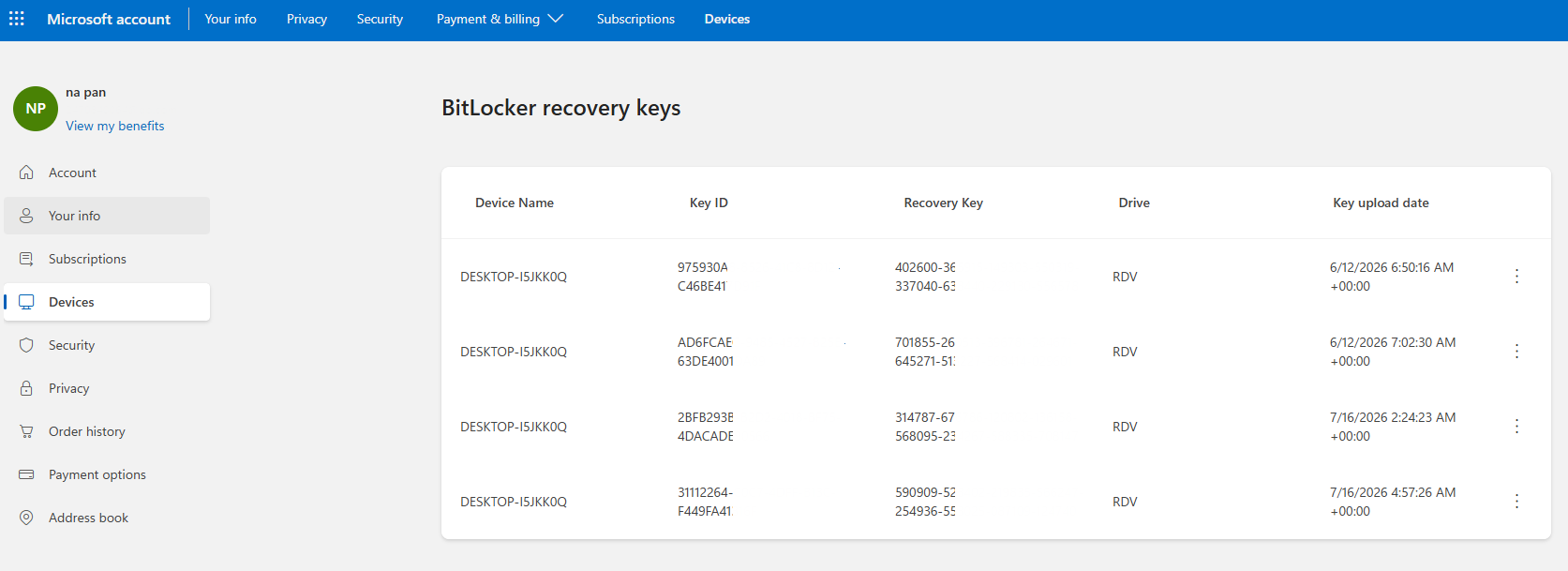
If you have several devices, double-check that you choose the correct recovery key. If the computer was set up by another person, the key may be in their account instead of yours.
Method 2. Check Your Work or School Account
If your computer belongs to your company or school, the recovery key is often managed by your IT department. Many organizations store BitLocker keys in Microsoft Entra ID or Active Directory.
If you use a work or school account, retrieve BitLocker recovery key with the following steps:
Step 1. Contact your IT administrator.
Step 2. Provide the Recovery Key ID shown on the BitLocker screen.
Step 3. Ask them to look up the matching recovery key.
Method 3. Retrieve BitLocker Recovery Key from Active Directory
In many business environments, BitLocker recovery keys are stored in Active Directory.
- If you're an IT administrator, you can retrieve the key through Active Directory Users and Computers or the BitLocker Recovery Password Viewer.
- If you're not an administrator, contact your IT team instead.
Method 4. Look for a Saved Recovery Key File
During BitLocker setup, Windows lets you save the recovery key as a text file.
Think about where you usually save important files. Common locations include:
- Documents
- Desktop
- Downloads
- External hard drives
- Cloud storage folders
The file name might include words like "BitLocker Recovery Key." If you have backups of your files, search them as well.
For a complete overview of BitLocker management, see our [BitLocker Management and Operations Guide].
Method 5. Check a USB Flash Drive
Some users choose to save the recovery key to a USB drive. You may find the BitLocker recovery key through the steps:
Step 1. Connect any USB drives you used during Windows setup.
Step 2. Open the drive and look for a text file containing the recovery key.
📖Note: Don't confuse this with a Windows installation USB. The recovery key is stored as a separate text document.
Method 6. Find a Printed Copy
When you enable BitLocker, Windows also gives you the option to print the recovery key. So, if you want to retrieve the BitLocker recovery key, you can check places where you keep important documents, such as:
- File folders
- Home office drawers
- Safe boxes
- Document organizers
Many people forget they printed the key years ago. So, please check them again. And if you think these methods are helpful, share them with others!

What If You Can't Retrieve the BitLocker Recovery Key?
If you've tried every possible method above and still can't retrieve the BitLocker recovery key, don't give up. There are still a couple of things you can try before reinstalling Windows.
EaseUS Partition Master can help you manage BitLocker drives more easily. You can use it to check encrypted partitions, manage the drive, and handle BitLocker-related operations from one clear interface. EaseUS Partition Master offers two options to fix the "Can't retrieve BitLocker recovery key" issue.
Option 1. Retrieve the BitLocker Recovery Key Automatically
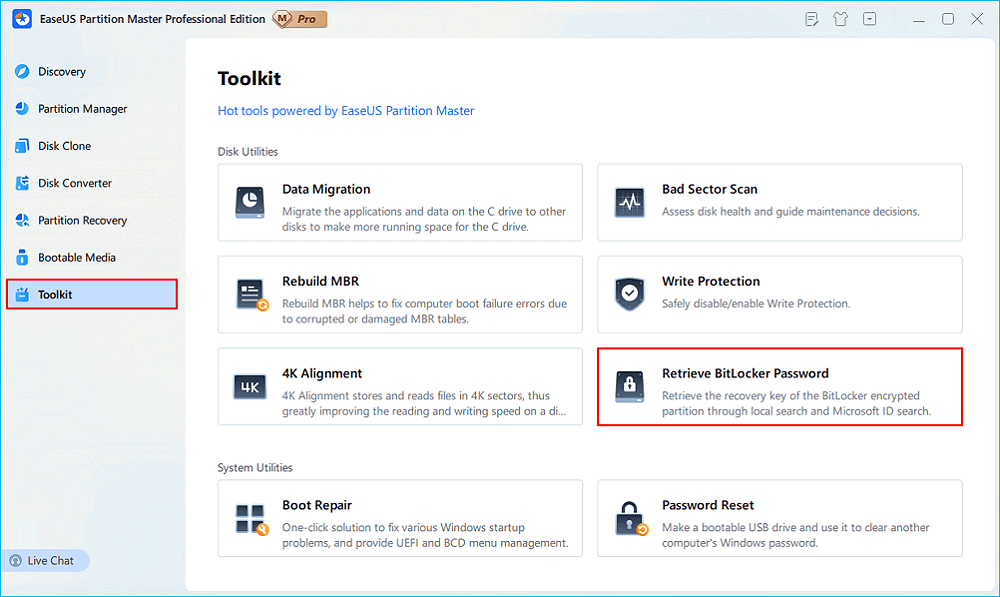
If Windows is still accessible or the recovery key was previously saved on your computer, EaseUS Partition Master can help you locate it more easily. This tool has a BitLocker key finder feature to scan for available recovery keys stored on the system. Here is how to retrieve BitLocker recovery key with EaseUS Partition Master.
Step 1. Install and launch EaseUS Partition Master. Under the Toolkit tab, select the "Retrieve BitLocker Password" option.
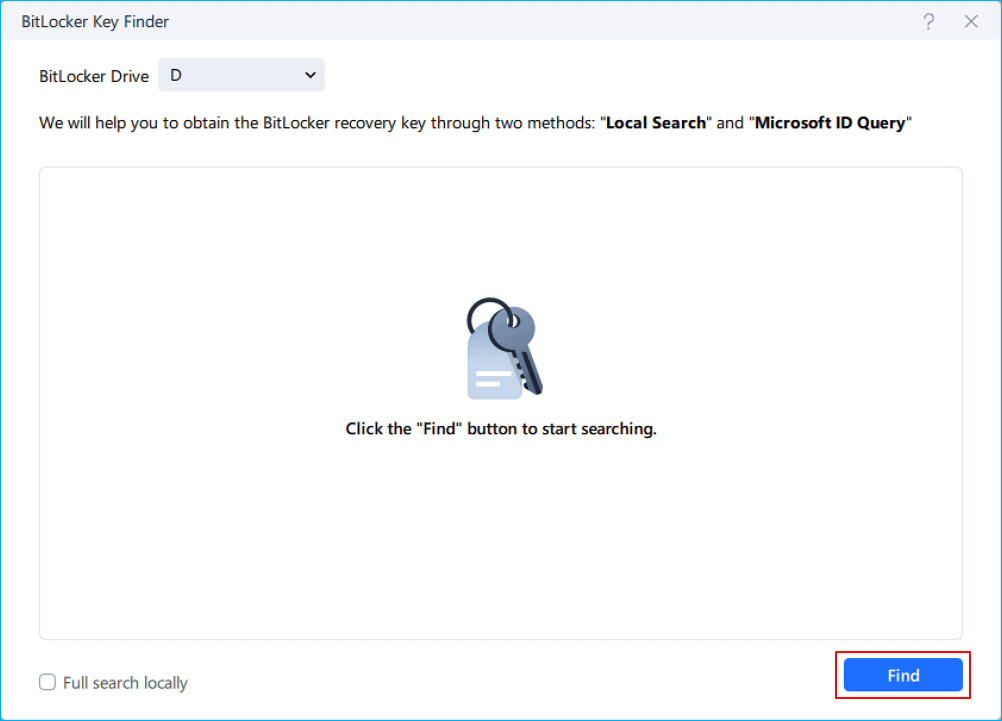
Step 2. It'll automatically detect your encrypted drive. Please click the "Find" button to search the BitLocker recovery key on your encrypted drive.
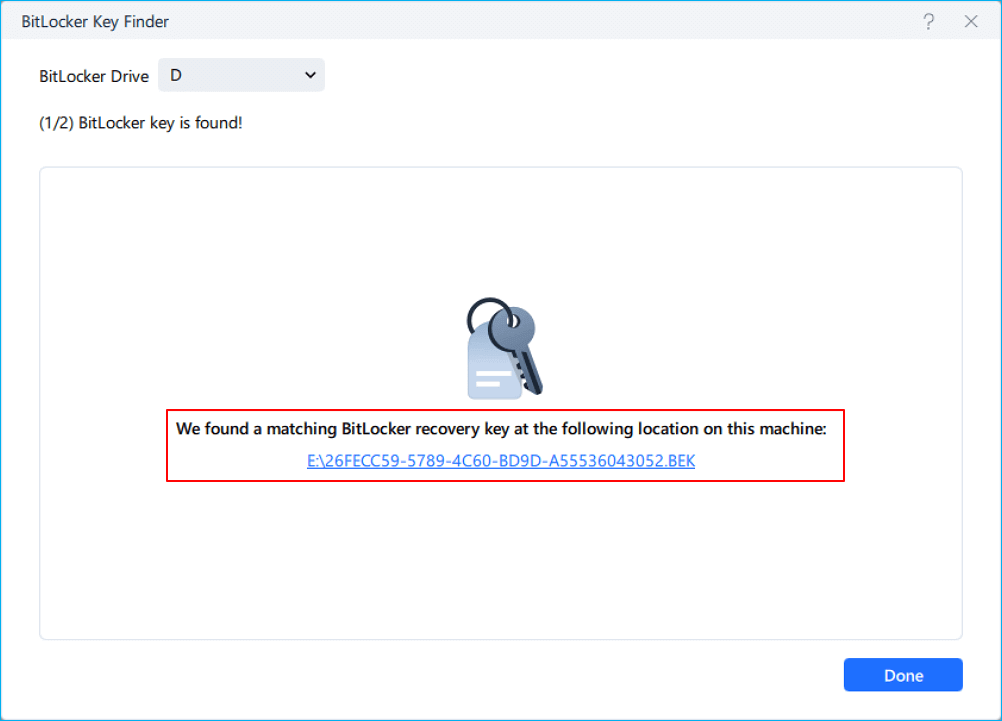
Step 3. In the next window, you'll see the retrieved BitLocker recovery key.
Option 2. Create a Bootable USB to Unlock BitLocker
Sometimes the bigger problem is that Windows won't boot at all. EaseUS Partition Master lets you create a bootable USB drive on another working computer. You can then start the locked PC from the USB drive and access a recovery environment.
If you're dealing with both a BitLocker lock screen and a system that won't boot, follow these steps:
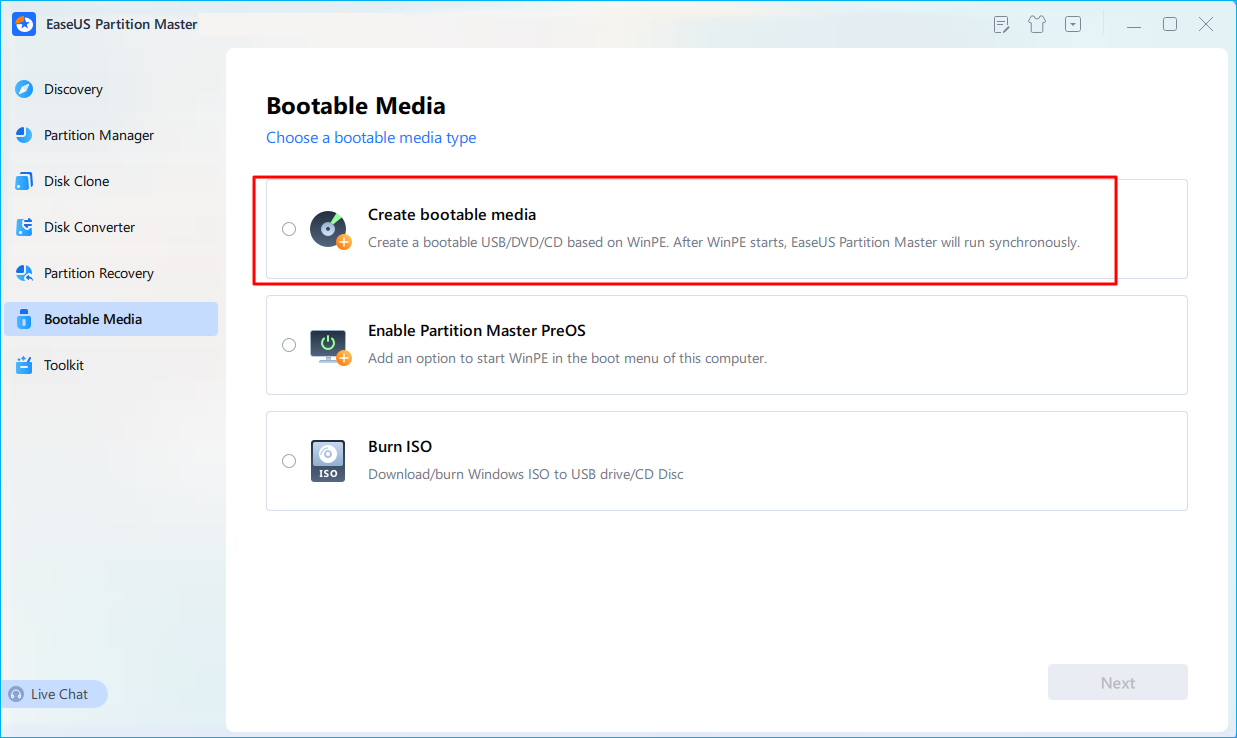
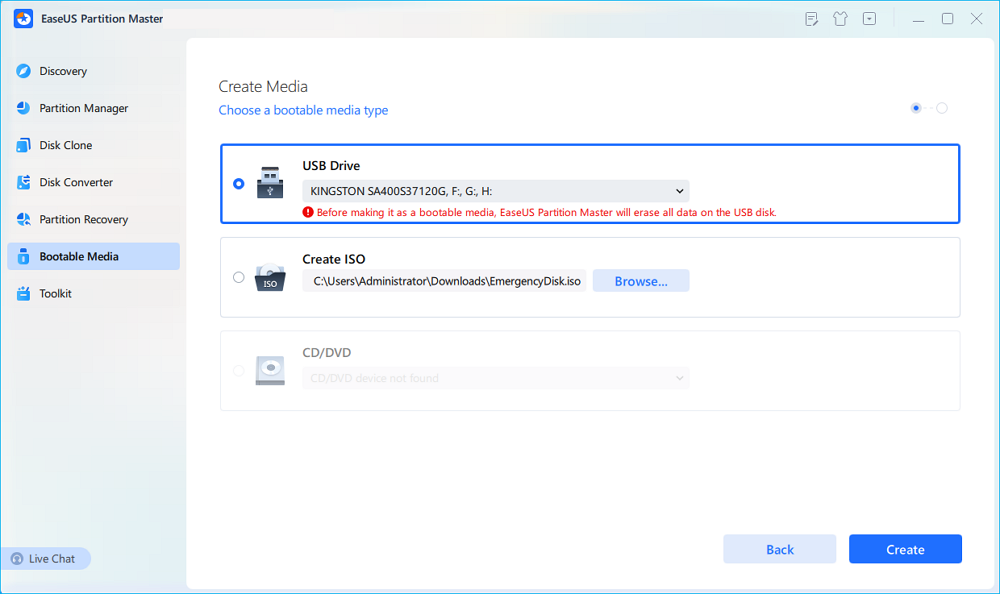
Step 1. First, connect a USB to the PC running properly. Launch EaseUS Partition Master, navigate to "Bootable Media" section, and click "Create bootable media" option. Click "Next" to continue.
Step 2. Select the target USB drive and click "Create" to continue. Please back up your data in advance since this will erase all data on the USB drive. Then, click "yes" to confirm when you see the warning. Do not exit EaseUS Partition Master until it's done.
Step 3. Connect the bootable USB to the BitLocker encrypted PC and restart PC. During the reboot, press the BIOS key (F2/F8/F12/DEL/ESC) to access BIOS and set the bootable USB as the boot drive. This PC will automatically boot from the USB disk.
Step 4. EaseUS Partition Master will automatically unlock the BitLocker encrypted drive and you can see a "unlock" icon.
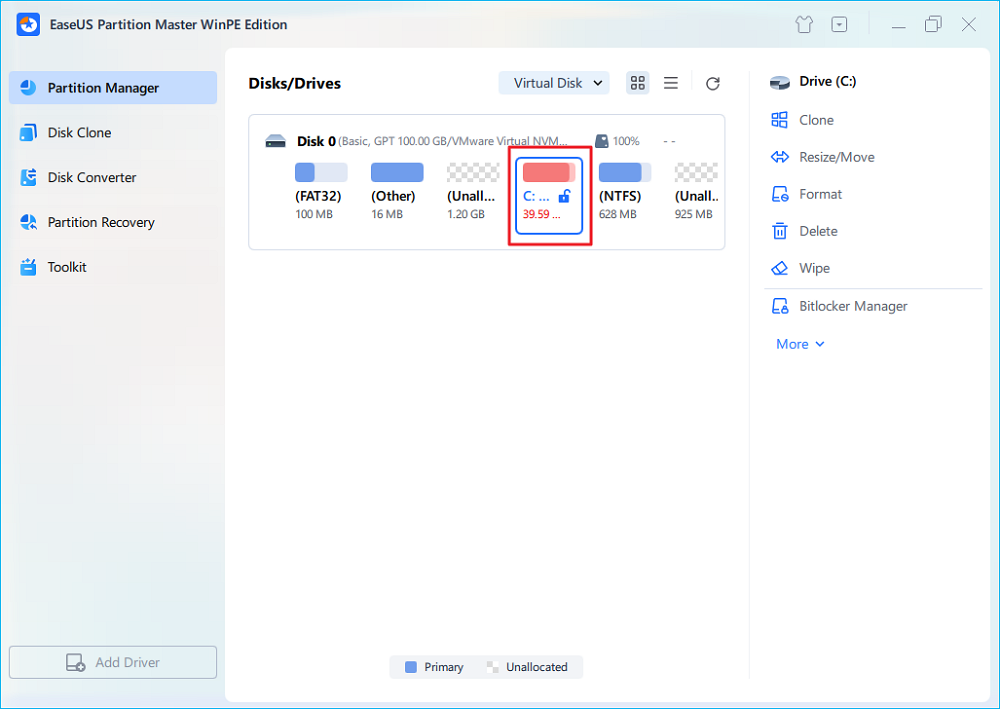
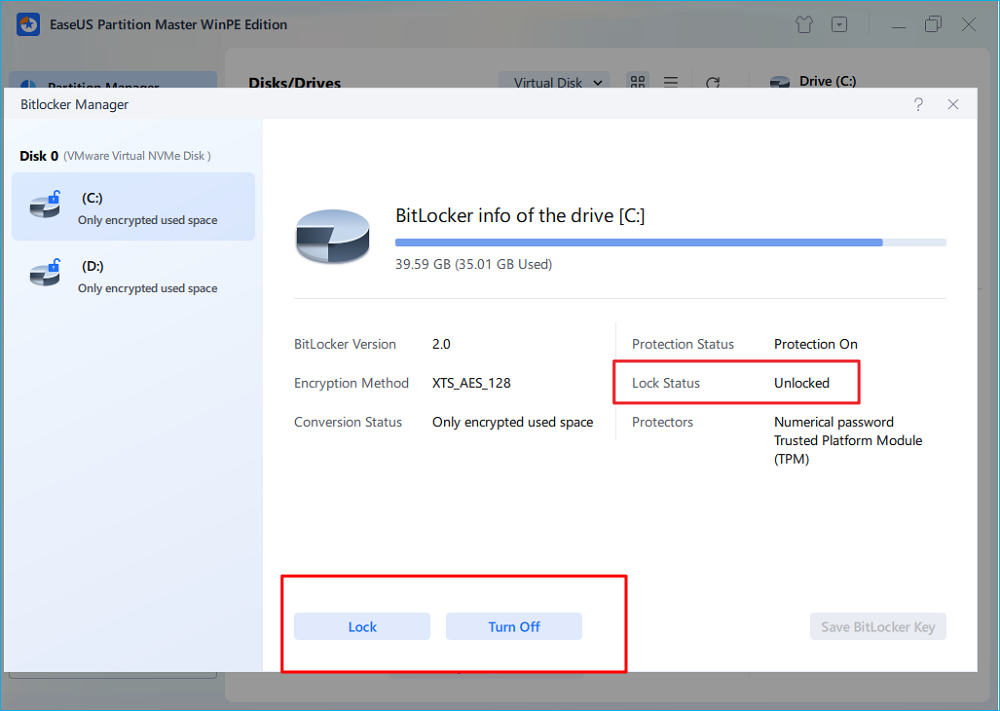
Step 5. Hover the mouse on the BitLocker partition; you can see more info of this partition and manage the BitLocker partition such as locking it or turning off BitLocker.
Conclusion
If your computer is asking for a BitLocker recovery key, don't panic. In most cases, the key has already been saved somewhere during setup. You can retrieve the BitLocker recovery key from your Microsoft account. Then check your work account, USB drives, saved files, and printed copies. If the device is managed by a company, your IT administrator can often help retrieve the key.
If you encounter an issue when dealing with BitLocker, use EaseUS Partition Master as an excellent BitLocker manager. It helps you find the BitLocker recovery key more easily.
Frequently Asked Questions
1. Why Is Windows Suddenly Asking for the BitLocker Recovery Key?
- A BIOS update can trigger a security check.
- A TPM reset can also require the recovery key.
- Changing boot settings or Secure Boot configuration can have the same result.
- Replacing hardware is another common cause.
- Some Windows updates can trigger BitLocker recovery on certain systems.
2. Can I retrieve a BitLocker recovery key without logging into Windows?
Yes. If the key is backed up to your Microsoft account, a work account, or another storage location, you can retrieve it from another device.
3. Can I bypass the BitLocker recovery key?
No. You can't bypass BitLocker encryption without the correct recovery key. But you can create a bootable USB and use it to turn off BitLocker.
4. Why doesn't my Microsoft account have the recovery key?
You may store the recovery key in other places. The key might be saved under another Microsoft account. Business devices usually store recovery keys through the organization's management system instead.
5. Does reinstalling Windows remove BitLocker?
Reinstalling Windows removes the existing operating system, but it also erases data if the encrypted drive must be formatted first. Recover your files before reinstalling if necessary.
How Can We Help You
About the Author

Sherly joined EaseUS in 2022 and she has always loved writing articles and enjoys the fun they bring. She receives professional training here, focusing on product performance and other relative knowledge. She has written over 200 articles to help people overcome computing issues.

Written by Joey Albert
Joey is an enthusiast of science and technology. With a passion for uncovering the latest tech innovations, she creates clear, engaging how-to guides that make technology accessible and enjoyable for all.
Product Reviews
-
I love that the changes you make with EaseUS Partition Master Free aren't immediately applied to the disks. It makes it way easier to play out what will happen after you've made all the changes. I also think the overall look and feel of EaseUS Partition Master Free makes whatever you're doing with your computer's partitions easy.
Read More -
Partition Master Free can Resize, Move, Merge, Migrate, and Copy disks or partitions; convert to local, change label, defragment, check and explore partition; and much more. A premium upgrade adds free tech support and the ability to resize dynamic volumes.
Read More -
It won't hot image your drives or align them, but since it's coupled with a partition manager, it allows you do perform many tasks at once, instead of just cloning drives. You can move partitions around, resize them, defragment, and more, along with the other tools you'd expect from a cloning tool.
Read More
Related Articles
-
How to Reset Windows 7 Password without Disk [2026🔥]
![author icon]() Cici/2026/06/17
Cici/2026/06/17 -
Easy Solutions to Fix "You cannot format this volume" on Windows 11/10
![author icon]() Tracy King/2026/08/13
Tracy King/2026/08/13 -
Best Bootable Manager Software for Windows 2026 Recommend
![author icon]() Tracy King/2026/08/13
Tracy King/2026/08/13 -
[Fixed] BitLocker Backup Recovery Key Option Missing
![author icon]() Cici/2026/08/13
Cici/2026/08/13
 Cici/2026/06/17
  Tracy King/2026/08/13