


Page Table of Contents

Many opt for cloning because it allows them to transfer Windows to the new HDD/SSD without having to reinstall. But what if you try to boot the cloned SSD, and the system fails to find the operating system? There are many reasons for this, but we can fix it by making a few changes. This post resolves the "no operating system found after cloning" issue with practical solutions.
Quick Guide: Fix No Operating System Found After Cloning
| Possible Cause | Recommended Fix |
| SSD is not detected correctly | Fix 1. Check the SSD connection and BIOS detection |
| Incorrect boot order or boot mode | Fix 2. Set the correct boot priority and UEFI/Legacy mode |
| Corrupted Windows startup files | Fix 3. Run Windows Startup Repair |
| Missing or damaged MBR/BCD | Fix 4. Repair the boot configuration using Bootrec |
| Incorrect active partition | Fix 5. Set the correct system partition as Active |
| Incomplete or failed cloning | Fix 6. Reclone the entire system disk |
Important: Before making changes to partitions or boot files, back up important data whenever possible. If your old HDD/SSD is still working, keep it unchanged until the new drive boots successfully.
Why Does My Computer Say No Operating System Found After Cloning?
After cloning a hard drive, Windows may fail to boot due to missing boot files, incorrect settings, or partition issues. Here are five common causes.
- Incomplete Disk Cloning - Cloning only the C: drive or an interrupted process may leave essential boot partitions missing.
- Incorrect BIOS Boot Settings - The computer may boot from the wrong drive or use an incompatible boot mode (UEFI/Legacy).
- Missing or Corrupted EFI Partition - If the EFI System Partition (ESP) is missing or damaged, UEFI cannot find Windows Boot Manager.
- Corrupted Boot Configuration Data (BCD) - Missing or incorrect BCD files may prevent the system from locating Windows.
- Incorrect Active Partition - On Legacy BIOS/MBR systems, the boot partition must be marked as active. Otherwise, Windows may fail to start.
Note: The active partition flag does not apply to UEFI/GPT systems.
How to Fix No Operating System After Cloning HDD/SSD
Before trying the following fixes, disconnect unnecessary USB drives, memory cards, and external storage devices. If possible, disconnect the original HDD/SSD temporarily and test the cloned drive by itself. This helps prevent the computer from booting from the wrong disk.
Fix 1. Check the SSD Connection and BIOS Boot Priority
The first thing to check is whether your computer can detect the cloned SSD. If the SSD is not properly connected or is incompatible with the computer, Windows cannot boot from it.
Step 1. Shut down your computer and disconnect the power supply.
Step 2. Check whether the cloned SSD is properly installed. If you are using an external enclosure or USB adapter, reconnect it and make sure the connection is stable.
Step 3. Restart your computer and enter BIOS/UEFI settings. Depending on your computer manufacturer, you may need to press F2, F10, F12, Del, or Esc during startup.
Step 4. Find the Storage, Boot, or System Information section and check whether the new SSD is detected.
Step 5. If the SSD is detected, open the Boot menu and check the boot priority. Select Windows Boot Manager associated with the cloned SSD as the first boot option when available.
Step 6. Save the changes and restart your computer.
If the SSD is detected but Windows still cannot start, continue to the next solution.
Fix 2. Verify UEFI/Legacy Boot Mode and GPT/MBR
An incorrect boot mode is another common reason why a cloned hard drive cannot boot. Your computer's firmware mode should match the boot configuration of the cloned Windows installation. Here's how to check the partition style of your cloned SSD.
Step 1. Connect the original working drive or another Windows installation to your computer and boot into Windows.
Step 2. Press Win + X and select Disk Management.
Step 3. Right-click the cloned SSD's disk label (such as Disk 1) and select Properties.
Step 4. Open the Volumes tab and find the Partition style field.
You will see one of the following:
- GUID Partition Table (GPT)
- Master Boot Record (MBR)
Step 5. Restart your computer and enter BIOS/UEFI settings. Check the boot mode and make sure it matches the original Windows installation.
| Partition Style | Typical Boot Mode | Required Boot Partition |
| GPT | UEFI | EFI System Partition (ESP) |
| MBR | Legacy BIOS/CSM | Active system partition |
If your original Windows installation used UEFI/GPT, keep the computer in UEFI mode. If it used Legacy BIOS/MBR, use the corresponding Legacy or CSM mode when supported.
Do not randomly switch between UEFI and Legacy modes. Changing the boot mode without matching the disk configuration can create additional boot problems. You should also avoid converting MBR to GPT simply to fix this error unless you have confirmed that conversion is necessary.
Fix 3. Run Windows Startup Repair Tool
Windows Startup helps the system identify the OS partition and boot the PC. However, the operating system will not be recognized if the startup files are corrupted. Therefore, we need to perform a startup repair to diagnose and repair faulty files and fix the issue.
To perform a startup repair, enter the Windows Recovery Environment (WinRE). So, create a bootable USB installation media.
Step 1. Connect the bootable USB, and enter the Windows Recovery Environment (winRE).
- Restart the PC.
- While restarting, press the power button for 10 seconds to switch off the device.
- Repeat the exact three times to pop up the Automatic Repair screen.
- Click the Advanced options.

Step 2. On the Choose an option screen, go to Troubleshoot > Advanced options.
Step 3. From the Advanced options, select Startup Repair and click Restart.
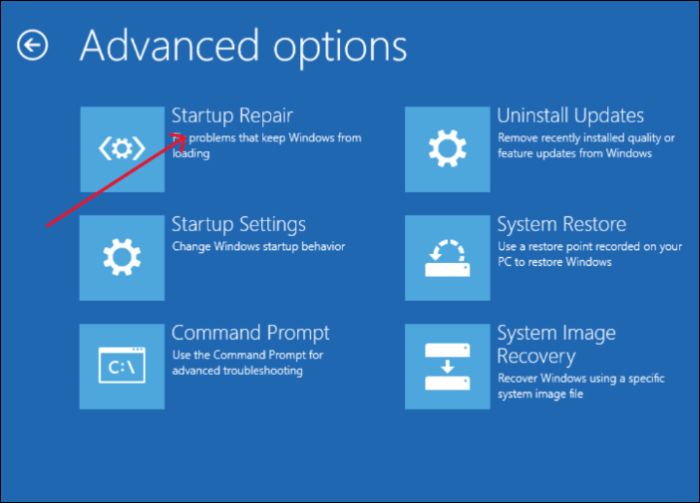
Now, Windows scans for potential issues restricting and repairing the operating system.
Note: If your drive is encrypted with BitLocker, you may need the BitLocker recovery key to access recovery tools or repair the installation.
Fix 4. Repair MBR and Boot Configuration Data Using Bootrec.exe files
If the fixes above do not fix the operating system not found on the cloned SSD problem, you should run the bootrec.exe files. You need installation media to run the bootrec.exe files.
Step 1. Connect the installation media (USB drive or CD/DVD) to the PC and reboot it.
Step 2. Press any key if the screen shows "Press any key to boot".
Step 3. Go to Troubleshoot > Advanced Options > Command Prompt from the options.
Step 4. In the pop-up window, type the bootrec.exe command to activate the program and run the commands.
Step 5. Run the bootrec.exe commands.
- bootrec.exe /fixmbr
- bootrec.exe /fixboot
- bootrec.exe /scanos
- bootrec.exe /rebuildbcd
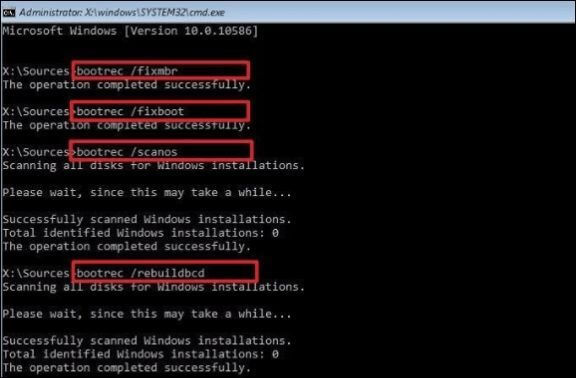
Once you've done this, try booting the PC using the cloned HDD/SSD to see if it recognizes the operating system.
Fix 5. Set the System Partition as an Active Partition
While booting, the Windows checks for the active partition. Active Partition, or Primary partition, contains all the boot files required to function the OS (similar to C Drive). So, if the System Partition is not set as an active partition, Windows fails to identify the operating system and shows an "Operating System not found" error. Let us see how to set the System partition as an Active partition. Connect the cloned SSD to the PC using a hard drive enclosure.
Step 1. Get the old SSD back and boot the PC using Windows.
Step 2. Once you enter the PC, click Windows + R to open the Run dialog box.
Step 3. Enter "diskpart" and click OK.
Step 3. Run the following commands with CMD as administrator:
- list disk
- select disk X ( Here "X" is the disk ID of cloned SSD)
- list partition
- select partition X ("X" refers to the system partition ID of the cloned SSD)
- Active
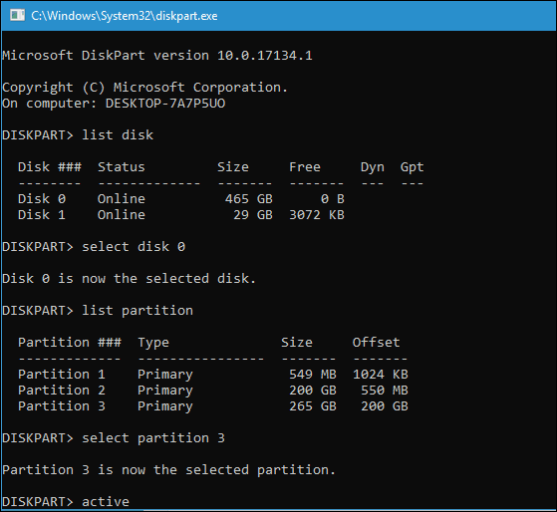
Step 4. Once the system partition on the cloned SSD is set as active, replace it and restart the PC to find the operating system.
Fix 6. Failed Cloning Process - Reclone HDD/SSD with EaseUS Disk Copy
When opting for cloning, choosing the right cloning software is very important. The PC cannot find the OS if the clone hard drive with bad sectors, incompatible MBR or GPT, incomplete cloned parts, or missing boot components. So, cloning software like EaseUS Disk Copy is essential to clone your hard drive to create a bootable SSD without any bad sectors and errors.
The software automatically partitions the HDD/SSD based on the old drive and makes it efficient to boot. Features like sector-by-sector clone copy data bit-by-bit allow the target SSD to be completely cloned with the operating system, data, and files. Try cloning the new SSD with EaseUS Disk Copy and booting it using the Windows operating system.
 Free Download
Windows 11/10/8/7
Step 1. Prepare New Drive
- Backup data: If the target drive contains data, back it up before cloning because cloning will wipe all data on the target disk.
- Connect the disk to your PC: For desktops or laptops with more than one slot, install it internally. For laptops with only one slot, use an external disk enclosure or a SATA-to-USB adapter to connect the disk externally to the PC.
Step 2. Run Disk Cloning Software
- Download, install, and open EaseUS Disk Copy.
- Choose Disk Mode.
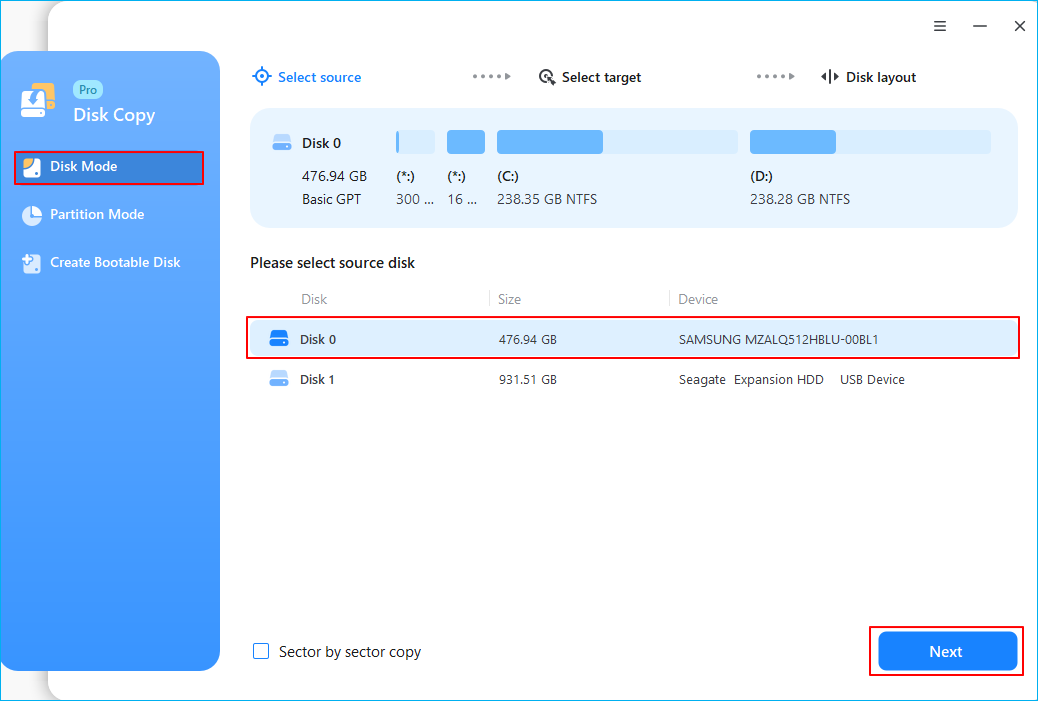
Step 3. Select Source and Target Drives
- Select the old disk as the source.
- Select the new disk as the destination.
- Check whether enabling the "Preview partition layout" box for the advanced feature.
Note: Adjust disk layout if necessary.
- Select "Autofit the disk" to make full use of the larger capacity on the destination disk.
- Select "Copy as the source" to use "Sector-by-sector copy" feature.
- Select "Edit disk layout" to manually resize the disk layout on destination drive.
Step 4. Start Cloning
- Confirm the warning message (data on the destination drive will be erased) and start cloning.
- Wait for the cloning process to be complete.
MBR vs. GPT: Which Boot Repair Method Should You Use?
Remember that MBR and GPT systems use different boot mechanisms. Applying the wrong repair method may not resolve the problem and could cause additional boot issues. Use the following comparison to identify the appropriate solution.
| Feature | MBR/Legacy BIOS | GPT/UEFI |
| Partition style | MBR | GPT |
| Boot mode | Legacy BIOS/CSM | UEFI |
| Required boot partition | Active system partition | EFI System Partition |
| Boot configuration | Boot sector and BCD | EFI boot files and BCD |
| Active partition required | Yes, for the BIOS boot process | No |
| Common repair tools | Startup Repair, Bootrec, BCDBoot | Startup Repair, BCDBoot |
- If your cloned SSD uses MBR and your computer boots in Legacy BIOS mode, check the active system partition and repair the MBR/BCD if necessary.
- If your cloned SSD uses GPT and your computer boots in UEFI mode, check the EFI System Partition and rebuild the UEFI boot files using BCDBoot if needed.
Do not mark an EFI System Partition as active. The active partition flag is relevant to BIOS-based booting, not UEFI booting.
What to Do If the Cloned SSD Still Won't Boot
If you have tried the solutions above but the cloned SSD still cannot start Windows, check the following situations.
- The SSD is not detected in BIOS
If the SSD does not appear in BIOS/UEFI, check its physical connection, storage slot compatibility, and power supply. You may also need to check whether the SSD is detected on another computer.
- Windows Boot Manager is missing
For UEFI systems, check whether the EFI System Partition exists and contains the required boot files. If necessary, rebuild the boot files using BCDBoot.
- The computer keeps booting from the old HDD
Disconnect the original drive temporarily and set Windows Boot Manager associated with the cloned SSD as the first boot option.
- The cloned SSD shows a blue screen or enters a boot loop
This may indicate a driver, system file, or boot configuration problem rather than a missing operating system. Try Windows Startup Repair and check whether the cloning process completed correctly.
- The SSD is detected but Windows cannot load
Check the disk partition structure, EFI/System Reserved partition, and Windows installation. If the source drive has file system errors or bad sectors, investigate the source drive before attempting another clone.
If you suspect physical drive failure, avoid repeated cloning attempts that could put additional stress on the drive. Prioritize recovering important data first.
FAQs about No Operating System Found After Cloning
1. Why does my cloned SSD say no operating system found?
This error usually occurs because the computer cannot locate the Windows boot files on the cloned SSD. Common causes include incomplete cloning, incorrect BIOS boot settings, missing EFI partitions, corrupted boot files, or an incorrect boot order.
2. Should I use UEFI or Legacy mode after cloning?
You should use the same boot mode as the original Windows installation whenever possible. UEFI is typically used with GPT disks, while Legacy BIOS is typically used with MBR disks. Check your original system configuration before changing BIOS settings.
3. Can I fix the operating system not found error without reinstalling Windows?
Yes. In many cases, you can fix this error without reinstalling Windows. Checking the boot order, repairing startup files, rebuilding the BCD store, or recloning the system disk may resolve the problem while preserving your existing Windows installation and data.
4. Do I need to clone the EFI partition along with the C: drive?
Yes, if your Windows installation uses UEFI/GPT, you generally need to clone the EFI System Partition along with the Windows partition. The EFI partition contains essential Windows Boot Manager files required to start the operating system.
5. Why does my computer boot from the old drive instead of the cloned SSD?
Your BIOS/UEFI boot order may still prioritize the original HDD/SSD. If both drives are connected, the computer may also select the original Windows Boot Manager entry. Temporarily disconnect the old drive and set the cloned SSD's Windows Boot Manager as the first boot option.
Conclusion
The "No Operating System Found" error after cloning does not necessarily mean that your Windows installation or personal files are lost. In most cases, the problem is related to boot configuration, missing system partitions, or incomplete cloning.
If you think the cloning is the problem or nothing can fix the new SSD, we suggest you use the EaseUS Disk Copy to clone your SSD efficiently without bad sectors and errors.
-
Updated by
![Larissa]()
Larissa
Larissa has rich experience in writing technical articles and is now a professional editor at EaseUS. She is good at writing articles about data recovery, disk cloning, disk partitioning, data backup, and other related knowledge. Her detailed and ultimate guides help users find effective solutions to their problems. She is fond of traveling, reading, and riding in her spare time.…Read full bio