





 About the Author
 Reviews and Awards
 Mac SD Card Recovery
So you've signed up for the macOS 27 Golden Gate beta, eager to test drive the new features, but the installation keeps failing. You're staring at cryptic error messages like "An error occurred during installation" or "Installation failed," and it's incredibly frustrating. Don't worry—this is a common experience for beta testers, and it's usually caused by a handful of known issues that you can often fix yourself.
Why Won't the macOS Golden Gate Beta Install
Before we jump into the solutions, let's figure out what might be going wrong. Here are the most frequent culprits for beta installation failures:
💾 Reason 1: Hardware Incompatibility (The Big One)
This is by far the most common reason. The macOS Golden Gate beta, like the final version, no longer supports Intel-based Macs. Apple has fully transitioned to its own silicon. You'll need a Mac with an Apple Silicon chip (M1, M2, M3, M4, or M5) to install this beta. If you're on an Intel Mac, the installer will simply refuse to proceed.
💾 Reason 2: Insufficient Storage Space
Beta installers are often larger than final releases. You'll likely need significantly more than the final version's requirement of 20 GB. Having at least 30-40 GB of free space is highly recommended for the download, extraction, and installation process to prevent "out of space" errors.
🌐 Reason 3: Unstable Internet Connection
The beta installer is a hefty download (around 15–20 GB). A slow, intermittent, or congested internet connection can corrupt the download or cause it to fail mid-installation, leading to a "Verification failed" error.
❌ Reason 4: Beta-Specific Software Conflicts
This is a unique challenge for beta software. Some system extensions, third-party kernel drivers, or even certain virtual machine environments (like an older version of Parallels or UTM) are known to cause conflicts during the beta installation. The new system may also flag or block outdated security software.
❌ Reason 5: Corrupted Beta Installer
If you downloaded the beta through the Software Update panel or the Apple Developer website, the installer itself could be corrupted. A partial or interrupted download is a common reason for installation failure.
In order to save users from more complicated processes, EaseUS Data Recovery Wizard for Mac provides a convenient and absolutely safe macOS installation solution, which helps users who are considering upgrading or downgrading their macOS for various reasons to download the operating system they want safely.
5 Ways to Fix macOS Golden Gate Beta Installation Issues
Here are several solutions to help you get the beta up and running. Before you start, back up your Mac! Beta software can be unstable, so a full Time Machine backup or a clone of your current drive is essential to protect your data.
Fix 1. Try a Bootable Installer via a Professional Tool
Creating a bootable installer on a USB drive is a reliable workaround for many installation issues, including beta ones. It bypasses many potential problems with the in-place Software Update process. EaseUS Data Recovery Wizard for Mac offers a free feature to help you create a macOS installer boot drive easily.
It allows you to install the latest macOS on multiple Mac computers and, more importantly, helps you recover lost data if your macOS Golden Gate upgrade encounters issues.
Step 1. Select a macOS version
Select the "macOS Golden Gate Beta" version from the list, or click the "Refresh" option to get it. Or you can add the beta installer from your disk by clicking the "Add" button. Insert a USB flash drive larger than 16 GB to save the installer.
Step 2. Erase the USB flash drive
After choosing the USB flash drive, click the "Erase and create" option in the pop-up window to format your USB flash drive quickly, and then click the "Create macOS installer" button to continue.
Step 3. Create the macOS installer boot drive
Wait for the process to complete, and click the "Finish" button. Your bootable beta installer is ready! Now, restart your Mac, hold the Power button (for Apple Silicon) or Option key (for Intel), select the USB drive, and follow the on-screen instructions to perform a clean install.
Fix 2. Verify Your Mac's Compatibility
As emphasized, this beta is only for Apple Silicon. Here's the list of compatible models:
-
MacBook (2020 and later with M1 chip)
-
MacBook Air (2020 and later)
-
MacBook Pro (2020 and later)
-
Mac mini (2020 and later)
-
iMac (2021 and later)
-
iMac Pro (2023 and later)
-
Mac Studio (2022 and later)
-
Mac Pro (2023 and later)
To check your Mac model, click the Apple logo in the top-left corner and select "About This Mac." If you don't see "Chip" (e.g., M2 Pro) listed, your Mac is Intel-based and unfortunately cannot run this beta.
Fix 3. Free Up a Significant Amount of Storage Space
Lack of free space is a primary reason for installation failures. For a beta, you need to be extra generous.
Step 1. Go to the Apple menu and select System Settings.
Step 2. Click General in the sidebar, then select Storage on the right.
Step 3. You'll see a bar at the top showing your available space. Aim for at least 30-40 GB free. If you're low, delete large, unnecessary files, empty the Trash, clear old iOS backups, and consider moving large media files to an external drive to free up space.
Fix 4. Scan and Repair Your Drive in Recovery Mode
Repairing disk errors can resolve installation issues that are rooted in your current system files.
Step 1. Restart your Mac and press and hold the Power button (for Apple Silicon Macs) until you see startup options. For Intel Macs, hold down Command + R.
Step 2. Select "Disk Utility" and click "Continue".
Step 3. Choose your startup drive (usually "Macintosh HD").
Step 4. Click "First Aid" and then "Run".
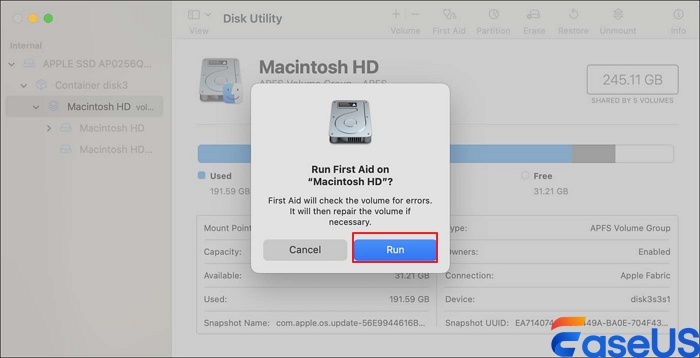
Step 5. Wait for the process to complete and then restart your Mac. This will fix any logical errors on your drive that might be blocking the installation.
Fix 5. Disable Third-Party System Extensions and Security Software
Beta installations are sensitive to low-level software. Before installing, try the following:
Step 1. Go to System Settings > Privacy & Security.
Step 2. In the "Security" section, temporarily disable any third-party security or antivirus software.
Step 3. You may also need to uninstall any system extensions for apps like VPNs, audio drivers, or hardware tools. You can check these under System Settings > General > Login Items & Extensions.
Step 4. Restart your Mac and attempt the installation again. You can re-enable these after the beta is successfully installed and updated.
What If Nothing Works? Downgrade to a Stable Version
If you're still stuck and your Mac is acting up, it's best to cut your losses. You may need to downgrade back to macOS 26 or your previous stable version. Here's how to restore from a Time Machine backup:
-
Connect your Time Machine drive to your Mac.
-
Restart your Mac and enter Recovery Mode (hold the Power button for Apple Silicon, or Command + R for Intel).
-
From the macOS Utilities window, select "Restore from Time Machine Backup".
-
Choose your backup drive and follow the on-screen instructions. This will revert your entire system to the state it was in before you started the beta installation.
Final Thoughts
Frustrated that the macOS Golden Gate beta won't install on your Mac? It's often due to compatibility issues (Intel Macs are a hard stop), insufficient storage, network problems, or beta-specific software conflicts. By following the steps outlined above—verifying compatibility, using a bootable installer, freeing up space, running First Aid, and disabling conflicting software—you can resolve most issues.
However, if you need to perform a clean install or, unfortunately, encounter data loss during the process, EaseUS Data Recovery Wizard for Mac is your reliable safety net. Download it today to ensure your valuable files are always recoverable during your beta testing adventures.
FAQs on macOS Golden Gate Beta Installation
1. Why can't I install the macOS Golden Gate Beta on my Mac?
The most common reasons are hardware incompatibility (your Mac must have an Apple Silicon chip), insufficient free storage space (aim for over 30 GB), a corrupted beta installer, network interruptions, or conflicts with third-party system extensions.
2. How do I get the macOS Golden Gate Beta to update?
Go to Apple menu > System Settings > General > Software Update. If you are enrolled in the Apple Beta Software Program, the update should appear. Click Upgrade Now. If it fails, try downloading the full installer from the Apple Developer website or using a bootable installer.
3. Can I downgrade from the Golden Gate Beta to a previous version?
Yes, you can downgrade using a Time Machine backup you made before installing the beta. Alternatively, you can create a bootable installer of macOS 26 or your previous version and perform a clean install. Be aware that downgrading requires erasing your startup drive.
4. Is 20 GB of free space enough for the macOS Golden Gate Beta?
While the final version might need around 20 GB, it is strongly recommended to have 30-40 GB or more free space for a beta installation. This provides room for the large download, temporary files, and the extraction process, preventing frustrating "out of space" errors.
Was This Page Helpful?

Finley is interested in reading and writing articles about technical knowledge. Her articles mainly focus on file repair and data recovery.
-
EaseUS Data Recovery Wizard is a powerful system recovery software, designed to enable you to recover files you’ve deleted accidentally, potentially lost to malware or an entire hard drive partition.
Read More -
EaseUS Data Recovery Wizard is the best we have seen. It's far from perfect, partly because today's advanced disk technology makes data-recovery more difficult than it was with the simpler technology of the past.
Read More -
EaseUS Data Recovery Wizard Pro has a reputation as one of the best data recovery software programs on the market. It comes with a selection of advanced features, including partition recovery, formatted drive restoration, and corrupted file repair.
Read More
Related Articles
-
Missing Photos After macOS Sequoia Update, How to Recover Safely?
![author icon]() Dany/Sep 20, 2026
Dany/Sep 20, 2026 -
How to Recover from Time Machine After Clean Install macOS
![author icon]() Jaden/Sep 20, 2026
Jaden/Sep 20, 2026 -
How to Recover HFS, HFS+ Partition Data on Mac
![author icon]() Daisy/Sep 20, 2026
Daisy/Sep 20, 2026 -
Word Crashing Repeatedly after macOS Tahoe: How to Fix
![author icon]() Brithny/Sep 20, 2026
Brithny/Sep 20, 2026
 Dany/Sep 20, 2026
  Jaden/Sep 20, 2026
  Daisy/Sep 20, 2026
  Brithny/Sep 20, 2026

