






You can retrieve your 48-digit BitLocker recovery key without a Microsoft account using either active system commands or offline backup checks, depending on whether you can boot into Windows. If your PC is already locked on the blue BitLocker recovery screen, search any secondary PC or USB flash drive for a saved BitLocker Recovery Key [ID].txt file, check printed documents, or contact your organization's IT administrator to retrieve it from Microsoft Entra ID (Azure AD) or Active Directory.
- Method 1. Unlock & Recover Data from Corrupted BitLocker Drives
- Method 2. How to Get BitLocker Recovery Key from CMD
- Method 3. How to Get a BitLocker Password from PowerShell
- Method 4. Check Offline Backups (USB, Local TXT File & Entra ID)
- Bonus Tip: Get a BitLocker Recovery Key with a Microsoft Account
Retrieving the BitLocker recovery key with an MS account is hassle-free, since it's usually uploaded to your MS account. However, the harsh truth is not everybody has an MS account—many Windows 11/10 Pro users rely on local accounts or domain-joined workstations—which raises an urgent question: "How to get a BitLocker recovery key without a Microsoft account?"
Using BitLocker encryption technology, a drive's recovery key - a 48-digit numerical password paired with a 32-character Key ID that allows you to retrieve data from BitLocker-protected drives with granted permissions - is generated by default during the encryption procedure. If the BitLocker-protected drive cannot be unlocked due to a Windows update, BIOS change, or TPM reset, the BitLocker recovery key is the best tool to help you regain access.
| Current Device Status | Best Retrieval Strategy Without MS Account |
| Can Boot into Windows (Local Account) | Use elevated Command Prompt (manage-bde) or PowerShell (Get-BitLockerVolume) to extract the key directly. |
| Locked on Blue BitLocker Recovery Screen | Search another PC/USB for BitLocker Recovery Key.txt, check printed files, or ask IT to check Entra ID / Active Directory. |
| Corrupted, RAW, or Formatted BitLocker Drive | Use EaseUS Data Recovery Wizard with your credentials/key to decrypt and extract files safely. |
Although having an MS account makes finding the BitLocker recovery key much more straightforward, not everybody has an MS account, and some Windows users don't even require one. Hence, finding the BitLocker recovery key without an MS account might be a hindrance in front of you. You may obtain more details about the BitLocker recovery key and how you get such a key without an MS account. Keep reading to learn more about the methods!
Method 1. Unlock & Recover Data from Corrupted BitLocker Drives
What would you do if you forgot your BitLocker password, lost your BitLocker recovery key due to an unexpected deletion, or ran into a corrupted BitLocker volume that refuses to mount even with the right credentials? Don't fret! BitLocker recovery keys can often be preserved as a document file on your local disk or USB flash drive, and when a BitLocker-encrypted partition becomes RAW or damaged, specialized recovery tools can help you regain access to your files safely.
A powerful data recovery tool, EaseUS Data Recovery Wizard can recover accidentally erased disks, files, or partitions from PCs, recycle bins, desktop computers, and storage devices. Most importantly, it supports BitLocker drive data recovery by parsing damaged partition headers once verified.
This beneficial tool can recover data from BitLocker encrypted drive using simple procedures. It can solve your problem if your drive is BitLocker-encrypted and you encounter corruption issues. Check this video tutorial to unlock and rescue files from a BitLocker drive without a Microsoft account:
This software can decrypt the accessible BitLocker partition structure and make the underlying data extractable to a healthy drive.
Step 1. Choose the encrypted drive to scan
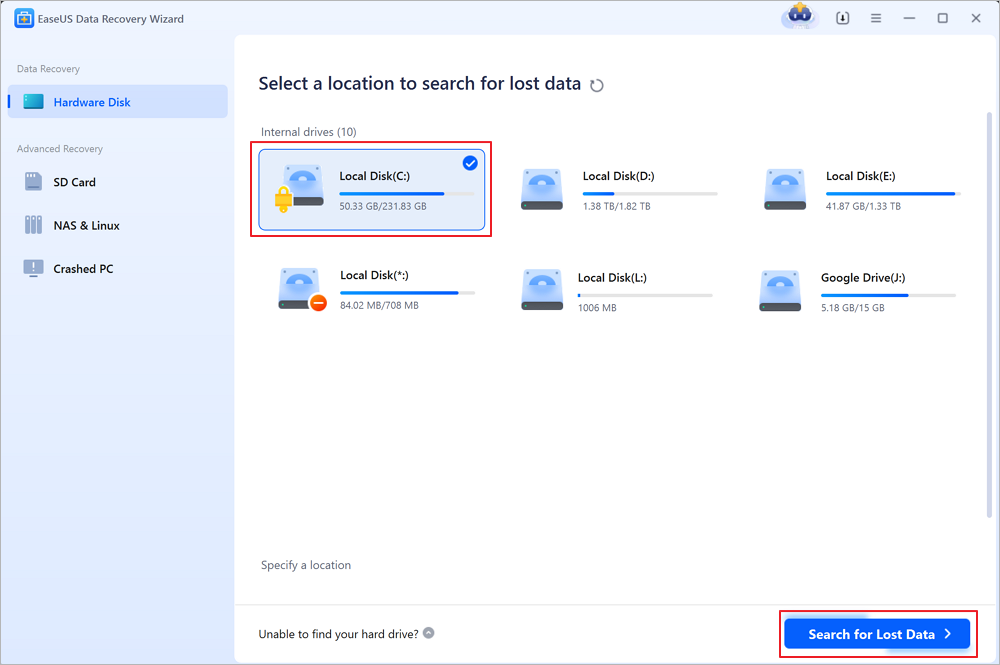
Launch EaseUS Data Recovery Wizard, and you will see the BitLocker encrypted drive displayed there. Hover the mouse on the BitLocker partition or storage device from which you want to recover data. Then click "Search for Lost Data".
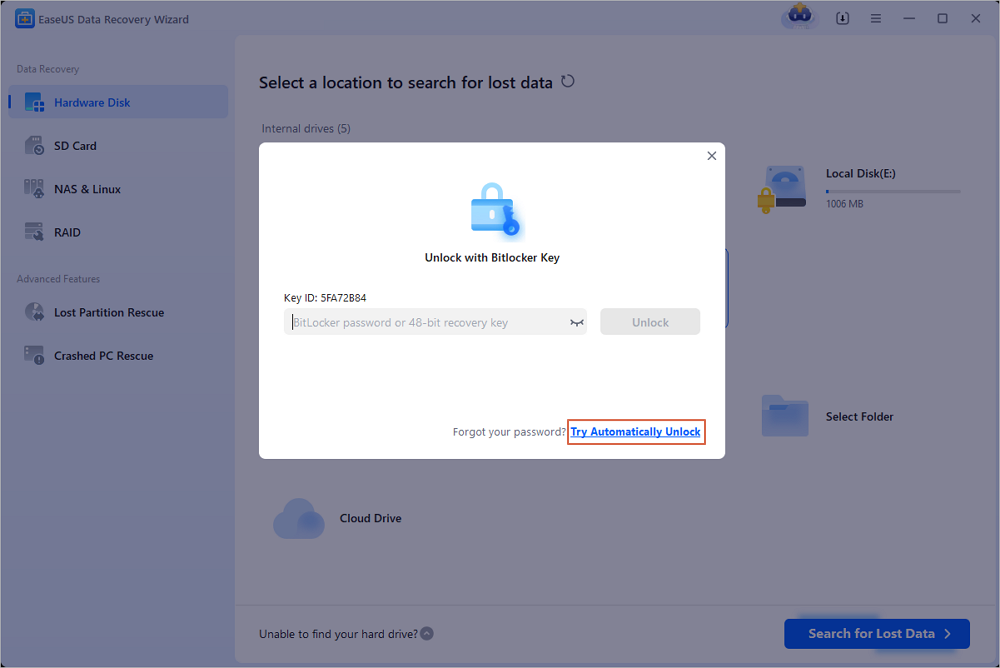
Note: If you don't have a key or password, you can use "Try Automatically Decrypt", which may help you scan your recovery key from your Microsoft account or your C drive, then decrypt the drive without providing your password.
Step 2. Select and preview scanned files
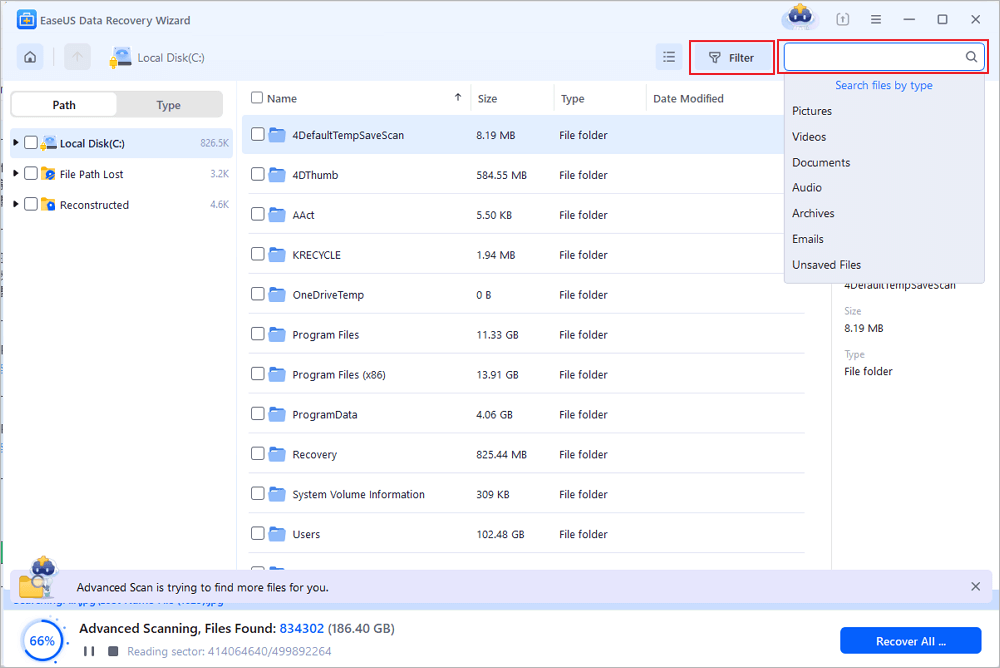
The software will start a quick scan for deleted files and perform advanced scan for more lost files from the BitLocker device. When the process completes, you can apply the "Filter" feature or use the search feature to find the lost files in a short time.
Step 3. Recover lost files from BitLocker encrypted hard drive
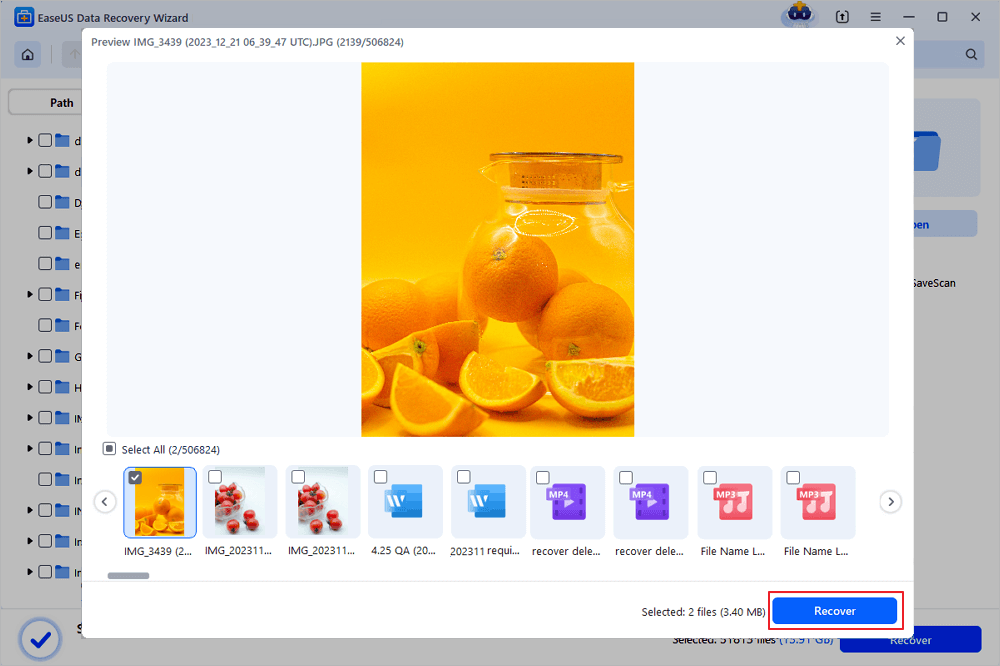
After previewing the file, click the "Recover" button to restore deleted or lost files from BitLocker encrypted partition on Windows. You can choose a cloud storage, such as OneDrive, Google Drive, etc., and click "Save" to save your recovered files.
So, download this professional data recovery software now! If you're impressed by the tool's convenience, you can share this information with your friends on social media.
Method 2. How to Get BitLocker Recovery Key from CMD
Using CMD (Command Prompt) to retrieve the BitLocker recovery password is ideal when you are logged into a local Windows account without Microsoft account synchronization. Although technical and requiring administrative privileges, it displays the exact 48-digit recovery key quicker than any other native method. Moreover, it works reliably on internal drives and connected external BitLocker drives. The steps are the following to find your BitLocker recovery key with Command Prompt:
Step 1. Open an elevated "Command Prompt" by typing CMD in the "Run" box (Win + R) and hitting the "Ctrl + Shift + Enter" keys.
Step 2. Type the command: manage-bde -protectors -get G: in the elevated Command Prompt window, and hit "Enter." Don't forget to replace "G" with the actual locked or encrypted drive letter (such as C: or D:).
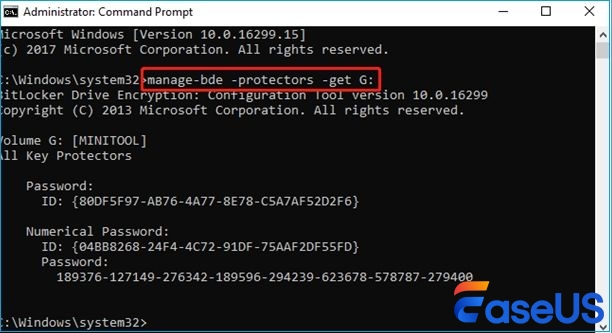
Step 3. Under the "Numerical Password" section, you will see a 48-digit recovery key and its matching Key ID on your PC. Save the recovery key in a secure place for future use—for example, on an external HDD, in a password manager, or written down on paper.
Method 3. How to Get a BitLocker Password from PowerShell
PowerShell is a powerful command-line tool that provides a way to retrieve the BitLocker recovery key without an MS account, especially useful when managing multiple encrypted volumes. Follow the steps below to get the BitLocker recovery key from PowerShell:
Step 1. Hit the "Win + X" key and opt for "Windows PowerShell (Admin)" or "Terminal (Admin)" from the popup menu.
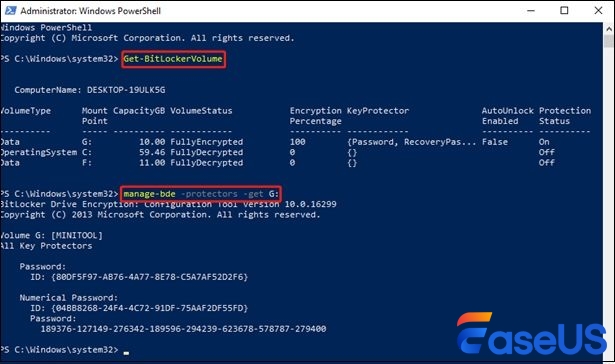
Step 2. Type Get-BitLockerVolume and hit "Enter." It will display a complete list of every BitLocker-protected drive on your PC, along with its protection status.
Step 3. Run the command manage-bde -protectors -get [VolumeId] (or (Get-BitLockerVolume -MountPoint "C:").KeyProtector) and hit "Enter" to check the recovery key. Replace [VolumeId] with the encoded drive's drive letter. You will now see the 48-digit recovery key.
Did you find the steps valuable? If so, share them with your mates on social media!
Method 4. Check Offline Backups (USB, Local TXT File & Entra ID)
If your computer is already locked on the blue BitLocker recovery screen and you cannot open CMD or PowerShell, Windows requires you to locate where the key was exported during initial encryption. Because Windows prohibits saving the recovery key file onto the exact same drive being encrypted, check these three offline and organizational locations:
- Search Local Drives & USB Flash Drives: When activating BitLocker without a Microsoft account, Windows prompts users to save the key to a file or USB drive. Connect any USB flash drives you own to another working PC and search for files named BitLocker Recovery Key [Key-ID].txt or hidden .bek system files.
- Check Printed Paper Copies: If you selected the "Print the recovery key" option during setup, check physical folders, binders, or PDF print queues on a secondary computer.
- Contact IT Admin (Entra ID / Active Directory): If you are using a work or school laptop without a personal Microsoft account, your key is automatically backed up to your organization's Microsoft Entra ID (formerly Azure AD) or on-premises Active Directory server. Provide the Key ID shown on your blue screen to your IT helpdesk so they can retrieve the 48-digit password.
Bonus Tip: Get a BitLocker Recovery Key with a Microsoft Account
Encrypting your files to prevent unauthorized access is an excellent feature of Windows called BitLocker. But what if you forget the recovery key? Even if you set up the PC locally, Windows 11 Home/Pro often links Device Encryption automatically if you've ever signed into a Microsoft app (like Office or OneDrive). Connecting your MS account to BitLocker lets you quickly access the recovery key whenever required. Below are the steps to find the BitLocker recovery key in your MS account:
- Log in to your MS account on another phone or computer using the same credentials you use for your Windows PC.
- In account settings, go to "Device", find your BitLocker-encrypted device, and choose "See details".
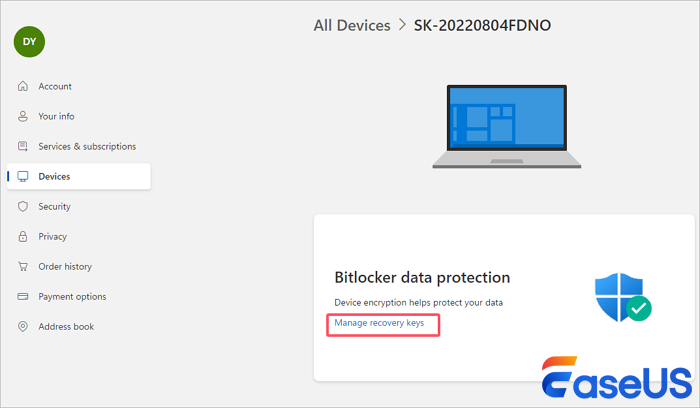
- Find the BitLocker data protection and click on "Manage recovery keys".
- In this section, you can view and manage every BitLocker recovery key for every device linked to your Microsoft account, matching the exact Key ID shown on your locked screen. To turn off BitLocker in Windows 11, you'll need to retrieve the recovery keys first.
- Notice:
- It's crucial to back up daily and preserve your BitLocker recovery key in several places, for example, on an external HDD, a printed sheet, or a secure password manager. This way, even if you lose access to your MS account or use a purely local Windows account, you can still find the required information. By following these steps and keeping a safe backup of your BitLocker recovery key, you can use this feature without worrying about losing access to your encrypted data. Following these steps will save time & energy when you need to retrieve the recovery key later.
Conclusion
To summarize, if you don't have an MS account and need to find or recover your BitLocker recovery key, you may quickly retrieve it using the structured methods discussed in this article. Whether you're proactively extracting the 48-digit password via Command Prompt and PowerShell or searching offline USB backups and organizational Entra ID records, multiple reliable paths are available.
If your BitLocker drive has become corrupted, turned into a RAW partition, or suffered accidental deletion after unlocking, deploying EaseUS Data Recovery Wizard provides a safe way to extract your valuable files before reformatting the drive.
Unlock BitLocker Drive Without Microsoft Account FAQs
Getting locked out of an encrypted Windows drive without a cloud account backup can feel overwhelming. Below, our storage security specialists answer the most frequent questions regarding offline BitLocker key retrieval and encrypted drive recovery.
1. How can I unlock a BitLocker Drive if I forgot the recovery key?
To unlock a BitLocker Drive without the key, first check the Microsoft BitLocker Recovery Key website on another device to see whether any Microsoft app silently linked your device. Next, search all secondary PCs and USB drives for a BitLocker Recovery Key.txt file, or contact your workplace IT administrator if the PC is domain-joined. If the partition structure is corrupted after unlocking, use EaseUS Data Recovery Wizard to extract your data safely.
2. Where does Windows 11 save my BitLocker recovery key without a Microsoft account?
When BitLocker is enabled on a local Windows 11 account without Microsoft cloud sync, Windows forces you to choose an external backup destination: a USB flash drive, a plain text file (.txt) saved on a separate non-encrypted drive, a printed physical copy, or your organization's Active Directory / Microsoft Entra ID server.
3. How do I get a 48-digit recovery key for BitLocker using CMD?
If you can still boot into Windows, open Command Prompt as Administrator, type manage-bde -protectors -get C: (replace C: with your encrypted drive letter), and press Enter. The console will immediately display the 32-character Key ID alongside your 48-digit numerical recovery password.
4. Can I bypass the BitLocker recovery screen without a recovery key or password?
Because BitLocker uses AES-128 or AES-256 hardware-grade encryption, there is no backdoor to bypass the recovery screen without either the 48-digit recovery key, startup PIN/password, or a valid TPM state. If the key is permanently lost across all offline and organizational backups, the only way to reuse the physical drive is to wipe and reformat it via Command Prompt (diskpart clean), which erases all encrypted data.
Was This Page Helpful?
Related Articles
-
EaseUS Partition Recovery Download: Restore Partitions Now
![author icon]() Jean/2026-11-24
-
How to Recover Lost Partition on External Hard Drive [Easy]
![author icon]() Dany/2026-11-19
 Jean/2026-11-24
 Dany/2026-11-19
-
Hetman Partition Recovery Download (2026 Review)
![author icon]() Jean/2026-11-23
-
System Reserved Partition Deleted? 4 Ways to Recover It Here
![author icon]() Tracy King/2026-11-20
 Tracy King/2026-11-20


