
Featured Articles
What Is RAID 5
Before learning what exactly RAID5 is, let's figure out what RAID is first. As an acronym for Redundant Array of Independent Disks, RAID is designed to store the same data in different locations on multiple hard disks or solid-state drives (SSDs) to preserve data in the event of a drive failure. It works to enhance the performance, capability, and fault tolerance by using the techniques of mirroring, striping, and parity.
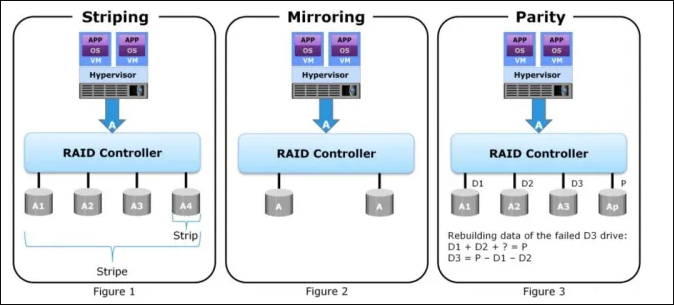
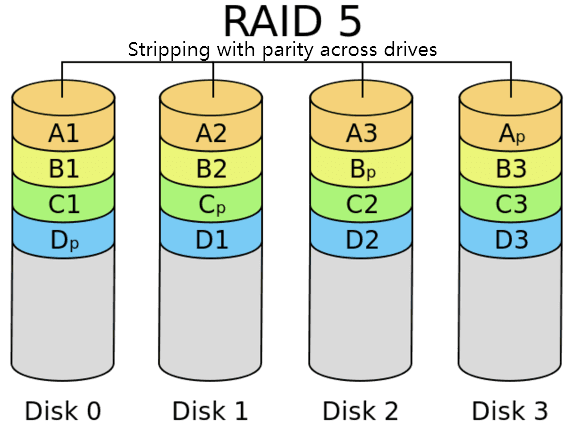
RAID 5 is one level of the RAID. It is a data backup technology for hard disk drives. One of the features that distinguish it from other RAID levels is that it uses both disk striping and parity, which allows it to remain operable even when the disk fails. Disk striping technology ensures that the data will be distributed efficiently across multiple disks, while the disk parity feature ensures that the data stored in the disks will transfer correctly and helps reconstruct missing data based on the information from other disks.
RAID Requirements for Disks
To make sure that each level of array functions well as a single unit, every RAID level has a minimum requirement for the number of hard disks, and RAID 5 is not exceptional. The minimum requirements for each RAID level are listed below:
RAID 0: requires at least 2 disks.
RAID 1: requires at least 2 disks.
RAID 5: requires at least 3 disks.
RAID 6: requires at least 4 disks.
RAID 10 or RAID 01: requires at least 4 disks.
Key Features of RAID 5
As a powerful technology, RAID 5 is created to ensure the security and integrity of the data stored on the hard drive disks. To get a deeper understanding of this advanced technology, let's take a glance at its key features.
1. Functionality of RAID 5
RAID 5 is the most commonly used RAID level, using striping to divide data across multiple disks and parity to reconstruct missing data based on the information from other disks. It is the combination of different physical drives that helps to distribute data and parity information to all of the integrated drives that makes the RAID 5 different from other levels.

Offering excellent performance in reading and writing systems with a higher level of fault tolerance, RAID 5 allows you to use all of your disks at the same time. RAID 5 also has a capacity of N - 1, where N is the total number of disks in the system. Such a combined capacity of all units minus the capacity of one drive is the effective usable capacity of RAID 5.
2. Benefits of RAID 5
RAID 5 consists of at least 3 disks and a maximum of 16 disks. It is one of the most widely used RAID levels since it is good enough to keep your data safe and reconstruct the missing data. However, the benefits of RAID5 technology are far more than that. Here are some of the typical advantages it can bring to its users:
- Highly efficient for data storage
- Fast reading speed due to the striping feature
- Less expensive to implement compared with other RAID levels
- Good balance between security, fault tolerance, and performance
3. Drawbacks of RAID 5
Although users of RAID 5 can enjoy many benefits, this technology also has some drawbacks that make it not so good:
- Rebuilding time is longer.
- Implementation is more difficult.
- Data will be easily lost when two or more disks crash. Half of the storage capacity is used due to the parity feature.
4. RAID 5 Commonly Used Situations
RAID 5 is a great technology that offers efficient storage, robust security, and adequate performance. Therefore, it's perfect for file and application servers that only have a few data drives. Generally, this technology is more suitable in the following scenarios:
- Data warehousing
- Web serving
- Archiving
Differences Between Hard RAID 5 and Soft RAID 5
RAID can be divided into two groups: hardware RAID and software RAID. The former is more reliable and requires specialized hardware to handle the drives, while the latter is less expensive and takes up a portion of the host processor.

RAID 5 can also be divided into two types: hardware and software RAID 5. Now let's take a look at the detailed differences between the two.
Basically, for hardware raid 5, RAID cards or controllers are used to manage different drives which work together to enhance overall system performance for computer users, particularly Servers users. However, the software RAID 5 combines numerous physical drives into one or more logical units by using the operating system's computing capabilities.
In addition, the benefits they bring to users and the drawbacks they have are also different. The comparisons regarding the advantages and disadvantages of the two are as follows:
| Differences | Hard RAID 5 | Soft RAID 5 |
| Advantages |
Faster read and write speed More stable that the soft RAID 5 |
Cheaper than Hard RAID 5 Unlimited RAID Controller numbers |
| Disadvantages |
Cost is relatively high |
The data access speed is slower |
RAID 5 Data Recovery With Hard Drive Recovery Software
You may encounter a problem in which the data stored on the RAID 5 system is suddenly gone. To make matters worse, after you have tried so many different methods to recover lost files , only to find that the data stored on the RAID 5 is permanently gone with the disk failure.
But can you still restore the permanently deleted files and documents? The answer is yes. If you have unfortunately encountered a data loss problem and nothing changed after trying various ways to recover it, then it is suggested that you use EaseUS Data Recovery Wizard.
EaseUS Data Recovery Wizard is a specific data recovery software that functions well in restoring different types of files and documents. Due to its high performance and compatibility, it has been widely used by users from different places around the world. It won’t let you down if you try it after the RAID 5 installed on your devices fails and the data is deleted or lost.
You can follow the step-by-step guidance below to use it to recover the lost RAID 5 data :
Step 1. Scan the RAID drive
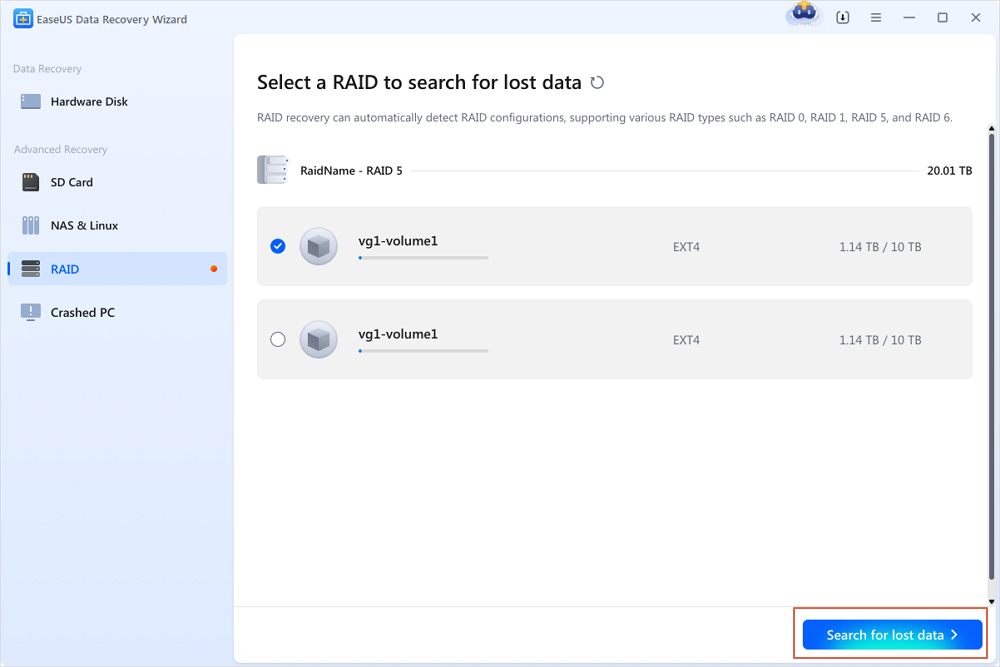
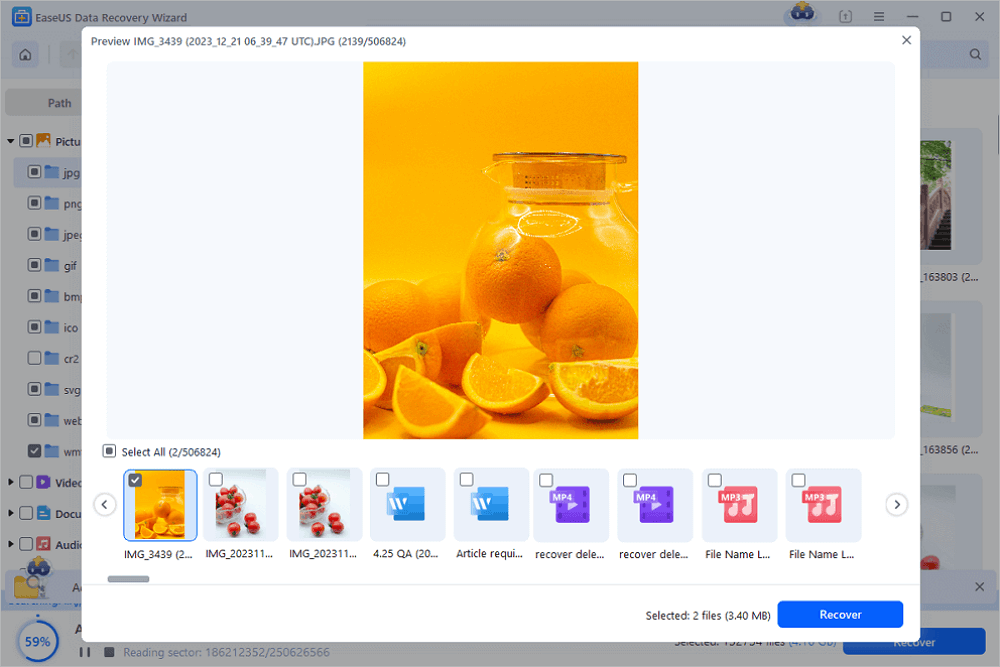
Choose the RAID section from the sidebar, select the RAID 0/1/5/6 drive from which you wish to recover data, and then click "Search for lost data". Wait for the scanning process to finish, the deleted files will show up one by one.
Step 2. Find and preview lost RAID files
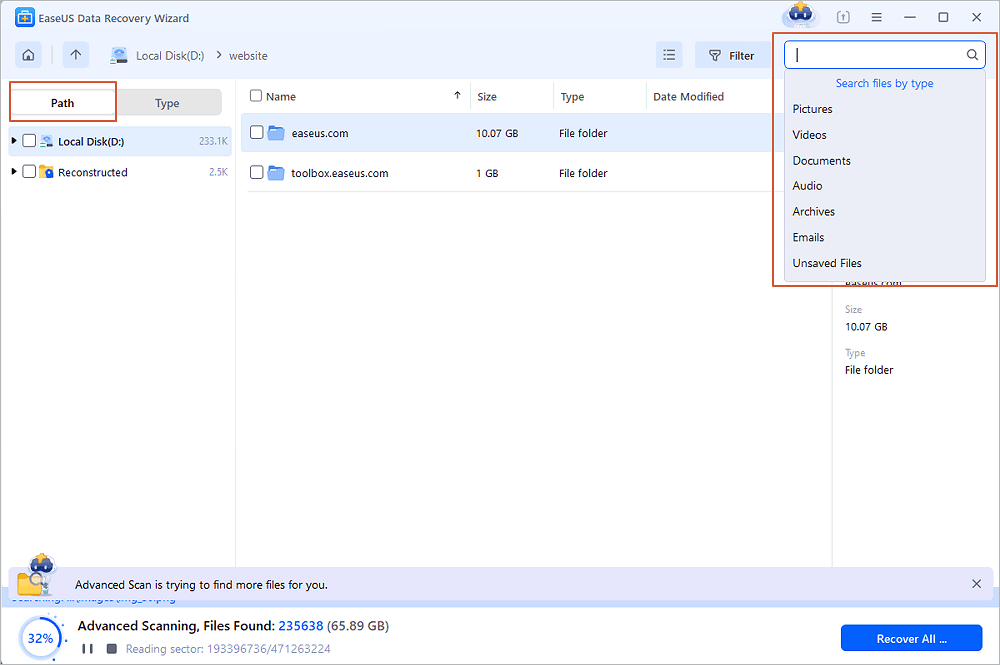
You can use "Filter" as quick navigation to find deleted or lost files. Besides, you can also use Search to find your lost RAID drive files via its file name or file extension.
Step 3. Restore lost RAID drive files
Select the wanted files and click "Recover". Browse to save these files to another secure location.
💡Tip: You can restore data on the local disks, external hard drives, and also the cloud storage. Do not save them on the RAID drive again.
RAID 5 Data Recovery Services
If the deleted or lost data is still not recovered after trying EaseUS data recovery software according to the guidance above, you can try the manual recovery service supported by EaseUS:

Consult with EaseUS data recovery experts for one-on-one manual recovery service. We could offer the following services after FREE diagnosis. Our decades-experienced engineers are knowledgeable and can repair the damaged RAID structure and restore data from all RAID levels.
- Restore data from all RAID levels, including RAID 0, RAID 1, RAID 5, RAID 6, RAID 10, etc.
- Recover data from enterprise RAIDs such as QNAP, Synology, WD, Buffalo, etc.
- Retrieve lost RAID data caused by any issues
- Fix disks that become GPT protected partitions
- Recover data from RAID remotely, no need to ship
Comparisons of RAID 5 and Other RAID Types
By comparing the RAID 5 with other commonly used RAID technologies, you can better grasp a comprehensive understanding of this data storage system.
1. RAID 5 vs RAID 0
Compared with the disk striping and parity functions, RAID 0 focuses on striping, which translates to better performance. In a RAID 0 system, data is partitioned into blocks that are written across all of the array's devices.
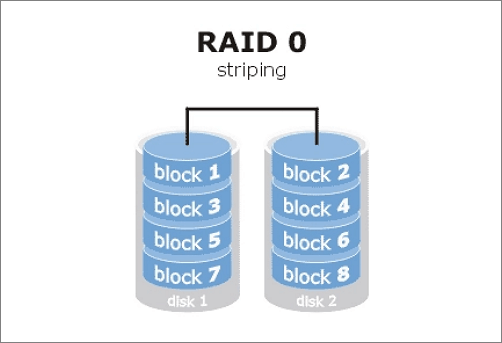
The pros and cons of this level is listed as below:
Pros of RAID 0:
- Implementation is easy.
- Storage capacity is completely utilized.
- Read and write operations are great.
Cons of RAID 0:
- No fault tolerance
- Complete data loss due to single drive failure
- Not suitable for mission critical systems
Should you choose RAID 0 or RAID 5? When performance is more important than data redundancy, RAID 0 is the way to go, while RAID 5 may be better when you're dealing with mission-critical data, and fault tolerance is a must.
2. RAID 5 vs RAID 1
RAID 1 technology is relatively simple compared with RAID 5. It mainly uses mirroring, where the same data is copied to two or more disks, to store the identical data across multiple disks for better redundancy.
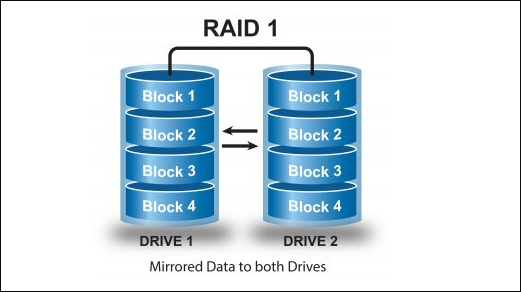
Now let's take a look at the advantages and disadvantages of RAID 1, contrasted to RAID 5.
Pros of RAID 1
- Perfect for mission-critical data
- Read multiple data simultaneously with a high speed
- Offer enhanced performance even when the write operations are slower
Cons of RAID 1
- More expensive
- No security measures
- Require twice the storage space
- Need to shut down to repair the failure disks
After comparing the two, have you figured out when to use RAID 5 and when to use RAID 1? In real-life cases, the RAID 1 technology can function well in the following scenarios:
- Financial Systems
- Electronic Databases
- Enterprise Web Servers
However, if a great balance between speed and safety is required, the RAID 5 may be your choice. It can also be used for enterprise and business file and application servers where the data drives are limited.
3. RAID 5 vs RAID 6
The RAID 6 technology is pretty similar to the RAID 5 technology, both of which use disk striping and parity data to store and secure information. But the RAID 6 offers double parity, which allows it to provide double fault tolerance capacity to improve performance. Though it may offer higher data security than RAID 5, RAID 6 is more expensive and complex to implement.

Pros of RAID 6
- Fast read operations
- Excellent data accessibility
- Highly secure due to double parity
- High fault tolerance and data redundancy
Cons of RAID 6
- The restoration takes a long time.
- Implementation is rather difficult.
- Write speed is very slow due to double parity.
- All data is lost if more than 3 disks fail simultaneously.
RAID 5 Frequently Asked Questions
Some frequently asked questions related to RAID 5 may offer more help for you to learn more about this data storage system.
What is a RAID Controller?
A RAID controller can be a hardware device or a software program. It is created to make sure the hard disk drives or solid-state drives installed in the computer or integrated into the storage array of the RAID levels can work smoothly as a logical unit. By using a RAID controller, the stored data can be well preserved and the computing performance will be elevated.
How many physical disks are required to implement raid 5?
The minimum requirement for the physical disks implemented in RAID 5 is 3, but it can be extended up to 16 disks if needed.
What will be the available drive space in a RAID 5 configured system with 3250 GB hard drives?
There will be 500 GB of drive space available in a RAID 5 configured system with 3250 GB of hard drives.
What is the minimum number of physical disks required to create a RAID 5 volume?
If you desire to create a RAID 5 volume, you need to prepare at least 3 physical disks.
Conclusion
After a thorough introduction of the RAID 5 technology, you must have left with a relatively deep impression of it. When a good balance between security, fault tolerance, performance, and high efficiency for data storage is required, RAID 5 deserves a trial. And there is no need to worry about the data loss problem due to the RAID 5 failure since the EaseUS data recovery software can offer help in recovering lost files and documents without downtime.
Was This Page Helpful?

Brithny is a technology enthusiast, aiming to make readers' tech lives easy and enjoyable. She loves exploring new technologies and writing technical how-to tips. In her spare time, she loves sharing things about her game experience on Facebook or Twitter.
Related Articles
-
Windows Installation Not Detecting SSD? Fixes Here
![author icon]() Jaden/Jan 29, 2026
Jaden/Jan 29, 2026 -
Fix Hard Drive Shows 0 Bytes Error Free
![author icon]() Tracy King/Jan 29, 2026
Tracy King/Jan 29, 2026 -
WD Easystore Not Working? 5 Solutions Here
![author icon]() Jaden/Jan 29, 2026
Jaden/Jan 29, 2026 -
How to Fix PS4 USB Storage Device Not Connected [2026]
![author icon]() Jaden/Feb 12, 2026
Jaden/Feb 12, 2026
 Jaden/Jan 29, 2026
  Tracy King/Jan 29, 2026

